Where every student belongs: A unified approach to advising and success
When students step into the College of Education’s new Student Success and Advising Center (SSAC), they’re walking into more than renovated space — they’re entering a reimagined approach to student support that brings every resource including advising, wellness and financial aid under one roof.
What used to be three separate offices — the Teacher Preparation Advising Center, Credential Center, and Graduate Studies Office — have merged into one unified team. The goal is to help every undergraduate, credential and graduate student thrive, not only academically but professionally and personally.
To make that vision real, the college retrained staff, deepened partnerships across campus, and welcomed collaborators like Financial Aid and the Career Development Center to hold on-site advising hours. The result is a space designed to connect students with the right support the first time — no handoffs, no confusion, and no getting lost between offices.
“Students would sometimes get bounced around and have to go between offices because we all had a little piece of the puzzle,” Jessica Olague, assistant director of the SSAC, said of advising.
“Now that all those pieces of the puzzle live in one place, it’s been really helpful for students.”
A central hub for student success
The SSAC team includes 14 professional staff and a group of student assistants and peer mentors. They serve more than 3,000 students preparing to become teachers, counselors, school psychologists, and academic leaders.

The reorganization began in 2024 under the leadership of Dean Anna Ortiz, who envisioned a more unified, student-centered experience.
Mary Anne Rose was hired as interim director in November 2024 and oversaw the move into new space and the training of staff to be both generalists and specialists. That way, students could get quick answers from any advisor while still receiving deeper, program-specific support when needed.
The model reduces handoffs and delays that once occurred when students transitioned between programs — for example, from a bachelor’s degree to a teaching credential or into graduate studies.
Olague gave the example of a prospective student who came into the former Teacher Preparation Advising Center saying he wanted to get a master’s degree in teaching. So, staff sent him to the Graduate Studies Office.
But he was back at TPAC 10 minutes later because it turned out he didn’t have a teaching credential — a requirement for many master’s degrees in education. With advising teams now under one roof, students like him can get clearer answers faster.
Another recent advising case showed how the new collaborative model can directly change a student’s path.
Lead Liberal Studies Advisor Nancy de Haro recently took a call from a prospective student who was discouraged after learning he might need to take a CSET exam to qualify for a special education credential program. He was ready to hang up the phone, she said.
But de Haro, who has now learned more about programs outside the Liberal Studies undergrad program, checked his transcript, quickly consulted with Olague and a credential analyst, and confirmed he could meet the requirement through his coursework. She then helped him apply to the program.
“In our conversation he also shared that he eventually wants to get his master’s in special education,” de Haro said. “And I was like, ‘Great, we’ll be here.’”
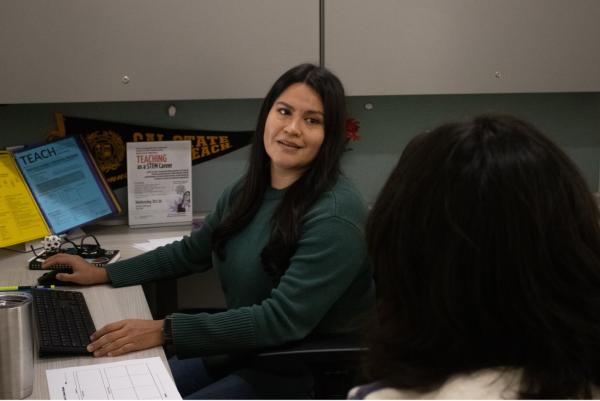
Privacy and time for deeper conversations have improved, too, with all of the advisors having their own offices, de Haro said.
The Student Success and Advising Center also ensures students no longer need to submit the same documents to multiple offices or reintroduce themselves to new advisors with each transition, said Rose.
Instead, their progress is tracked centrally, with one advising team guiding them from start to finish.
“It used to feel like you had to start over every time you reached a new phase,” Rose said. “Now, it’s one continuous relationship.”
Wraparound services come south
Another standout feature of the reimagined SSAC is its commitment to support beyond academic planning.
The center now hosts representatives from Financial Aid, Student Health Services, University Writing Center and the Career Development Center on-site, rotating through the center throughout each week to offer one-on-one assistance.
That’s important because the College of Education, located at the south end of campus, is geographically distant from many centralized student services.
“The goal is to meet students where they are, not just academically but as whole people,” Rose said.
Beyond convenience and structure, the SSAC team is cultivating a culture of care, Rose said. Advisors are trained to focus on holistic development, emphasizing wellness, self-advocacy, and a sense of belonging — especially for first-generation students, students of color, and others from underrepresented communities.
To support that mission, the center is developing an “advising syllabus,” outlining what students can expect from the SSAC: a listening ear, a welcoming environment, knowledgeable guidance, and, most of all, a team that genuinely wants them to succeed.
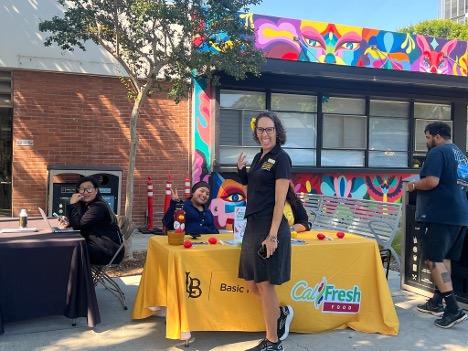
And because the college serves future teachers, counselors and leaders, it’s aiming to teach students how to advocate for themselves and pass those lessons on.
The SSAC’s partnership with the College of Education’s Student Engagement Center, which is undergoing a transformation of its own with a remodeled space and expanded programming, has also deepened the sense of community, Olague said.
The student perspective
In his fourth year at Cal State Long Beach, History and German double major Minh Ngo Nguyen, has served as a peer mentor with the now-Student Success and Advising Center for nearly two years. His work there has shaped both his professional aspirations and his understanding of how advising can transform the student experience.
He described the new, unified model as far more accessible and efficient than the former one that required students to navigate multiple offices.
“It’s convenient to ship all your questions to one box and have us do the work,” he said.
Nguyen also emphasized the growing sense of culture and community with more events, expanded space and inclusion of campus partners that connect the college to the rest of campus.
Through his peer mentor role, he’s developed communication, patience, and case management skills, and gained a deeper appreciation for the diversity of students pursuing education pathways.
Looking ahead
Next up, the SSAC plans to further leverage Beach Connect, a digital tool for the campus care network that tracks student appointments and progress. The team is also improving how it documents support for prospective students and alumni — both major parts of the SSAC’s daily work.
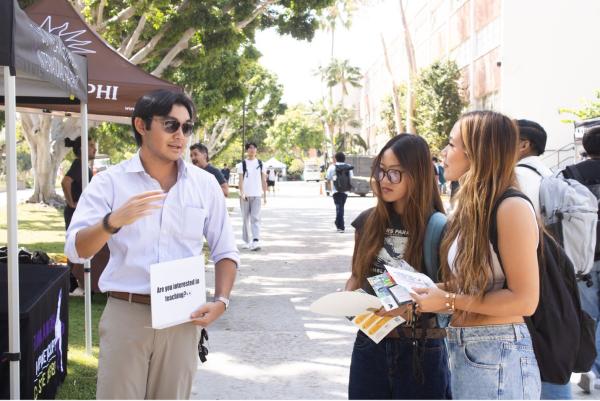
In addition, the center is collaborating with other colleges to promote teaching careers in STEM fields, developing new outreach materials and events with the Colleges of Engineering and Natural Sciences and Mathematics.
And if there’s one small thing students can do to make the new system work even better?
“Please read your email,” Rose said with a laugh. “We actually do have pertinent information. Like it’s critical for you to know this info.”