
Chancellor Mildred García calls for systems where women leaders can thrive
During a visit to the College of Education this past week, California State University Chancellor Mildred García posed a sobering statistic: fewer than 40 percent of U.S. colleges and universities have had a woman president.
When she was appointed chancellor in October 2023, García also said, she became the first Latina in the nation to lead a four-year, public higher education system.
“How sad is that?” she asked.
We clearly need to build systems where women are supported, mentored and empowered, García told the audience of faculty, staff and students.
García’s talk, delivered at the start of Women’s History Month, focused on what it takes for leaders — particularly women and people from historically underrepresented communities — to not just reach leadership roles but thrive in them.
Thriving has been the theme of College of Education faculty and staff meetings this year with particular attention paid to faculty, staff and students who are undocumented, LGBTQ, Black and, during Monday’s gathering, female. García praised the college for centering their experiences, calling it “a model for the rest of the system.”
García not only leads the CSU system but retains “retreat rights” in the College of Education’s Educational Leadership Department.
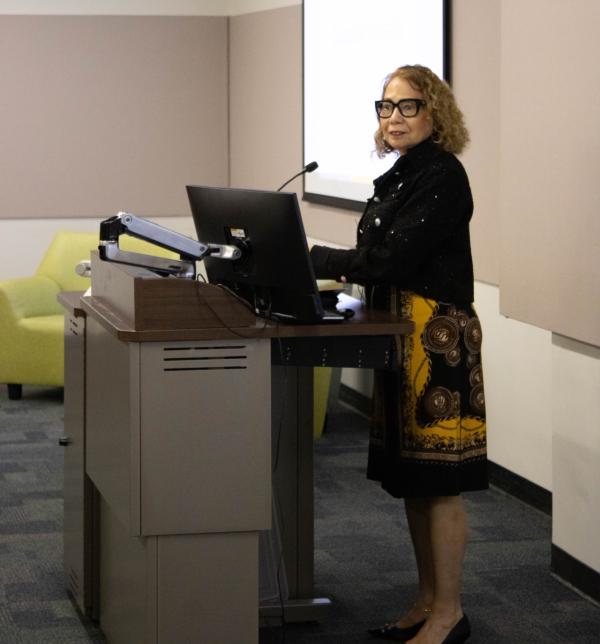
García wove together statistics, personal history and lessons from decades in higher education leadership. A first-generation college student who lost her father at age 12, García was raised by a mother who supported seven children on a factory salary. Her background, she said, shaped her commitment to expanding opportunity.
“What I am doing in my life — because I am a first-generation college student — is to ensure that women and people who are underrepresented in this country get to their highest potential,” she said.
García outlined several pillars she believes are essential to building equitable leadership pathways: access, equity, belonging, support and eliminating elitism in higher education.
García recalled being questioned early in her career about whether her experience as a community college dean qualified her for a leadership role at a four-year institution. Her mentors had prepared her to answer that question by touting her resume, accomplishments and evidence.
“Yes, I got that job at Montclair, because I had absolutely wonderful women mentors who had gone before me and were there for me, 24/7,” she said.
On equity, García said “thriving cannot occur where inequities persist,” pointing to disparities in compensation, workload and evaluation processes, as well as the disproportionate service and mentoring responsibilities often placed on women and faculty of color.
Support through professional development opportunities is also key, she said, as is creating a sense of belonging.
“Belonging means having a group of individuals to help you and see you and make you part of the culture with your authenticity, that they are accepting you for who you are, not who they want you to be,” García said.
She closed by encouraging aspiring leaders to cultivate strong networks of support and to approach leadership as a collaborative endeavor.
“You need to have a network of individuals that will support you in this journey, because the journey is not a journey of aloneness, it's a journey of collaboration,” Garcia said.
Following García’s talk, she along with CSULB Provost Karyn Scissum Gunn and College of Education Dean Anna Ortiz reflected on leadership, mentorship and sustaining wellness in demanding roles.
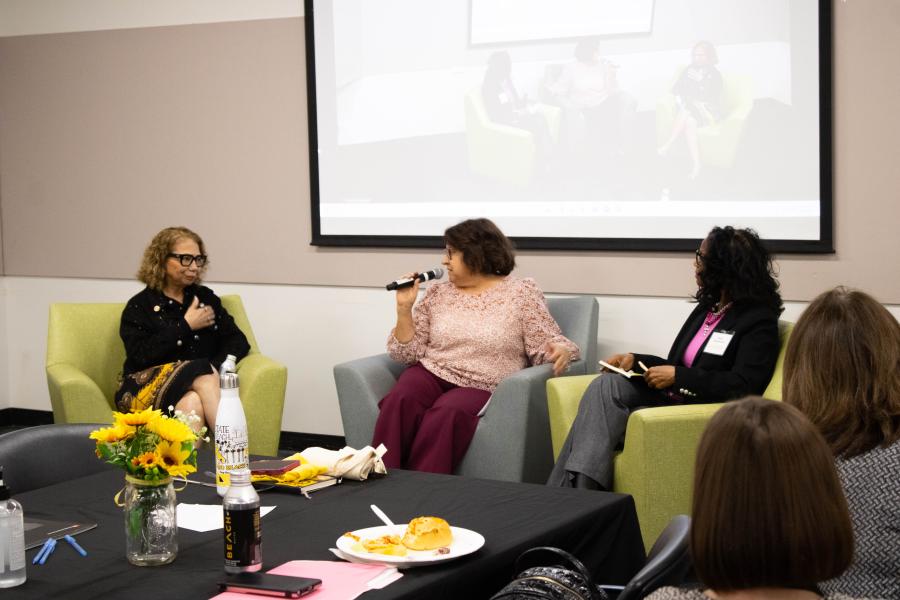
García said she measures her impact both by institutional progress and by the leaders she has helped develop, some of whom have gone on to serve as provosts, vice presidents and presidents.
Gunn, who is Black, framed leadership as not just service but representation, “showing up as my best, doing my job day in and day out…doing what I feel my mission is, what I was designed to do.”
Ortiz, whose college leadership team is composed entirely of women, highlighted wellness as a central priority and asked how her fellow leaders sustain themselves. García underscored the importance of intentional self-care and modeling healthy boundaries.
“If you want to stay in this life, you better start taking care of yourself,” she recalled a doctor friend telling her. She also makes sure her team takes time off and doesn’t text people who are on vacation.
The conversation also addressed caregiving responsibilities and workplace equity. Gunn emphasized flexibility and empathy.
“All of us have been there at one point or another. We’ve either taken care of parents, which was me, or you’re taking care of children, which could be now, and there’s nothing like a supervisor saying, ‘I got you, I hear you,’” Gunn said.
Reflecting on barriers faced by women and Latinas in leadership, García said they’re often underestimated and unseen. Ortiz added that women’s leadership styles are sometimes mischaracterized, which has happened to her as a professor, department chair and dean advocating forcefully but respectfully for students and colleagues.
“My assertiveness is often interpreted as aggressiveness,” Ortiz said, “and a man wouldn’t be judged in the same way.”