Student Clubs and Competition Teams
| Index | Team Members | Senior Design Project Title and Short Synopsis (<100 words) |
|---|---|---|
| DBF | RC Fixed-Wing Banner Towing Aircraft | |
Image
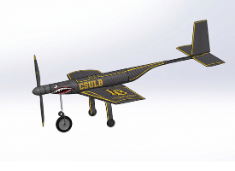
| The design of this aircraft is centered around the AIAA Design Build Fly competition, which is an annual international competition where university student teams design, fabricate, and demonstrate the flight capabilities of unmanned, electric-powered, radio- controlled aircraft. The goal of this year’s competition was to design a banner towing bush plane, which balanced the challenges of maximizing payload capacity with the capability to tow a banner. | |
| ESRA | Wyrmwood: A Low-Cost Regeneratively Cooled Engine and Rocket | |
Image

| As student rocketry teams advance along with high performance, high cost additive manufacturing methods, the status quo for well funded teams is to create regenerative engines using metal 3d printing. ESRA's project aims to create a high thrust (1000 lbf) regeneratively cooled engine using only traditional subtractive manufacturing methods. To test, and launch this new engine, the lessons learned from Persephone- ESRA's previous rocket will be iterated on to create an upscaled and highly modular launch and engine testing platform. | |
| SAT | SharkSat-1: Monitoring Global Blue Light Pollution | |
Image
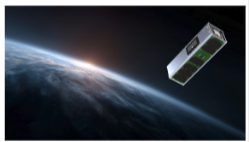
| SharkSat-1 is a 3U CubeSat, awarded with a rideshare from NASA CSLI, that is being designed by a team of multi-disciplined students at CSULB to monitor blue light pollution on Earth. Light pollution experts from DarkSky International coordinated with the team to explain the importance of having this data to push education and advocacy for health risks associated with blue light emissions. SharkSat-1 is equipped with a SkyFoxLab piCam 4 (Sensor B) to capture JPEG images of blue light wavelength emissions on Earth as low as 365 nm. These wavelengths cannot be detected by the current state-of-the-art technology, RTX’s VIIRS component. Additionally, SharkSat-1 acts as a gateway to future satellite missions designed and built at CSULB. By developing the tools, knowledge, and workforce at the university and local high schools, the future of SharkSat holds many possibilities for innovation at the Beach! | |