Composite & Materials
| Images | Description |
|---|---|
Image
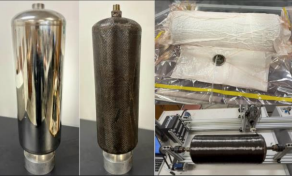
| COPV tanks for liquid rocket tanks Our COPV tank is designed to improve pressure capacity for high-pressure hydrogen storage applications. The composite vessel is produced through a multi-stage manufacturing process that combines pre-preg layups with carbon-fiber filament winding. Surface preparation—including acid etching, vacuum bagging, and heat treatment—ensures strong adhesion before filament winding, which provides the primary structural reinforcement needed for high-pressure performance. |
Image
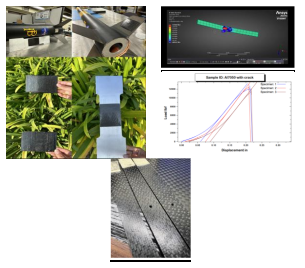
| CFRP patch for metallic structures (1) This senior design project explores bonded composite patches as a repair strategy for damaged wind turbine blades. We model a carbon-fiber coupon with a 0.25 in circular defect and reinforce it with a 1 in × 1 in octagonal patch. Using ANSYS finite element analysis, we compare intact, damaged, and repaired configurations to evaluate stiffness recovery, stress redistribution, and potential delamination zones, providing design guidelines for effective composite blade repairs |
Damage to metallic components often results in substantial costs in operational downtime, especially in the aerospace industry. This project aims to develop an effective procedure for repairing metallic structures through the application of a composite patch, specifically on 7075-T6 aircraft grade aluminum. Image
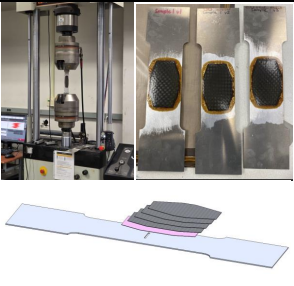
| CFRP patch for metallic structures (2) The work involves reviewing experimental studies, evaluating material properties, and performing comprehensive tensile testing. Our ultimate goal was to enhance the adhesion between the composite patch and the aluminum coupon through the use of nanoparticles and optimal surface prep. |
Image
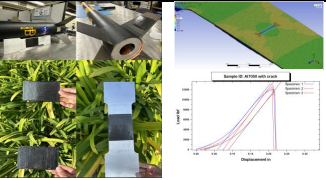
| CFRP patch for metallic structures (general / military repair version) Our senior project showcases an innovative repair solution for cracked or damaged military structures. A carbon fiber patch is applied to a 7075 T6 aluminum coupon in a dog-bone shape for maximum strength and performance. Two separate nanoparticles were tested and were used to enhance the adhesive bond strength, durability, and structural integrity for real-world military applications, offering a quick and effective repair solution. |