Publications, Preprints, and Presentations
CSULB student co-authors are in bold and asterisk (*) denotes publications have co-authorship from both CSULB and OSU PREM partners.
Publications
- Chhom, S.; Cano, K.; Gredig, T. Magnetic Properties in Co-Deposited Iron and Metal-Free Phthalocyanine Thin Films. Nanomaterials 2026, 16, 1061. https://doi.org/10.3390/nano16171061
- Metkar, V., Benedicto, V.G., Zheng, J. Zivkovic, A. Plascencia N. Gredig, Thomas, Narayanaswami V., Targeting of Acid Sphingomyelinase, a Lysosomal Membrane Protein, Using Apolipoprotein E3-containing Nanodiscs. J Membrane Biol 259, 35 (2026).
https://link.springer.com/article/10.1007/s00232-026-00393-4
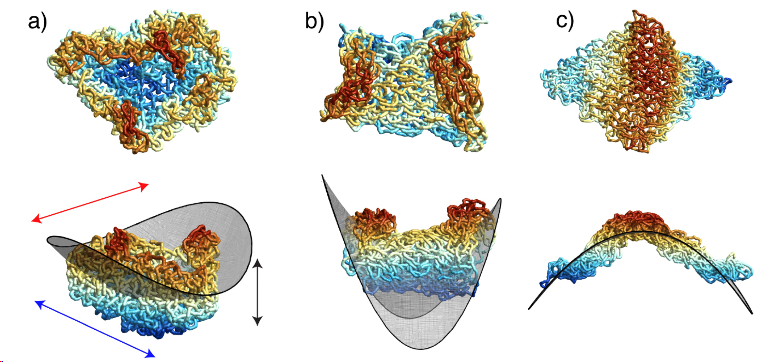
Chirality effects in molecular chainmail
Alexander R. Klotz, Caleb J. Anderson, and Lisa M. Hall, "Chirality effects in molecular chainmail", Soft Matter, (Advance Article) 2024
CSULB PREM faculty Alex Klotz worked with CSULB student Caleb Anderson and Michael Dimitriyev from the Department of Materials Science and Engineering at Texas A&M University to explore the effect of linking chirality on the curvature of polymer chainmail networks through simulations and optimization techniques.
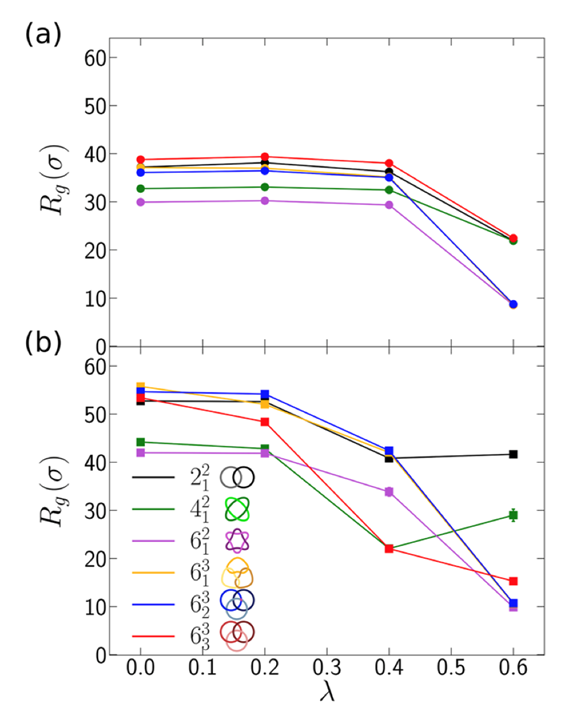
Single-molecule analysis of solvent-responsive mechanically interlocked ring polymers and the effects of nanoconfinement from coarse-grained simulations
Diego Becerra, Alexander R. Klotz, and Lisa M. Hall, “Single-molecule analysis of solvent-responsive mechanically interlocked ring polymers and the effects of nanoconfinement from coarse-grained simulations”, Journal of Chemical Physics 160, 114906 (2024) https://doi.org/10.1063/5.0191295
CSULB PREM faculty Alex Klotz worked with OSU PREM faculty Lisa Hall and her postdoc Diego Becerra to simulate mechanically interlocked semiflexible ring polymers inspired by the minicircles of kinetoplast DNA (kDNA) networks. They were able to provide valuable insights into the conformational behavior of mechanically interlocked ring polymers, highlighting challenges in extrapolating single-molecule analyses to larger networks such as kDNA. Diego is now faculty in the Department of Chemical Engineering at Universidad de Concepcion in Chile.
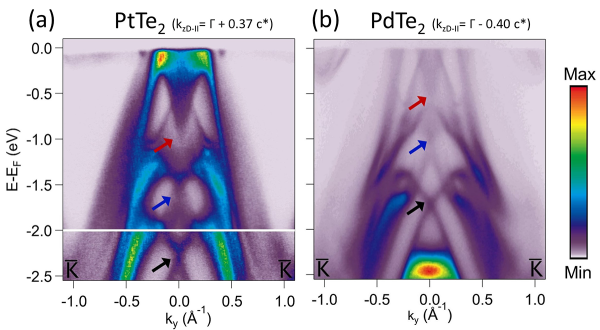
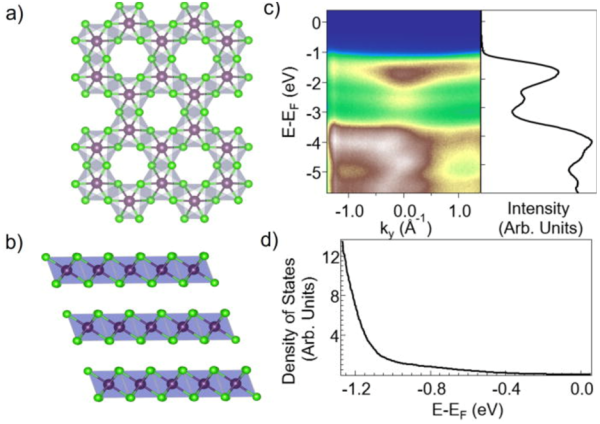
Observation of a new three-dimensional Dirac-like dispersion in the type-II Dirac semimetals PtTe2 and PdTe2*
(preprint) Ivan Pelayo, Derek Bergner, Archibald J. Williams, Jiayuwen Qi, Mahfuzun Nabi, Warren L. B. Huey, Luca Moreschini, Ziling Deng, Jonathan Denlinger, Alessandra Lanzara, Wolfgang Windl, Joshua Goldberger, Claudia Ojeda-Aristizabal. "Observation of a new three-dimensional Dirac-like dispersion in the type-II Dirac semimetals PtTe2 and PdTe2", arXiv 2312.15371 (2023) https://arxiv.org/abs/2312.15371
PtTe2 and PdTe2 are among the first transition metal dichalcogenides that were predicted to host type-II Dirac fermions, exotic particles prohibited in free space. These materials are layered and air-stable, which makes them top candidates for technological. The PREM team was able to experimentally characterize the electronic band structure of PtTe2 and PdTe2 using Angle Resolved Photoemission Spectroscopy ARPES and Density Functional Theory DFT calculations, unveiling a new three-dimensional Dirac-like dispersion in these materials.
Electronic transport mechanisms in a thin crystal of the Kitaev candidate α-RuCl3 probed through guarded high impedance measurements
Patrick Barfield, Vinh Tran, Vikram Nagarajan, Maya Martinez, Amirari Diego, Derek Bergner, Alessandra Lanzara, James G. Analytis and Claudia Ojeda-Aristizabal. "Electronic transport mechanisms in a thin crystal of the Kitaev candidate α-RuCl3 probed through guarded high impedance measurements", Appl. Phys. Lett. 122, 243102 (2023) https://pubs.aip.org/aip/apl/article-abstract/122/24/243102/2896115/Ele…
α-RuCl3 is considered to be the top candidate material for the experimental realization of the celebrated Kitaev model, where ground states are quantum spin liquids with interesting fractionalized excitations. It is, however, known that additional interactions beyond the Kitaev model trigger in α-RuCl3 a long-range zigzag antiferromagnetic ground state. In this work, we investigate a nanoflake of α-RuCl3 through guarded high impedance measurements aimed at reaching the regime where the system turns into a zigzag antiferromagnet. We found that below about 30 Kelvin, transport is ruled by Efros–Shklovskii variable range hopping (VRH). Most importantly, our data show that below the magnetic ordering transition known for bulk α-RuCl3 in the frame of the Kitaev–Heisenberg model (7 Kelvin), there is a clear deviation from VRH or thermal activation transport mechanisms. Our work demonstrates the possibility of reaching, through specialized high impedance measurements, the thrilling ground states predicted for α-RuCl3 at low temperatures in the frame of the Kitaev–Heisenberg model and informs about the transport mechanisms in this material in a wide temperature range.
Oral Presentations
- Thomas Gredig, Atomic Force Microscopy: Molecular Thin Films and Nanoscale Interfaces, CNSM Faculty Research Showcase, CSULB HSCI-102, Friday, April 24, 2026.
- Thomas Gredig, Surface Morphology in Annealed and Bithermally Grown Copper Phthalocyanine Thin Films, 2026 MRS Spring Meeting & Exhibit; Honolulu, HI, April 28, 2026.
- Sarah Grefe, Interplay of Topology and Strong Correlations, CNSM Faculty Research Showcase, CSULB, Friday, April 24, 2026.
- Sarah Grefe, Extremely Sensitive Control of Topological Phases in a Weyl-Kondo Semimetal via Zeeman Effect, 2026 APS Global Physics Summit; Denver, CO, Monday, March 16, 2026.
- Kaeden Russell, Andreas Bill, Electronic collective modes for systems with two effective masses, 2025 Annual Meeting of the APS Far West Section; UC Santa Cruz, Sunday, October 12, 2025.
Poster Presentations
- Alan Mejia, Brianna Christensen, Jiyeong Gu, Curvature Induced Magnetic Behavior in Permalloy and Samarium Cobalt Nanocap Thin Films, 2026 MRS Spring Meeting & Exhibit; Honolulu, HI, April 26-May 1, 2026.
- Eric Corona-Oceguera, Narith Chan, Anise Mansour, Deanna Diaz, Movindu Dissanayake, Erin Henkhaus, Alexander Goytia Fajardo, Jungyoun Cho (University of California, Los Angeles), Joshua Luna, Kenji Watanabe (National Institute for Materials Science), Takashi Taniguchi (National Institute for Materials Science), Matthew Mecklenburg (University of California, Los Angeles), Thomas Gredig, Claudia Ojeda-Aristizabal, A Magnetic Phthalocyanine Thin Film on Monolayer Graphene Probed in the Mesoscopic Regime, 2026 APS Global Physics Summit; Denver, CO and online, March 15-20, 2026.
- Narith Chan, Michelle McKenzie, Eric Corona-Oceguera, Movindu Dissanayake, Chenchu Yakasiri Saravanan, Archibald Williams (The Ohio State University), Joshua Goldberger (The Ohio State University), Claudia Ojeda-Aristizabal, Fabrication and Electronic Transport Measurements of Thin Layers of the Type-II Dirac Semimetal Platinum Ditelluride PtTe2, 2026 APS Global Physics Summit; Denver, CO and online, March 15-20, 2026.
- Emilliano Benitez, Sarah Grefe, Photo-Induced Phase Change in Kongo Systems, University of Michigan, Ann Arbor, MI, July 2026.
- Anthony Acebal, Sarah Grefe, Zero Frequency Nonperturbative Response Across a Topological Phase Transition, Conference Across MRSEC-PREM Scholars (CAMPS 2026); Ann Arbor, MI, July 2026.
- Jason Spada, Lisa Hall (Ohio State University), Jacob Breese (Ohio State University), How Ring Deletion Impacts the Structure of Interlocked Ring Polymer Sheets, 2026 APS Global Physics Summit; Denver, CO and online, March 15-20, 2026.
- Andrew Le Blanc, Jiyeong Gu, Building a Magneto-optical Kerr Microscope and Characterizing Magnetic Nanocap Thin Films, 2026 APS Global Physics Summit; Denver, CO and online, March 15-20, 2026.
- Mario Vasilev, Alexander Klotz, Molecular dynamics investigation of percolating membranes, 2026 APS Global Physics Summit; Denver, CO and online, March 15-20, 2026.
- Anthony Acebal, Benedikt Fauseweh, Jianxin Zhu (Los Alamos National Laboratory), Sarah Grefe, Zero Frequency Nonperturbative Response Across a Topological Phase Transition, 2026 APS Global Physics Summit; Denver, CO and online, March 15-20, 2026.
- Tianfei Zhang, Tyler Hadsell (Yale University), Mahfuzun Nabi, Archibald Williams (Ohio State Univ - Columbus), Bowen Yu (Ohio State Univ - Columbus), Jonathan Denlinger (Lawrence Berkeley National Laboratory), Wolfgang Windl (Ohio State Univ - Columbus), Joshua Goldberger (Ohio State Univ - Columbus), Claudia Ojeda-Aristizabal, Preliminary Photoemission studies of the van der Waals material Fe2Ga2S5, 2026 APS Global Physics Summit; Denver, CO and online, March 15-20, 2026.
- Joshua Luna, Michelle McKenzie, Eric Corona-Oceguera, Archibald Williams (The Ohio State University), Joshua Goldberger (The Ohio State University), Claudia Ojeda-Aristizabal, Fabrication of a PtTe2 / α-RuCl3 van-der-Waals Heterostructure for Electronic Transport, 2026 APS Global Physics Summit; Denver, CO and online, March 15-20, 2026.
- Adam Bowen, Oscar Padilla, Jiyeong Gu, Fabrication of Micropillar Josephson Junction with Niobium Nitride and Permalloy/Samarium Cobalt Exchange Spring Magnet Using Microwriter ML3, 37th Annual Student Research Symposium, CSULB, September 2025.
- Alan Mejia, Jiyeong Gu, Hysteresis and FORC Characterization of SmCo and Permalloy Nanocap Thin Films, 37th Annual Student Research Symposium, CSULB, September 2025.
- Brianna Christensen, Jiyeong Gu, Enhancing the Robustness for the Magneto-Optical Kerr Effect Magnetometry Set Up, 37th Annual Student Research Symposium, CSULB, September 2025.
- Brianna Christensen, Jiyeong Gu, Enhancing the Robustness for the Magneto-Optical Kerr Effect Magnetometry Set Up, 37th Annual Student Research Symposium, CSULB, September 2025.
- Anthony Acebal, Sarah Grefe, Nonlinear Current Response Contrasting High-Harmonic Response of Trivial and Nontrivial Topological States, CSU Solid-State Chemistry Symposium, CSULB, December 2025.
- Anthony Acebal, Sarah Grefe, Nonlinear Current Response Contrasting High-Harmonic Response of Trivial and Nontrivial Topological States, CNSM Student Research Symposium, CSULB, September 2025.
- Kaeden Russell, Andreas Bill, Electronic Collective Modes for Systems with Two Effective Masses, CNSM Student Research Symposium, CSULB, Wednesday, September 17, 2025
- Alexander Goytia Fajardo, Emmy Freudenrich (Ohio State University), Robert Claasen (Ohio State University), Ezekiel Johnston Halperin (Ohio State University), Thomas Gredig, Controlled Dilution of Copper Spins in Phthalocyanine Thin Films for Electron Paramagnetic Resonance, 2025 Annual Meeting of the APS Far West Section; UC Santa Cruz - Stevenson College Room: Stevenson Campus, 10:30 AM, Sunday, October 12, 2025.
- Andrew Le Blanc, Jiyeong Gu, Building a Magneto-optical Kerr Microscope by Modifying a Polarizing Microscope, 2025 Annual Meeting of the APS Far West Section; UC Santa Cruz - Stevenson College Room: Stevenson Campus, 10:30 AM, Sunday, October 12, 2025.
- Eric Corona-Oceguera, Anise E Mansour, Deanna Diaz, Movindu Kawshan Dissanayake Dissanayake Mudiyanselage, Erin Henkhaus, Jungyoun Cho (University of California, Los Angeles), Vinh Tran, Francisco Ramirez, Joshua Ariel Luna, Kenta Kodama, Yueyun Chen (University of California, Los Angeles), Ho L Chan (University of California, Los Angeles), Jacob Weber, Blake Koford (Auburn University), Maya H Martinez, Watanabe (National Institute for Materials Science), Takashi Taniguchi (National Institute for Materials Science), Matthew H Mecklenburg (University of California, Los Angeles), Thomas Gredig, Claudia Ojeda-Aristizabal, Proximity-Induced Electronic and Magnetic Effects in Phthalocyanine/Graphene/h-BN Heterostructures, 2025 Annual Meeting of the APS Far West Section; UC Santa Cruz - Stevenson College Room: Stevenson Campus, 10:30 AM, Sunday, October 12, 2025
The Partnership for Research and Education in Materials (PREM) program between California State University, Long Beach and The Ohio State University is supported through a grant from the National Science Foundation (grant no. 2425133).