Engineering, psychology meet at CSULB to develop a future for 'flying cars'
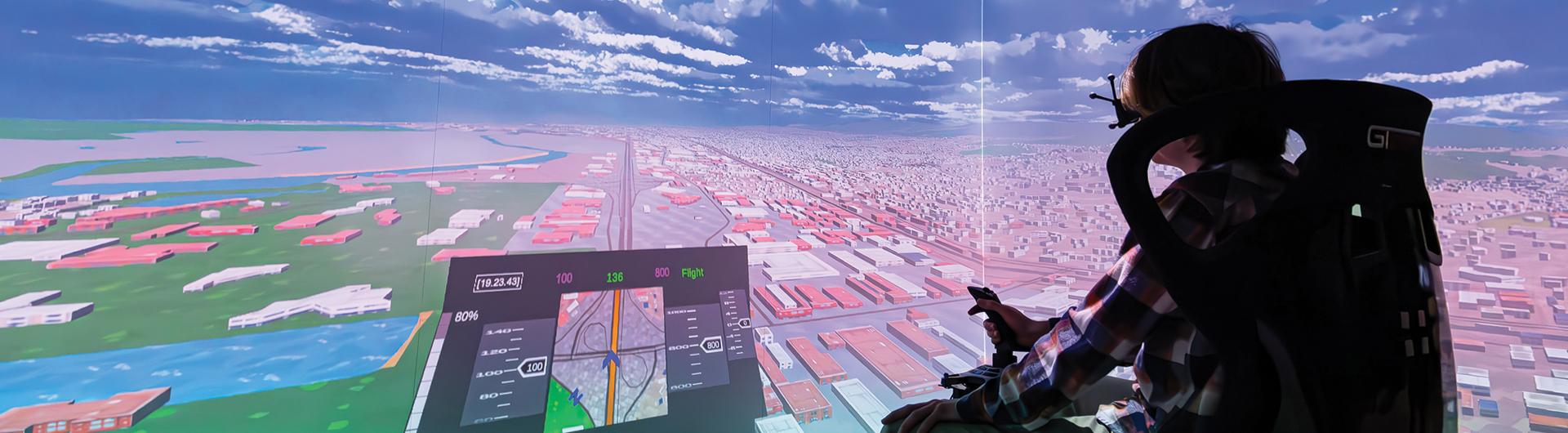
Gazing into a computer-generated cityscape, a Cal State Long Beach student pilots a course to the future of transportation while flying through a virtual world that exists within a high-tech campus lab.
“In no other world am I making a flight simulator,” said Kieran Whitney, a third-year computer science student.
Whitney often pilots the simulator, a key asset for the Urban Air Mobility (UAM) project. The work brings the colleges of Engineering and Liberal Arts together to research how urban air mobility vehicles (UAMs) — essentially electric-powered “flying cars” — can be integrated into the nation’s air transportation system.
“I really want to get into software development,” Whitney said. “This is a great opportunity for me to get trained in a semi-professional environment.”
The work blends studies of technology and psychology. Computer science students hone coding skills while ensuring the simulator at BeachCAVE, an engineering lab kitted out with an advanced projection system, functions as needed. They work alongside graduate students working in the Center for Human Factors in Advanced Aeronautics Technologies, focused on how aviation technologies and protocols can be designed to be easily understood by the people who use them, making air travel safer for all involved.
Since “the flying cars are coming,” Kim-Phuong Vu, professor of human factors psychology, said it is time to be ready for them.
“Companies are already in the process of producing UAM vehicles and are seeking certification for their operations,” Vu said. “We may see them in operation by the 2028 Olympics.”
Inside the CAVE
BeachCAVE’s virtual reality system places the operator inside the action, like watching television from inside the screen. Whoever is in the pilot’s seat controls a joystick while viewing images projected to three walls and the floor, creating a panoramic view.
The scenery can be shown in two or three dimensions, with a stereoscopic headset. The technology, obtained via a National Science Foundation grant, lets observers see the virtual cockpit and environment during simulated flights.
Faculty and students working on the Urban Air Mobility project fly within a simulated San Francisco, selected since the UAM project is a joint effort between The Beach’s Psychology and Mechanical & Aerospace Engineering departments and, from the Bay Area, from NASA Ames Research Center and San Jose State University Research
“Think of it like an air taxi,” said Panadda (Nim) Marayong, professor of mechanical and aerospace engineering. “You pick up a passenger downtown and you drop them off.”
The team’s design shows the flight path as an orange map overlay, like a navigation app telling a driver which roads to take. Other displays let pilots see if they are on a safe landing path or if the UAM has power. If these elements seem familiar, that’s the point.
“We based it off what felt the most intuitive to us, based on years of using technology,” said Eden Doss-Fillmore ‘25, contributing to the project after completing a bachelor’s degree in computer science.
“I really enjoy working in virtual reality particularly, and I don’t think I realized that until I started working here,” Doss-Fillmore said.
Blue skies
The UAM project prepares students to solve problems involving coordination and communication. Engineering students keep different hardware and software programs in sync for the simulation, while human factors students focus on user-friendly technology.
“Any time we throw a problem at them, they come back and solve it,” said Praveen Shankar, professor of mechanical and aerospace engineering.
Everyone is part of a team with a shared goal.
“I had the opportunity to collaborate across disciplines, which gave me a stronger understanding of the different perspectives and priorities, as well as what is technologically feasible during the development phase,” said Vannessa Nguyen, a second-year graduate student in human factors.
Nguyen wants to work in a field, like aviation or medical device design, where safety is paramount.
The UAM team’s approach to safety includes testing how to help pilots stay alert without overwhelming them. Is it better for air traffic controllers to communicate by voice, or by sending test messages on a heads-up display? Does it help if pilots wear small vibrating devices that send tactile alerts if they veer off course?
“What we do is minimize the work that the pilots have,” said Andrew Alfaro ‘23, who earned a bachelor’s degree in psychology and is now in his second year of a Master’s in Human Factors program.
Shelby Trainor, a first-year human factors graduate student, said the UAM project inspired her to pursue a pilot’s license and an internship enabling her to work on cockpit instruments.
“Before joining CAVE, the aviation field felt intimidating, but as I began immersing myself in the UAM project, my passion for aviation grew,” she said. “This experience has had a profound influence on my human factors career, and I am very grateful to be a part of such a fantastic team.”