PBL and Research
PBL and Research at the Hung Family College of Engineering provides students with hands-on, project-based learning experiences that integrate design, innovation, and real-world problem solving. Through collaboration with faculty and industry partners, students develop and test solutions across areas such as aerospace systems, energy technologies, and advanced materials. These projects emphasize practical application of engineering principles, preparing students for careers in research, development, and industry. The program fosters teamwork, technical expertise, and innovation through experiential learning.
The UAV research at CSULB focuses on the design, development, and optimization of advanced aerial systems for real-world applications such as surveillance, wildfire monitoring, and autonomous navigation. Projects include the conversion of gas-powered UAVs to electric propulsion systems, improving efficiency and sustainability while integrating FPV cameras for real-time data collection.
Additional work explores lightweight thermal-mapping UAVs equipped with infrared cameras, GPS, and long-range telemetry for wildfire detection across remote terrain. Autonomous quadcopters with waypoint-based navigation systems are also being developed to enable fully automated missions with minimal human intervention. These platforms emphasize durability, cost-effectiveness, and scalability for future aerospace applications.
Research in composites and advanced materials focuses on developing high-performance, lightweight structures for aerospace and energy applications. Projects include the fabrication of carbon-fiber reinforced UAVs and the development of molds for efficient composite manufacturing using simulation-driven design and testing.
Work also includes Carbon Overwrapped Pressure Vessels (COPVs) for high-pressure storage systems, manufactured through advanced processes such as filament winding and vacuum-assisted curing. Additionally, composite repair techniques are explored using bonded CFRP patches to restore damaged metallic structures, improving structural integrity and extending service life. These studies combine experimental testing and finite element analysis to optimize performance and durability.
Green energy research focuses on sustainable power generation systems, particularly in offshore and ocean environments. Projects include hybrid offshore wind turbines that combine wind and wave energy harvesting using floating platforms with integrated buoy-driven mechanisms. These systems convert ocean motion into electrical energy while maintaining stability through advanced structural design.
Additional work explores hydrogen fuel cell technology as a clean energy solution. These electrochemical systems generate electricity through redox reactions using hydrogen fuel, offering applications in transportation and renewable energy systems. Research emphasizes efficiency, scalability, and real-world deployment in marine and industrial environments
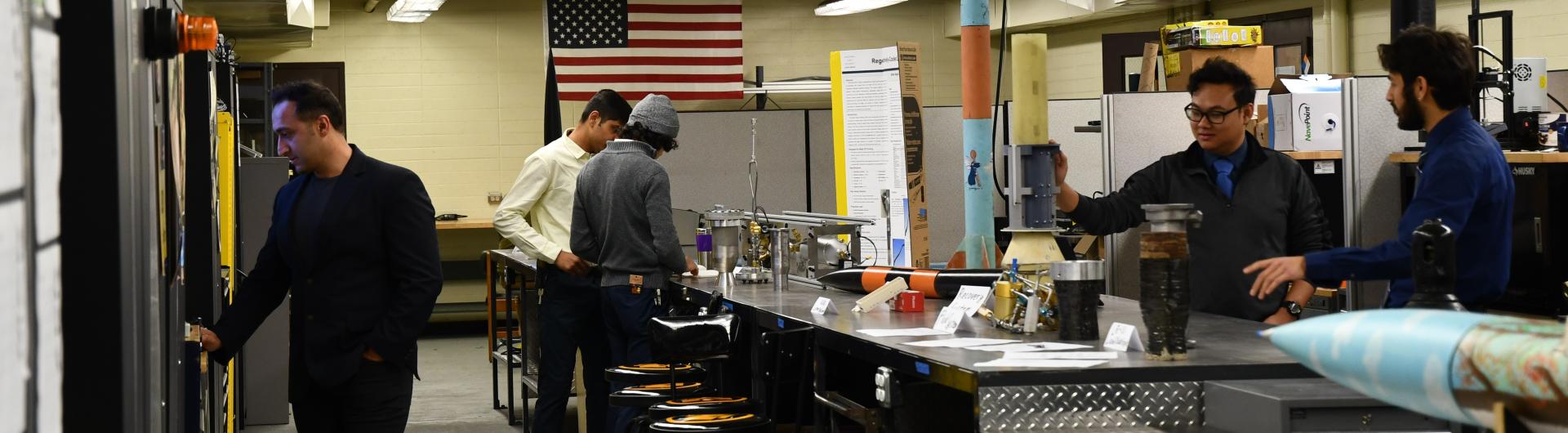
Rocketry research at CSULB is centered around the design, testing, and launch of liquid and hybrid propulsion systems. The Beach Rocket Lab supports multiple student teams working on projects such as nitrous-kerosene liquid rockets, pump-fed propulsion systems, and high-altitude launch platforms. These systems integrate structural, fluid, and avionics design to achieve reliable flight performance.
Advanced projects include the development of rockets like Supernova and Stratos, designed for high-altitude missions up to 30,000 feet. Additional innovations include electromechanical recovery systems for safer parachute deployment and modular high-altitude launch systems using helium balloons. Research also extends to high-performance rocket engines, including copper-chromium heat sink engines and additive manufacturing techniques for propulsion components.