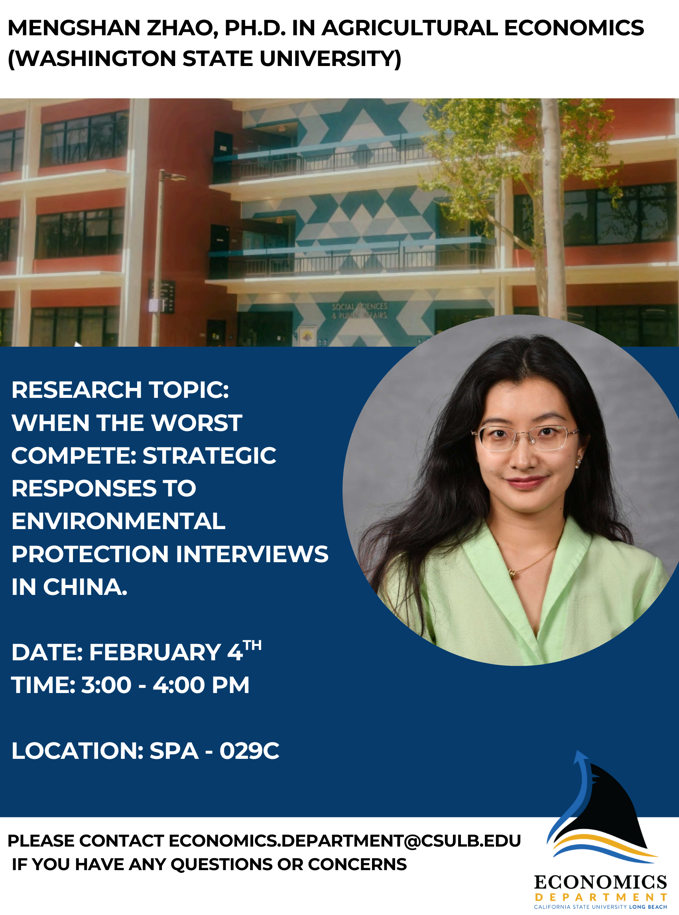
Job Talk: Mengshan Zhao Ph.D. (Washington State University)
Mengshan Zhao, Ph.D. (Washington State University) will be presenting:
“When the worst compete: strategic responses to environmental protection interviews in China”
Wednesday, February 4, 2026
3:00 PM – 4:00 PM
Location: SSPA-029C
Following the job talk, the Department of Economics encourages students to attend a 30-minute student meeting with the candidate at 4:30 PM in the SPA Conference Room.
This meeting provides an opportunity for students to meet the candidate, ask questions, and share their perspectives. Student participation is highly valued.
Remote Attendance:
The job talk (3:00–4:00 PM) will also be available via Zoom.
Topic: ECON Job Talk
Time: February 4, 2026, 3:00 PM (Pacific Time)
Zoom link:
https://csulb.zoom.us/j/82545645399
Title: When the Worst Compete: Strategic Responses to Environmental Protection Interviews in China.
Abstract: This paper explores the dynamic incentives embedded in ranking-based environ- mental governance, investigating how governments strategically respond to competitive performance evaluations. Using China’s Environmental Protection Interview (EPI): a high-profile, ranking-driven policy targeting underperforming cities as an empirical case, I leverage high-frequency air-quality data and a Callaway–Sant’Anna difference- in-differences framework to analyze behavior under pressure. Contrary to existing literature, which typically estimates modest pollution reductions for formally sanctioned cities, my
analysis shows that cities at risk of being treated reduce PM2.5 by approximately 12.6 μg/m3, nearly three times of prior estimates when facing the risk of evaluation sanctions. These reductions show clear seasonality: peaking at 21.7 μg/m3 in December and weakening midyear, consistent with short-term strategic abatement around evaluation windows. The policy also generates measurable healthcare cost sav- ings during the evaluation periods, though no significant changes are observed in the number of patients in either urban or rural areas. Political factors shape these re- sponses: cities with extensive elite ties intensify short term reductions around evalua- tion periods, whereas those near capital region oversight sustain steadier improvements throughout the year. Importantly, political connections shift effort across the calendar without increasing the total annual effect. A tournament model explains why elite ties and geographic adjacency generate different patterns by separating rank loss costs from pollution damage costs. Taken together, the findings highlight both the advantages and drawbacks of rank-ordered policy design and underscore the importance of aligning short-term incentives with long-term public-health goals.