Twelve Years of Impact: A Farewell to The Beach
Looking Back As I Step Forward
As I prepare to leave CSULB after twelve years leading the Office of Sustainability, I find myself reflecting on the journey that brought me here and the community that has made this time in my life and this work so meaningful. I’m about to embark on a year living in Spain where I’ll be studying Spanish, traveling, and taking a career pause, and it feels right to share how I found my way into sustainability and what these years at The Beach have meant to me.
From Artist to Environmentalist: My Unusual Origin Story
I didn’t take a traditional path into sustainability. I started out as an artist, a photography major from a small liberal arts college who moved from New Mexico to Los Angeles with dreams of working in the creative world.
My pivot into environmental work happened almost by accident. I landed a job at a media company that was producing an environmental documentary with Leonardo DiCaprio, and that project opened my eyes to the reality of the climate crisis. I was shocked, and the more I learned, the more I felt a sense of urgency and a pull I couldn’t ignore. I knew then that I wanted to be part of the movement.
I threw myself into learning as much as I could about environmental issues and solutions and began volunteering with an environmental education nonprofit in Santa Monica called Sustainable Works. After I was laid off during the Great Recession, my volunteering paid off when a part‑time position opened up and I was hired. I was suddenly leading sustainable living workshops for community college students, and that’s when everything clicked. I discovered that I loved working with students and helping people understand their environmental impact and recognize their ability to create change. That experience brought my career aspirations into focus. I wanted to work in sustainability, and I wanted to do it in higher education.
The People Who Showed Me What’s Possible
I was fortunate to have mentors at Santa Monica College and UCLA who showed me what campus sustainability programs could look like: creative, interdisciplinary, community focused, and deeply impactful. Their work inspired me, but I knew I needed more education to follow in their footsteps. I enrolled in UCLA’s Urban and Regional Planning program largely because it was the path my mentors had taken, trusting their guidance even though I didn’t aspire to be a planner.
The most transformative part of graduate school wasn’t the coursework. It was being selected for the Bohnett Fellowship, which placed me in the Los Angeles Mayor’s Office. As a Fellow, I worked alongside the city’s Chief Sustainability Officer, policy analysts, and senior leaders, which gave me the chance to contribute to sustainability planning and policy development at a systems level in one of the largest cities in the country. The experience was challenging and energizing, and it offered a powerful glimpse into what it feels like to tackle grand environmental challenges with a team of dedicated and passionate people focused on the greater good.
During my final semester at UCLA and the Mayor’s Office, I applied for the Sustainability Coordinator position at CSULB, a campus I had never visited that was part of a system I knew nothing about. When I was offered the job before I even graduated, I was thrilled, grateful, and nearly paralyzed by imposter syndrome. I was the first person in the university’s history hired to focus on sustainability, which meant there was no roadmap. As daunting as that was, the blank slate turned out to be a gift. Looking back, I feel like my creative background helped me think differently, experiment, and essentially invent the role as I went.
Finding My Place at The Beach
Stepping into my role at CSULB, I quickly realized that although I was the first person with sustainability in my job title and the first to be given full‑time responsibility for climate action, I was not starting from scratch. A small but mighty group of faculty and staff had already been volunteering their time for a few years as part of the Sustainability Task Force, squeezing sustainability work into the margins of their regular jobs. They welcomed me graciously, showed me the ropes, and were probably relieved to have someone who could take their ideas, priorities, and long‑standing hopes for the campus and finally run with them.
Those first couple of years were a whirlwind of learning and building. One of my first major projects was helping write the university’s inaugural Climate Action Plan in 2014, CSULB’s first public commitment to confronting climate change. Around the same time, I completed our first Sustainability Tracking, Assessment, and Rating System (STARS) report, a comprehensive measurement of our programs, initiatives, and accomplishments that gave us a baseline we could build from.
I also began hiring student assistants and interns to support our growing portfolio of initiatives. Their energy and creativity were essential, especially in those early days when I was still trying to understand how the university worked and navigate the silos, bureaucracy, and politics. It took time to get my bearings, and sometimes it felt like I was rowing upstream.
But little by little, things shifted. I built relationships, found allies, and started racking up some wins. Eventually, it became clear that my small team of student assistants was not enough to support the expanding scope of our work. I made the case for a second staff position, and in 2016, my first Sustainability Specialist, a recent CSULB graduate I had mentored, joined the team full‑time.
As our department grew, so did our impact. We won grants, launched a zero‑waste initiative, and partnered with service‑learning courses to give more students the opportunity to engage in hands‑on sustainability work on campus. One of the programs that blossomed the most was the annual Green Generation Showcase at the Japanese Garden. What began as a modest event has evolved over the years into a vibrant gathering for hundreds of attendees featuring student researchers, artists, campus partners, and community organizations, all raising awareness about environmental and social justice issues and inspiring attendees to get involved.
I’ve never been short on ideas for programs, campaigns, and initiatives I wanted to launch. Some ideas became reality, such as the Sustainability Fellows and Sustainability Champions programs, the Green Events program, and the Green Grad initiative. Others, like my dream of implementing a campuswide reusable container program or developing a student‑led Green Office certification program, never made it off the launchpad.
As I look back on those years of building, experimenting, and trying to move the needle wherever I could, I realize how much of the work was shaped by both momentum and limitation. We made progress then had setbacks. We weathered a pandemic and came back stronger. We faced budget cuts then found scrappy ways to fill the gaps. We faced burnout then got inspired by students and colleagues. That mix of progress and constraint became a defining part of my experience, and it taught me lessons I didn’t expect when I first stepped into this role. Those lessons stayed with me and shaped how I understand sustainability work today.
What This Work Taught Me
When I sat down to write this piece, I assumed I would just reflect on my time and highlight the accomplishments I am most proud of. But the truth is, this work has humbled me. I came into this, my dream job, with so much optimism and hope. I imagined transforming the campus into a model of sustainable operations and cultivating a culture of sustainability that could be felt everywhere.
There has been meaningful progress for sure, but I have also learned that this work is hard. The scale of the climate crisis is enormous, and change inside a large institution is slow. Most people genuinely want to do the right thing, but it has to fit within their time, budget, and bandwidth. And even when people are willing to spend more or give up conveniences, there are still obstacles. Products aren’t designed to be recycled. Markets haven’t yet created better alternatives. Systems weren’t built with sustainability in mind.
There were moments when I wondered whether the impact I was making was significant at all. But every time I felt discouraged, the students reminded me why this work matters.
What Made It All Matter

The most rewarding part of my job by far has been mentoring students and watching them go out into the world and make a real impact. One of my first interns went on to law school and now works for the Natural Resources Defense Council (NRDC). Another former intern works for a startup that 3D prints infrastructure for offshore wind turbines all around the world. A film major who worked for me landed a job at Sony helping make TV and film productions more sustainable and now runs her own consulting business. These are just a few of the incredible students who came through my office and who are now shaping their industries for the better. There are many more I worked with who I got to witness discover their own capacity to make positive change and who are out there now quietly improving the world in ways I may never know.
More than any event, policy, or program I launched, these students are my legacy.
And so are the relationships I built across the university. I am grateful for the faculty, staff, and students who served on the President’s Commission on Sustainability, for the hundred plus faculty who took part in work of integrating sustainability and climate justice into the curriculum, and for my colleagues in Beach Building Services who supported zero‑waste efforts, Earth Month events, and the data collection that made our STARS reports and greenhouse gas inventories possible.
All of you made my time at CSULB feel valuable and meaningful. I am grateful for every project we worked on together and every student I had the chance to support, even if there is still so much more I wish we could have done.
The Wind Beneath My Wings
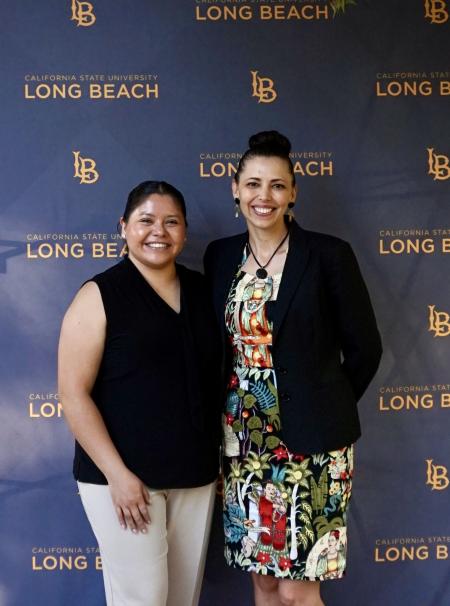
I would be remiss if I didn’t shout out Sylvia, Lily, Kayla and Nanci, the four extraordinary women who have held the role of Sustainability Specialist during my tenure. Each brought her own passion, creativity, and expertise and each left a meaningful and important mark on our programs. It has truly been an honor and privilege to work alongside them and each of them helped me grow personally and professionally in different ways. As their supervisor and the outspoken head of the Office of Sustainability, I know I often received the lion’s share of recognition, but our successes were always shared. They were essential partners in this work, the ones who helped turn ideas into reality and kept our efforts moving forward with skill, dedication, and heart .
I want to especially acknowledge Nanci Torres Poblano, who has been the Sustainability Specialist for the past three years. Nanci has been my right hand woman, taking on every challenge with thoughtfulness, professionalism, and a steady commitment to our mission and our students. She brings one of the strongest work ethics I’ve ever seen, paired with a genuine hunger for learning and growth that has continually elevated our work. As I step away, she will be the one guiding our programs forward, and I know she’ll carry that responsibility with the same resolve and intention she brings to her work every day. I have complete confidence in her ability to lead the department through this transition, and I call on our community of sustainability leaders to support her as she continues the progress we have made together.
A Grateful Goodbye and a New Chapter Ahead
I will truly miss being part of The Beach community. But I also know that the work we started together will continue, evolve, and grow long after I’m gone.
While it was not an easy decision to leave my position or the colleagues and students who mean so much to me, it feels like the right moment to slow down, reconnect with myself, and discover where my abilities can make the most positive impact in the world. But please know that even from many miles away, I will be cheering for The Beach and watching with hope and excitement as the sustainability and climate justice work continues to grow in the years ahead.