Newly endowed research symposium gives 150+ students a lasting stage
Starving sea creatures, rising coastlines, mouse memory, seaweed viruses and underwater robots.
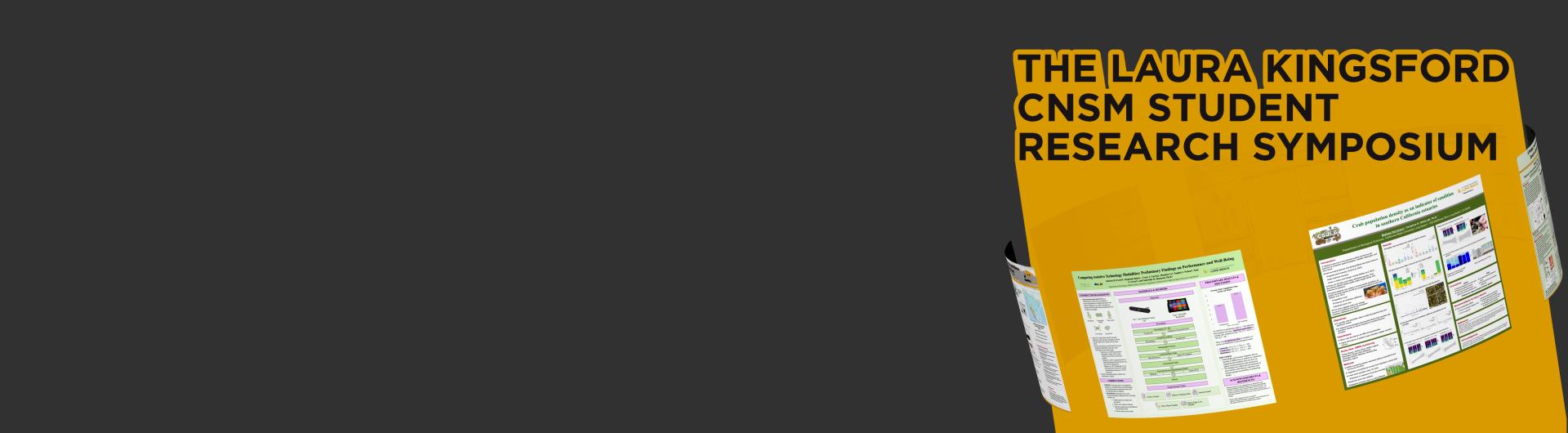
CSULB students are chasing all of it, in faculty labs across campus — and often across majors. On Friday, more than 150 of them will stand beside their posters at the newly named Laura Kingsford CNSM Student Research Symposium.
Mia Carter can hardly wait. The computer science major teamed up with other students in the College of Natural Science and Mathematics and Hung Family College of Engineering to teach a computer to sort lizard photos, about 13,000 of them, a job that otherwise falls to researchers clicking through images one by one.
“It has been rewarding to see our work move beyond an idea and become something that other researchers can learn from, provide feedback on, and potentially build upon," Carter said. Presenting the work at the symposium "feels like a true accomplishment and a meaningful reflection of our collaboration."
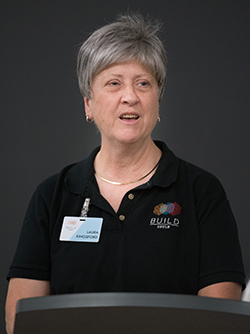
This year, retired engineer John E. Clark endowed the decades-old symposium in memory of his late wife, Elizabeth, who earned two degrees from the university, in 1980 and 1985, and spent more than 30 years in infection control at Torrance Memorial. With the gift came naming rights, and Clark asked that the event honor a faculty member. The college chose Laura Kingsford, who recently retired after 40 years at CSULB as a professor, department chair and dean — championing student research throughout.
"I am pleased to be able to ensure continuing support for the CNSM Student Research Symposium,” Clark said, “and to name it in honor of Dr. Laura Kingsford for her long history as an educator and mentor of students."
A closer look at the science
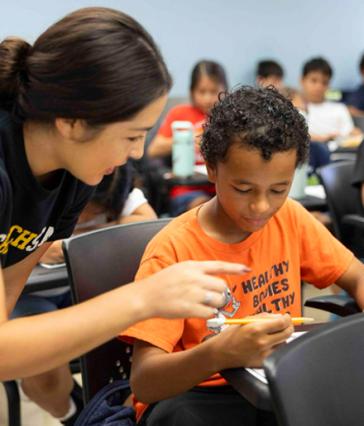
Taking place on the ground floor of the LBS Financial Credit Union Pyramid, the symposium reflects the hands-on mentoring involved in student research at The Beach. Every poster displayed has at least one faculty mentor behind it, and this year’s posters run the gamut — from wildlife and disease to distant stars and the mathematics of knots.
More than 130 projects are expected to be displayed, many of them crossing disciplines: a math student working with health science faculty, a psychology team testing assistive technology, and Carter’s group — which paired biology with computer science and machine learning.
“Interdisciplinary collaboration … allows people to develop solutions that a single field might not have considered on its own,” Carter said.
Jonathan Strange, a fourth-year CNSM student who worked with a mathematician and a physicist on his project, will present a new way to tell whether three loops are locked together; his is 150 times faster than an existing tool.
Elizabeth Forrey, a master’s student in biology, will share her work on whether hooded skunks mimic the coats of neighboring species, which could be the first evidence of such mimicry among mammals.
Interdisciplinary collaboration … allows people to develop solutions that a single field might not have considered on its own.
Under the guidance of CNSM Professor Christine Whitcraft, aspiring ecological toxicologist Melissa Herrmann took advantage of the nearby ocean, counting crabs in Southern California’s coastal wetlands to measure the health of the estuaries they live in.
And Marcus Ludes, an applied statistics undergrad interested in biomedical research, will present on fentanyl harm-reduction strategies for music festivals.
Ludes said his group surveyed CSULB students before and after a campus session on fentanyl test strips and naloxone after hearing about the prevalence of fentanyl use.
“I know that people won’t just quit substances,” he said, “so what matters to me is being able to prevent unnecessary overdose deaths from them.”
Fresh eyes on the work
In addition to giving students a chance to explain — and sometimes defend — their research to those outside their field, the symposium invites students to hear and consider new perspectives.
“I’m able to receive feedback on what I could do better and improve my ability on communicating scientific discoveries more effectively,” said Johnny Vu, a chemical engineering student who researched how portable, low-cost smartphone devices can be used to detect bisphenol A, a synthetic chemical used to manufacture plastics.
“I hope that visitors can understand," Ludes added, "how much work each student put into their poster — and, more importantly, their research.”
The symposium will be held at the LBS Financial Credit Union Pyramid from 11 a.m. to 1 p.m. Friday, Oct. 16, and is open to the campus community and friends of CSULB.