A Native American language at risk of fading has allies at Cal State Long Beach
A CSULB professor and his students have partnered with a Central California Native American tribe to ensure that its language is preserved.
Since 2017, linguistics professor Michael Ahland, along with about 15 of his students, have been collaborating with the Tübatulabal tribe of the Kern River Valley to examine the structure of the Tübatulabal (Pahka’anil) language, and record and digitize it for future generations.
It’s been an opportunity for the tribe — who also calls itself the Pakanapul — to safeguard its language, which has no native speakers left. And it’s been a chance for CSULB students to grow, travel, expand their minds outside the classroom and assist in a valuable cultural project.
“We are answering real scientific questions,” said Ahland, who is chair of the linguistics department. “This is combining scientific inquiry with supporting local communities’ own goals in language revitalization and reclamation.”
Ahland’s students, who were a mix of graduate and undergrad linguistics majors, worked with tribal members to analyze the Pahka’anil language and understand its structure and tendencies. They used digital tools to annotate recordings, as well as record and clean up stories, songs and conversations in Pahka’anil, an Uto-Aztecan tongue.
Members of the Tübatulabal tribe have been using the resources created and preserved by Ahland and his students, as well as a CSULB website dedicated to the Pahka’anil (Tübatulabal) Text Project, to teach the language to tribal members and others in Bakersfield and Lake Isabella.
Robert Gomez, chairman of the Tübatulabal tribe, said his tribe is proud to be part of the project, and Ahland and his students have been “immensely helpful.”
“We need to get back to our roots, and part of that is bringing back the language,” Gomez said. “We have to sustain it. That’s our culture. We got a website out of this collaboration, that we can share with the world.”
Ahland has completed a manuscript on his and the students’ findings, which will be published next year by John Benjamins Publishing Co. in a series called “Typological Studies in Language.”
Recording voices and stories
As the initial students — including Muhammad Damanhuri '17, '20, Bethany Lycan '17, '20, Sergio Sandoval Sanchez ’11, ’18 and Nicholas Sinetos '18 — studied and digitized the language, they also learned about the tribe’s history, myths, values and folktales. They recorded more than two dozen texts and stories onto the text project site, including myths like “How the Earth Was Made” and “Death Comes Into the World.”
A few students were able to publish their research with Ahland in the International Journal of American Linguistics’ supplemental volume, Texts in the Indigenous Languages of the Americas.
Sanchez, who obtained bachelor’s and master’s degrees in linguistics, used his experience as a professional musician to clean up and re-record Pahka’anil audio recordings that were originally captured on wax cylinders and given to the tribe by the Smithsonian Institution. He was able to recover six to seven songs for the tribe using the program Cubase.
“To hear the voices of their ancestors — it was a very special project for me to do that,” said Sanchez, now a full-time professor at Long Beach City College. “When you do this project, you learn the importance of a community’s linguistic heritage. A person’s identity becomes intertwined with their language. Against all odds, these folks are moving forward, revitalizing their language and teaching it to the next generation.”
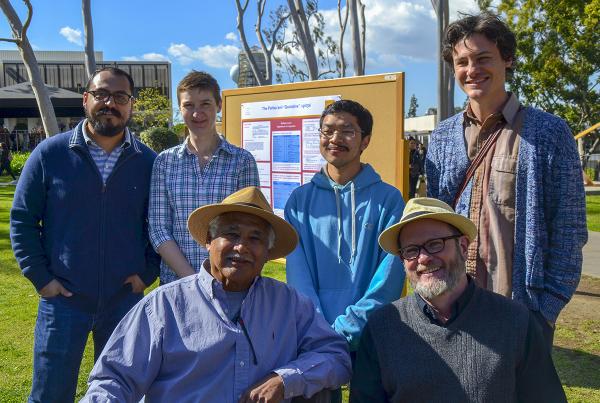
In 2018, Gomez and his cousin Tina Guerrero, who is vice chair of the tribe, visited the CSULB campus to meet with the students they had been working with, listen to their presentations about Pahka’anil and meet with Native American representatives on campus.
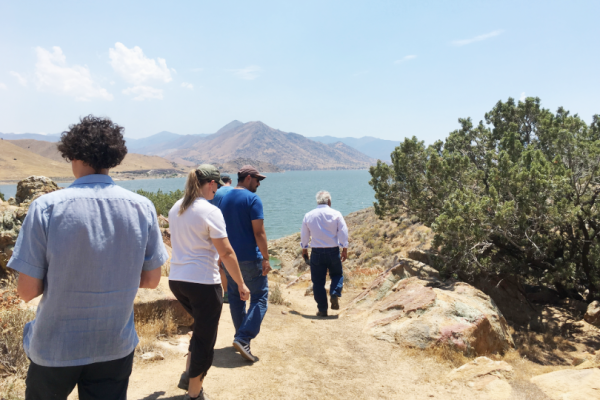
In a similar vein, Ahland and his students have visited Gomez and the tribe over the years to get updates, observe a powwow and commemorate a massacre that occurred on tribal land in 1863.
Ahland plans to visit the tribe in the next few months to offer a workshop, update the tribe on his findings and answer an initial question posed by the tribe about frequent variation in word order. After years of textual annotation and analysis, Ahland and his team can now explain why the Pahka’anil word order changes and what functions the different orders achieve.
“Culture is language, language is culture,” Gomez said. “What Michael and the students have done is a tremendous benefit to us.”