Community Based Research
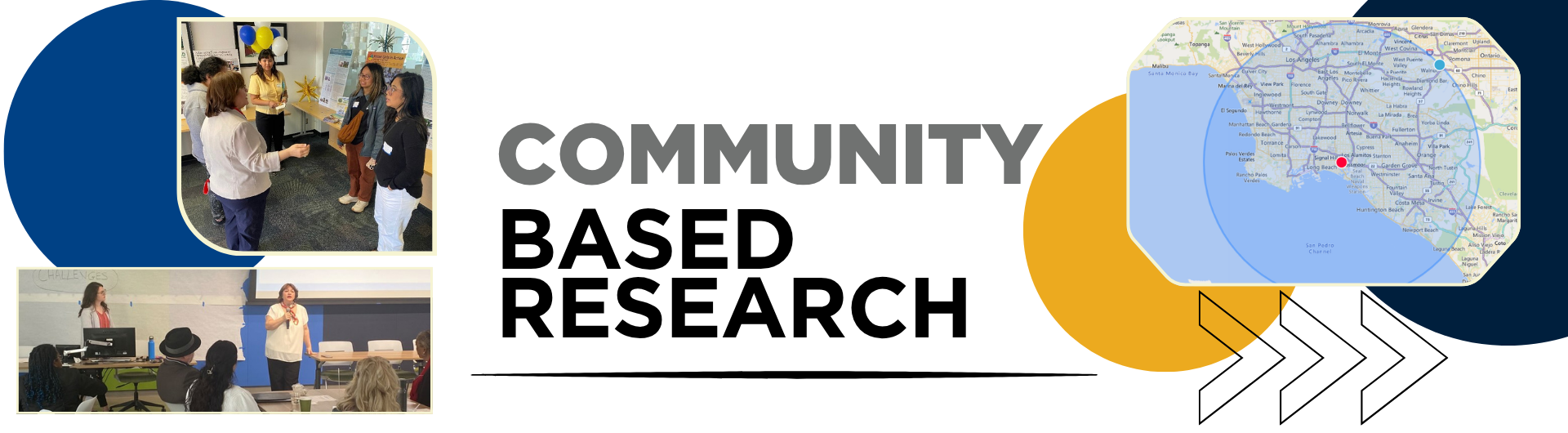
Community Based Research is a partnership approach to research that equally engages the university and community organizations. Each participant contributes their expertise, with shared responsibility and ownership, to integrate the knowledge gained with actions to improve the well-being of the community. (Israel, Schulz, Parker, and Becker, 1998).
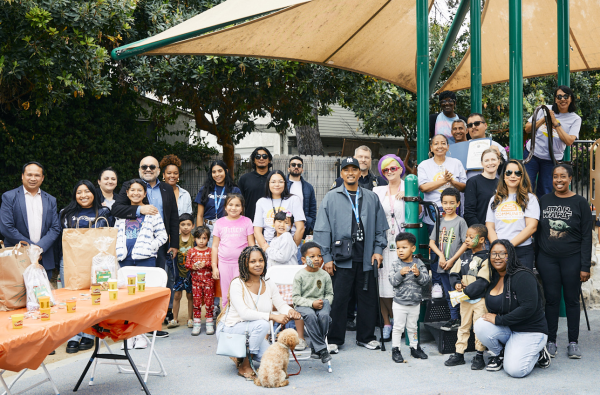
Our center defines “community partners” as on- and off- campus organizations formally collaborating with the CCE; providing service learning, academic internship, and/or community-based research opportunities for CSULB students. All partners have (or are in the process of securing) Student Field Placement Agreements (SFPA) in accordance with university policies guiding the formalization of partnerships (PS 19-13: Policy on Service Learning and PS 24-21 Policy on Academic Internships, (non-clinical, non-licensure).
Community partners may include non-profits, grass-roots organizations, government or educational institutions, and local businesses that provide formal, hands-on, experiential learning and research experiences for students. These partners offer structured opportunities for students to: engage in meaningful service, develop personal and professional skills, contribute to the public good, and participate in High Impact Practices. The purpose of these formalized partnerships is to integrate classroom knowledge with community experiences centered around mutual needs and assets, civic responsibility, social justice, and the public good.
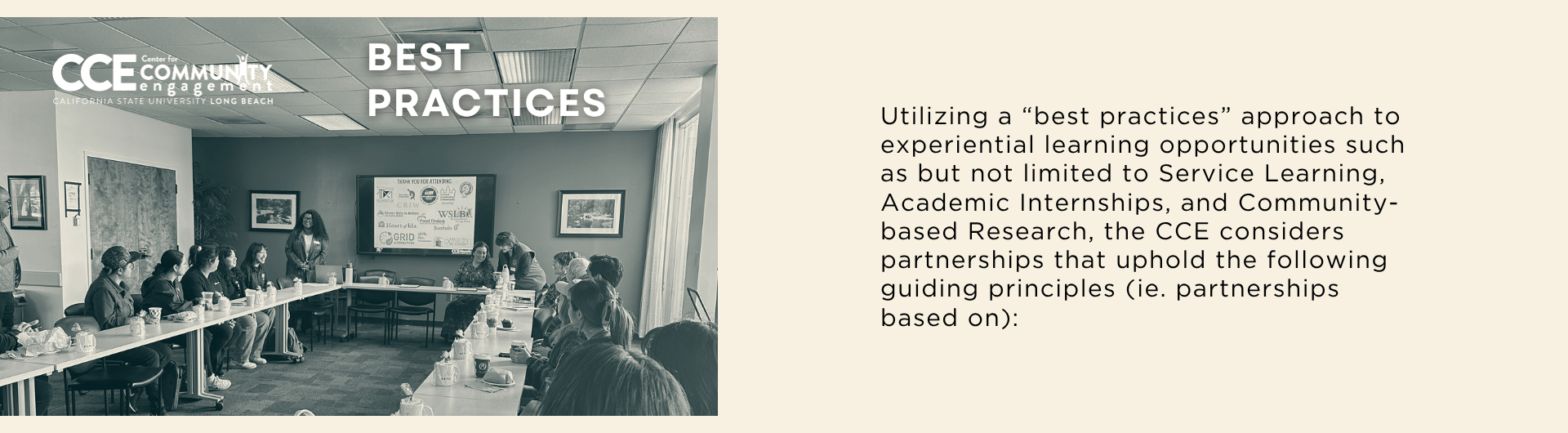
Our approach to curating, establishing, sustaining, and strengthening community partnerships is based on a set of values focused on reciprocity, mutuality, authentic collaboration and community engagement. This includes active involvement in addressing community needs through an asset-based, community-centered vision and mutual understanding around collective impact, student success and the public good.
High Impact educational teaching and learning Practices (HIPs) are anchored in deep learning and student engagement, and have a positive impact on students success indicators;
Assets- and strengths- based approaches recognize community partners as allies and co-educators in communities with a wealth of knowledge, gifts, talents, expertise and resources, and recognize that higher education is not the only place of teaching, learning and/or enlightenment;
Multi-stakeholder, participatory and action-oriented design and approaches are based on mutually identified needs and issues, and an understanding that those most affected by decision making should be a part of the decision-making processes as key stakeholders;
An emphasis on mutual benefits, reciprocity, and respect in relationships between students, community members/partners and the university and the community at large; promoting authentic collaboration and a commitment to upholding shared visions/goals, partnership norms, agreements, and agendas;
Critical thinking leading to praxis (reflective action) about experiences that deepen understanding and identify personal and professional growth areas as well as recognizing individuals’ own social location, perspectives, backgrounds, privilege, in the community and organizational context of power and hierarchical dynamics;
A commitment to the public good and preparing students for responsible civic participation, experiential learning and research that makes significant contributions to addressing community and regional problems while planning for future needs of our region, nation and the world simultaneously dismantling systems that limit full access and inclusion;
Small business and community development efforts with businesses and companies that focus on responsible economic development, sustainability, and social enterprises that fund, implement and/or support solutions to social, cultural and/or environmental issues.
To uphold our values of mutuality and advancing the public good, the CCE has hosted multiple community convening's since 2023 to engage in discussion, reflection, and action-planning to address local need. The summary reports provide a glace at community partner insights and ideas to strengthen campus-community partnerships, identify research priorities, and highlight opportunities for deeper learning. Furthermore, the yearly reports of the Service Learning and Academic Internship programs reflect the impact of campus-community partnerships in both our communities and the lives of CSULB students.
We deeply value our local community partners who represented their respective organizations and communities while sharing their policy insights with our campus community at large during these sessions. Find out more about our Partnership Development Cycle and Center for Community Engagement (CCE) Community Partner Inventory to understand who our partnerships are and how they're rooted in high-impact Practices
Select the report cover to review the summary report
February 2023
On February 10, 2023, the Center for Community Engagement hosted the 2023 CCE Community Partner Convening to advance campus-community partnerships. The event focused on creating new opportunities, expanding existing partnerships, and leveraging resources for mutual needs.
Report Highlights:
- Representatives from 27 community partners shared insights on service learning, academic internships, and community-based research.
- The convening introduced a new Academic Internships Office.
- The day involved engagement, reflection, and action-planning to address local needs and align with CSULB priorities. Opening and closing remarks were given by Mayor Rex Richardson, President Jane C. Conoley, and Provost Karyn Scissum Gunn.
- The summary report provides an overview of community partner insights and ideas to strengthen campus-community partnerships.
May 2023
The CSULB Center for Community Engagement (CCE) organized a community partner convening on May 19, 2023, focusing on community-based research opportunities as part of an ongoing effort to enhance campus-community partnerships for the Public Good.
Report Highlights:
- The event included a half-day training on community-based research and discussions on key research areas and identified needs from the previous convening on February 10, 2023.
- Fifteen community partners, who were also part of the first convening, participated in this event, allowing for continued exploration of research priorities and opportunities for collaboration between the community and CSULB stakeholders.
- The summary report outlines information shared during the convening, including research priorities, needs, and ideas from community partners.
September 2023
Community Leaders from six, local community organizations participated in, “The State of Community Policy Advocacy & Organizing in Long Beach”... policy convening. The purpose of the panel discussion was to identify concrete ways for our campus community to be more involved in local policy work, and to strengthen our partnerships with local community-based organizations.
Report Highlights:
- Community leaders from Long Beach Forward, KGA, Sunrise Long Beach, ORALE, CFJ, and LIBRE shared critical aspects of the work their respective organizations are advancing and highlighted key examples of opportunities for CSULB students, faculty, and staff to be directly involved in these efforts (e.g. community-based action and participatory research as well as community-based learning opportunities like Services Learning and Academic Internships).
- Those in attendance took away concrete examples of how our campus community can become more involved in positively impacting our surrounding communities. We greatly appreciated local community leaders representing their respective organizations and communities, and sharing their policy insights with our campus community at large.