Jan Groover

Untitled, 1986
toned gelatin silver print
10 x 8 in. (25.4 x 20.32 cm)
NEA Purchase
© Jan Groover
Jan Groover (American, b. 1943)
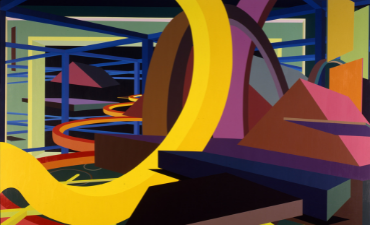
In 1988, photographers Jan Groover, Lee Friedlander, and Robert Cumming were commissioned by the Massachusetts Institute of Technology Committee on the Visual Arts to create their own visions of the scientific process, resulting in the University Art Museum exhibition Three on Technology (October 18 to December 11, 1988). The three artists examined new technologies that can no longer be fully described in the classic manner of photographer Charles Sheeler’s paean to gears, rods, and wheels, or Margaret Bourke-White’s grand monoliths of cement and steel, but instead reference chemistry and computer chips. Untitled, purchased by the Museum with support from the National Endowment for the Arts, is from Groover’s series of formalist images featuring the detritus of the laboratory: crucibles, wood blocks, metal slabs, and glass tubes. Working in her studio, using carefully arranged set-ups, Groover produced images that have the intimate quality of 17th-century Dutch still lifes, while still addressing contemporary means of developing new pictorial relationships. In addition to referring to current scientific procedures, Groover’s dramatic lighting, rich textures, and collage-like compositions are reminiscent of the work of László Moholy-Nagy and Man Ray, who responded in their photography to the early 20th-century excitement about what were then the “new” technologies.
Jan Groover trained as a painter at the Pratt Institute, Brooklyn, NY, graduating with a BFA in 1965. She then studied for an MA in Art Education at Ohio State University, graduating in 1970. In the early 1970s she began to take photographs, publishing a book in 1973 that included triptychs taken from a fixed point, showing vehicles traveling across the landscape. In the same year she moved to New York, where she continued to make photographic diptychs and triptychs of urban environments, emphasizing the formal composition. In 1976–7 she made a series of over 100 triptychs of the suburban landscape of New Jersey, where she had grown up. It was in the late 1970s that Groover achieved commercial success with her still-life compositions of kitchen objects. These images focused on the elegance of the objects, abstracting their functional quality and highlighting the interplay of shapes and light. The domestic still-life remained a dominant strand in Groover’s practice throughout the 1980s, alongside further experimentation in the type of film and camera used. In the late 1980s her compositions became more obviously artificial: the picture plane was flattened by the use of colored filters and the prints were retouched with paint, as in Untitled (1988; New York, MOMA). In the early 1990s she moved to France, where the style of her still-lifes and landscapes returned to the more relaxed compositions of her earlier work.