
O-PATSM: A Self-Management System
The Heart of Managing Your Time and Yourself
Tom G. Stevens PhDPsychologist/Professor Emeritus, California State University, Long Beach
Send Feedback/Questions to: Tom.Stevens@csulb.edu
You Can Choose To Be Happy:
Site dedicated to enhancing human happiness, self-development, and success
SITE MAP: All free Self-help resources includes online book, You Can Choose To Be Happy, and SHAQ

|
|||
| search engine by freefind |
O-PATSM:
A Self-Management System
The heart of managing your time and yourself
Note: This is the original step-by-step guide of the O-PATSM system--used by thousands of people. You may find an updated, version of OPATSM that includes special sections on other related self-management and achievement sections in Chapter 9 of my book, You Can Choose To Be Happy (free on this website--click here). For a download copy of the entire book (free), go to: www.csulb.edu/~tstevens/my-peek.htm
INDEX
1. INTRODUCTION to good TIME-MANAGEMENT
2. First, set personal OBJECTIVES
3. PATSM-Overview of weekly
time-management system
4. SUMMARY OF ACTIONS to get started
using the O-PATSM system
5. A 2-dimensional TO-DO LIST:
A MUST FOR STUDENTS
WHO IS THIS SYSTEM FOR?
- Do you ever feel under too much pressure with too many things to do?
- Do you feel that you are under stress too much of the time?
- Do you ever feel disorganized?
- Do you sometimes feel that your life is "out of control"?
- Do you sometimes sense a lack of direction or uncertainty about goals?
- Do you have goals, but feel ineffective about meeting them?
- Do you feel guilty about procrastination or ineffectiveness?
- Have you tried a time-management system that is only partially effective?
OBJECTIVES OF THIS MANUAL
- ACCOMPLISH MORE, BE MORE RELAXED, AND HAVE MORE FUN
- Learn O-PATSM self-management system. This is a system which has been used by several thousand people. Feedback on the system's usefulness has been very positive.
- Get control of your own time and life by filling the GAP BETWEEN your VALUES/GOALS and MOMENT-TO-MOMENT ACTIONS with WRITTEN OBJECTIVES AND "TO DO"s which keep accountable to yourself. You will no longer forget or loose sight of your goals and direction if you use the O-PATSM SYSTEM.
- Do more of the things that are REALLY IMPORTANT TO YOU
- BE MORE RELAXED--REDUCE STRESS. Good time management of all of the important conflicting demands in one's life is one of the most effective ways of reducing stress from too many conflicting demands.
- Not spend too much time on PATSM itself. Not become "overorganized" or too compulsive about list-making.
OUR RESEARCH ON LIFE SKILLS AND PERSONAL EFFECTIVENESS
We have been conducting research on several thousand people relating life skills such as various cognitive, self-management, and interpersonal skills to success criteria such as success in college, success in career, success in interpersonal relationships, and personal happiness.
Among our many findings showing how these life skills relate to life success are findings showing a STRONG RELATIONSHIP BETWEEN EFFECTIVE TIME MANAGEMENT BEHAVIORS AND OVERALL PERSONAL HAPPINESS.
ALTERNATIVES TO GOOD SELF-MANAGEMENT
* EXTERNALLY CONTROLLED.
Allowing all the pressures from others, demanding tasks, and routine things to do
in your life, dictate what you do.
* AVOIDANCE BEHAVIOR and PROCRASTINATION.
Avoiding the really important things in life because they are unpleasant or
overwhelming; or because you don't know how to do them.
* POOR SELF-MANAGEMENT
METHODS. Keeping "to do" lists that are not prioritized, that you lose, that
don't include the personal or fun things, not writing objectives, or not using your
lists well are examples of incomplete methods which will not work! Compulsive overplanning
with too much detail--requiring too much time--also may not work at all.
Return to INDEX
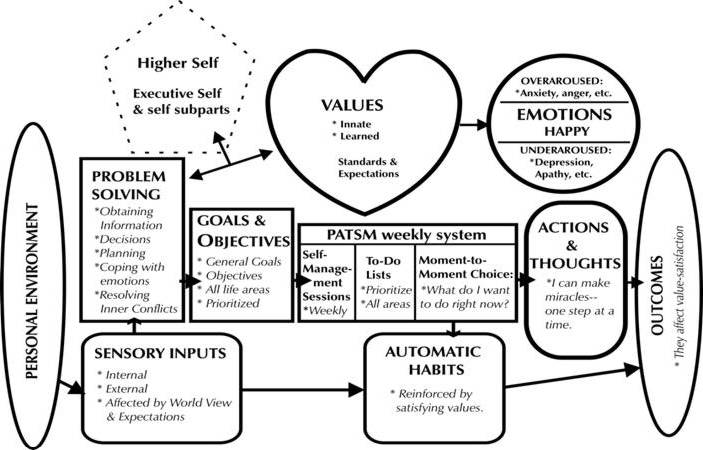
Do you ever wonder WHY you are not quite as happy or successful as you might like to be? There are many reasons of course, but perhaps some simple psychological principles will help you understand more about some of the underlying causes. Refer to figure 1 as you read the following.
THE VALUES-EMOTIONS LINK
THE DEGREE OF YOUR HAPPINESS IS DIRECTLY DETERMINED BY THE DEGREE OF SATISFACTION OF YOUR VALUES. This is one of the most important principles to remember. It is both actual satisfaction of values and ANTICIPATED satisfaction that is important.
* VALUES ARE:
Some are directly related to basic biological needs such as needs for water, food, activity, stimulation, sex, warmth, and air. All values have a strong learning or conditioning component.
Previous positive and negative conditioning has a strong effect on how positive you feel about something now. For example a liking or disliking of math may be a direct result of positive and negative experiences with math.
Maslow's famous hierarchy of values shows how once people satisfy more basic values they tend to seek "higher" values. Persons may have great individual differences in values due to very different learning histories. Return to INDEX
* EMOTIONS & SELF-CONFIDENCE
Include positive ones such as happiness, joy, love, relaxation and negative ones such as unhappiness/depression, anxiety/stress/fear/guilt, and anger/frustration/resentment.
ANTICIPATION OF INTERNAL CONTROL OVER VALUES SATISFACTION is a key factor in determining emotions and SELF-CONFIDENCE.
Use of a good self-management system such as O-PATSM can increase your self-confidence or self-esteem on a number of ways due to INCREASED CONTROL OVER VALUES SATISFACTION which it brings. When you write objectives you will have a greater confidence that you will truly accomplish what you want and SPEND MORE OF YOUR TIME DOING WHAT YOU REALLY WANT.
AUTOMATIC HABITS ARE USEFUL BUT MAY PREVENT INCREASED HAPPINESS
* AUTOMATIC HABITS are learned sets of thoughts & behaviors for satisfying goals & values.
* HABITS MAY BE COMPLEX. A tennis serve, problem-solving methods, playing the piano, driving, a social interaction habit are examples of complex learned automatic habits.
* HABITS ARE USUALLY AUTOMATIC. We do them "unconscious" of why or when or how
we do them. This is useful, but one of the dangers of habits. There may be actions
which would make us happier; however, alternative actions might make us happier!
Therefore fail to actualize our potential success and happiness.
Return to INDEX
THE O-PATSM SYSTEM BRIDGES THE GAP BETWEEN VALUES AND ACTIONS
- The haphazard and unconscious connection between values and actions leaves a self-management gap for most people.
- In O-PATSM conscious thought and written lists bridge that gap.
- In O-PATSM there is follow-up and self-feedback to keep on track, avoid forgetting, and grow.
1) MAKING A VALUES CHECKLIST
2) WRITING GENERAL GOALS
3) WRITING A LIST
OF 6-MONTH PERSONAL OBJECTIVES (The "O"), AND
4) USING
P = PRIORITIZED,
A = ALL AREAS of life
T = TO DO (or task) lists.
S = SELF-MANAGEMENT SESSIONS weekly for
about 1 hour.
M = MOMENT-TO-MOMENT
USE of these lists to guide actions.
CAN BRIDGE THE VALUES-ACTION GAP,
and help you ACCOMPLISH MORE, HAVE MORE FUN, AND ENJOY LIFE MORE!
USEFUL PERSONAL OBJECTIVES ARE:
- SPECIFIC & CLEAR
- INCLUDE QUANTITATIVE FACTORS -- when, how often, how long, how much, etc.
- INCLUDE PRIORITIES
- COVER ALL LIFE AREAS -- CAREER, PEOPLE, RECREATION, HEALTH, GROWTH, FINANCIAL, ETC.
- INCLUDE KEY CURRENT ACTIVITIES AS WELL AS PLANNED NEW ONES
- INCLUDE A PROPOSED WEEKLY SCHEDULE
- FOR A DEFINITE TIME PERIOD SUCH AS 6-MONTHS OR A SEMESTER (I do one each for Fall, Spring, and Summer)
- WRITTEN IN A LIST THAT
2- is in the form of an outline-list. More general goals are the main items, with more specific objectives or to-do's forming the sublists.
3- has areas for expansion and notes -- including comments on results.
4- includes priorities for each item written to the left side.
OBJECTIVES STEP 1: SELF-EXPLORATION AND DECISION-MAKING
1) Begin to think about them and even take notes weeks in advance.
2) Review your VALUES CHECKLIST and your feelings to see how things are going
and especially what you need more and less of in your life. If you have not done
so, find times to do VALUES CLARIFICATION EXERCISES.
3) Review your last set of personal objectives and write notes on how well you accomplished those objectives. Include objectives of things which came up during the last 6-months which you did that were important, but which you may have forgotten to write down.
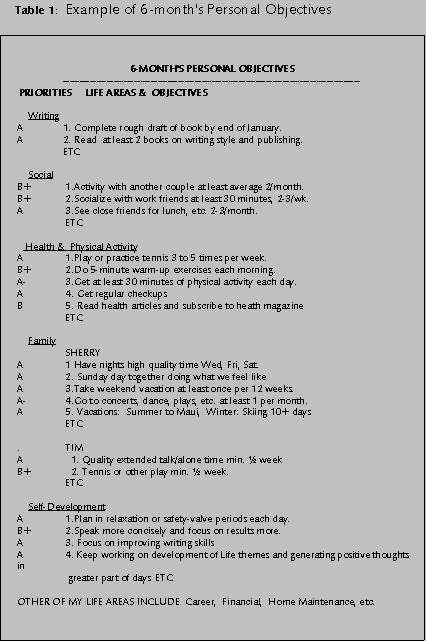
OBJECTIVES STEP 2: WRITING THE OBJECTIVES (SEE FIGURE 2 for example.)
1) Make a list of YOUR KEY LIFE AREAS. These may include areas such as:
- CAREER, you may also have a number of subareas here including both private and public objectives. You may want to use the public ones in your job.
- PEOPLE, including FAMILY, FRIENDS, COWORKERS/NETWORKING, etc.
- RECREATION and TRAVEL, including all your interests in entertainment, hobbies, etc.
- HEALTH and PHYSICAL ACTIVITIES
- SELF-DEVELOPMENT, habits or aspects of yourself to improve.
- FINANCIAL, overall budgeting guides or financial goals.
- ORGANIZATIONS, if you are involved in one or more of them.
- SPECIAL PROJECTS you are planning or currently involved in.
- PHYSICAL FACILITIES, important activities or objectives related to your home, car, or other material aspects of your life.
3) When you have written all your initial objectives, then review them and set priorities according to the system explained below under "priorities".
TYPICAL WEEK SCHEDULE--Make in coordination with Personal Objectives:
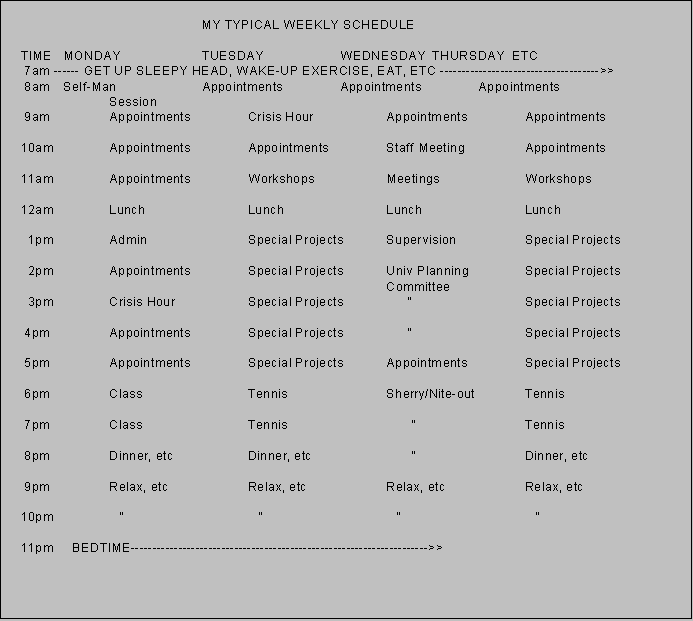
OBJECTIVES STEP 3: WRITING A PROPOSED WEEKLY SCHEDULE (SEE FIGURE above)
1) Make a form with all the days of the week and hours of your day.
2) Include
work, classes, study times, proposed activities, "flexible" time to do chores or
just relax, time to "do nothing", "going out" time, "family" or "friends" time,
commuting time, eating and other self-maintenance time.
3) INCLUDE ONE HOUR
PER WEEK FOR YOUR SELF-MANAGEMENT SESSION--(see below under the PATSM part). It
should be a regular "sacred" time--perhaps in a pleasant place. Monday morning,
during regular work - planning times, a lunchtime, a break between classes, etc.
might be good.
4) Using your objectives as a guide, try to sketch out what a
typical or average week would be like if you were to meet these objectives. If your
objectives say to "Play racquetball 5 times/week", but you can't fit them into your
schedule, then you must modify your objectives. Thus your proposed schedule also
serves as a REALITY CHECK on your objectives and your use of time.
NOTE: In the O-PATSM system, it is NOT necessary to make schedules each week if the "Proposed Weekly Schedule" works for you. This can save a lot of time in schedule making and is more flexible than some other systems. Try whichever way seems to work best for you. However, in the O-PATSM system it is necessary to make weekly to-do lists.
OBJECTIVES STEP 4: USE YOUR PERSONAL OBJECTIVES IN YOUR WEEKLY SELF-MANAGEMENT SESSIONS AS FOR DIRECTION TO PLANNING "TO-DO's
A number of factors lead me to develop the O-PATSM system
* After reviewing a great deal of psychological research and theory in the areas of self-management and motivation, I was very impressed with the power of setting specific goals and organizing those goals. It seemed that much of successful human motivation could be accounted for by factors related to setting specific goals which were consistent with one's true values.
* I read a book entitled, "How to Get Control of Your Time and Your LIfe" by Alan Lakein. I recommend it, and borrowed his use of using an "A, B, C" system. It's interesting that Lakein became interested in this topic after asking top executives in large corporations what their "secret of success" was. He thought it very odd that a frequent reply was to keep a prioritized to-do list and cross off completed items daily.
* The first group of students I tried this with was having trouble motivating themselves and was scheduled to meet weekly. After teaching them the system, I told them to keep coming to meetings only if they needed to. I asked them all to come back in 8 weeks for a follow up session. Well, the next week only one came, and after that no one. I thought the group a failure, but 8 weeks later all returned and told me what a success the system had been. I was amazed--even the "hang loose" surfer who complained of no self-discipline at all had done very well. Since that time many students, professionals, and even my colleagues have told me how O-PATSM has changed their lives.
* I believe that the O-PATSM system has made a tremendous difference in my own life. I especially notice that on weeks when I neglect utilizing the system as well or miss a self-management session, I feel less organized, get less done, have less fun, and usually feel more pressure and guilt. On those weeks, which are more rare now, I often cause some "disaster" due to forgetting something important.
REMEMBER, O-PATSM IS AN ACRONYM TO HELP YOU REMEMBER THE KEY PARTS OF THIS SELF-MANAGEMENT SYSTEM:
- O = OBJECTIVES
- P = PRIORITIES
- A = ALL AREAS of life
- T = TO-DO lists
- S = SELF-MANAGEMENT SESSIONS
- M =MOMENT-TO-MOMENT use of the system
Now let's look at the five letters which represent key aspects of this self-management system. Each letter has a set of guidelines which go with it. It is important that you learn these guidelines, since you may never read this again and SUCH SIMPLE HABITS CAN HAVE SUCH AN IMPORTANT EFFECT ON YOUR LIFE! Return to INDEX
* YOU HAVE A LIMITED AMOUNT OF TIME AND RESOURCES. Life has more possibilities for achievement and satisfaction than any one person can possibly take advantage of. There are also more external and internal requests, demands, pressures than we can ever meet. The secret to happiness is to use your limited time, energy, and resources in ways which maximize the chances of meeting your values. (Note: this is not "selfish". Values include both self-oriented and other-oriented values.)
1. I prioritize all activities A, B, or C. (May include A+, A-, etc or A1, A2, etc)
2. I recognize that A's provide the most satisfaction of my values over time.
That is the definition of an "A".
(It is necessary to balance immediate vs.
long-range values and self- vs. other-oriented values.)
3. I spend as MUCH TIME ON THE A's and as LITTLE TIME ON THE C's as possible, because I recognize I can't do everything. (One of my life goals is to spend as high a percentage of my time as possible on high A activities. If you can't abe productive or have fun, then why do it? I also apply the same rule to the use of my other resources such as my energy and my money.)
4. I do A's AS WELL AS POSSIBLE, and the C's AS QUICKLY AS POSSIBLE--or not at
all--or delegate them.
(A high A activity or goal is worth the resources required
to do it at a high level of quality, a C activity is not. People who are compulsive,
over-perfectionists, are ineffective because they waste so much time on the C's.
People who are sloppy are ineffective because they do their A's poorly. The ideal
is to be a perfectionist on the highest A's and "quick and dirty" on the C's.)
5. I discriminate between MY TRUE PRIORITIES and OTHERS' PRIORITIES for me. I
act accordingly.
(This is a difficult issue about balancing your own values
against the requests, demands, and needs of others whom you may care a great deal
about. ASSERTIVENESS is just this ability to pursue your own values actively--even
in the fact of opposition, ridicule, or threats. Yet assertiveness is also caring
about others and their values and needs. It is listening to them and showing consideration
for their values and needs. But then these become part YOUR VALUES and must be weighed
against your other values.)
6. I SPEND ONE HOUR EACH WEEK planning how to spend the other 112 waking hours. (This is the best investment I can make of my time, because it determines how effective and happy I will be with the other 111 hours. Just a 1% increase in effectiveness and happiness more than pays back that one hour.)
If you want satisfaction of values and goals in all life areas you must actively set goals and plan in all life areas
* Not actively planning time-use in all life areas is the biggest single problem that many persons have. They tend to get their life "out of balance" meeting some important values and needs at too great an expense to other values. It often is at the root of why a person can appear to be successful and yet be unhappy. The problem is often not lack of time, but lack of conscious attention and good planning.
* A feeling of LACK OF CONTROL, ANXIETY, AND DEPRESSION in one's life often stems
from lack of effective good time-management in all life areas. One of my clients
who was seeing me after several suicide attempts for chronic depression came back
to see me several years later. She had gone on to lead a successful and reasonably
happy life. In response to my question about what had helped her the most, she really
surprised me when she said it was using the O-PATSM system. She said that it really
gave her a much greater sense of controlling her life, and that she was able to
partially overcome her tremendous dependence upon others by using it.
Return to INDEX
1. Go over the list of life areas included in the section on writing personal objectives and MAKE YOUR OWN LIFE AREA LIST.
2. Whenever you write objectives; write your weekly to-do's; or just explore yourself, your past, or your future, SYSTEMATICALLY CHECK EACH AREA of your life.
3. When you notice that you have special values or value-areas which are NOT
BEING ADEQUATELY MET or attended to, make a SEPARATE SECTION in your objectives
for objectives just related to meeting those values. Also, be sure that EACH WEEK
you write to-do's and check them off in that area.
Return to
INDEX
A well-known fact among psychologists is that humans can actively attend to only 1-5 items at once. In addition they can only really focus well on one goal at a time. Many of the stupid and forgetful things that we get so angry at ourselves about are caused by this limitation. We may go to the store to get some toilet paper, but return home with everything but toilet paper.
The reason is that we were "distracted" while in the store. In other words we focused on something else and replaced the conscious goal of "buying toilet paper" with a new goal. Since replaced goals do not automatically come back into attention, we "forgot" the toilet paper.
Our whole life is filled with competing goals and to-dos. Why waste our energy
and worry forgetting and depend on an attention system built-in to our bodies which
was not designed to meet the complexities of modern society? We need a system for
organizing our goals and to-do's which will serve as a PERFECT MEMORY, which is
WELL ORGANIZED, which is WITH US AT ALL TIMES, and which is IMMEDIATELY AVAILABLE.
Return to INDEX
(A simple rule of thumb is that if you can not get at the actual page with your to-dos on it within 3-4 seconds, you will rarely use your to-do list when you need it. Lists kept on the desk, on the kitchen calendar, buried in a purse or briefcase, lists mixed in with other papers simply don't work well. They are either inaccessible or lost.
Other characteristics of good to-do books include:
- Open 2 pages which contain the entire week. For most people this works better than pages which contain a month or only one day.
- Some additional pages for other purposes, or the ability to add pages as you like. Separate telephone or expense sections can be useful. Keeping your shopping list or other subordinate lists on added pages can be helpful.
2. Keep ONE MASTER TO-DO LIST.
(Some people have all sorts of lists
in all sorts of places, instead keep one list in your to-do book. If you need "subordinate"
lists, that's ok, but refer to them in your master list. For example, your master
list in your to-do book might say "buy groceries". The subordinate list, sublist,
is the grocery list you take with you to shop from.
TIP: IDEAS LISTS are sublists which I find very useful. Whenever I get an idea for a project, paper, or am working on a long-term problem , I make an ideas list. Whenever I get a related idea, I write it on the idea list for that project with a reference where I got it.)
3. EFFECTIVELY ORGANIZE YOUR SPACE WITHIN THE 2 PAGES FOR THE WEEK BY KEEPING SEVERAL LISTS--Weekly lists, daily lists, phone calls, errands, meetings, work lists, personal lists.
(Within the space for organizing your week, it is helpful to keep multiple lists.
It saves time to organize those lists so that when you are in one setting or have
one type of purpose in mind, you can look at the right short list instead of having
to look through all of that space. For example, grouping your phone calls together
can save time when you sit down and start making a series of phone calls.
Return to INDEX
TYPES OF LISTS: Following are some possible categories for DIFFERENT LISTS to keep within each TO-BOOK WEEK OR SECTION. You will probably have to RE-DRAW the to-do book lines. (SEE To-Do book figure for example)
FOR EACH LIST, GROUP THE "A" TO-DO ITEMS AT THE TOP, THEN THE "B" items, THEN
THE C'S (If you write the C's down at all).
- DAILY TO-DO LISTS. These are items from ANY CATEGORY OF TO-DOS which HAVE TO BE DONE ON A PARTICULAR DAY or at a particular time. This includes appointments, reviewing for a test the next day, making a phone call that needs to be made on that day, etc.
- WEEKLY CAREER-RELATED LISTS. These are career - or job - related to-do's that DO NOT HAVE TO BE DONE ON ANY PARTICULAR DAY. It is possible to have sublists there too.
- WEEKLY PERSONAL LIST. This is all of the items you plan to do when you are not in your job setting. Keep it in a different column from your career list.
- PHONE CALLS. Don't forget to put the priority beside each item on this list and write the A's near the top.
- ERRANDS. just make a list of where you want to go. Generally use sublists when you need many items.
- MEETINGS OR PEOPLE. For significant people or meetings in your life try putting a circle around their name and putting it in a bottom corner of one of the pages facing you. Then write agenda items you want to be sure and discuss with them. Review the list before and during the meeting.
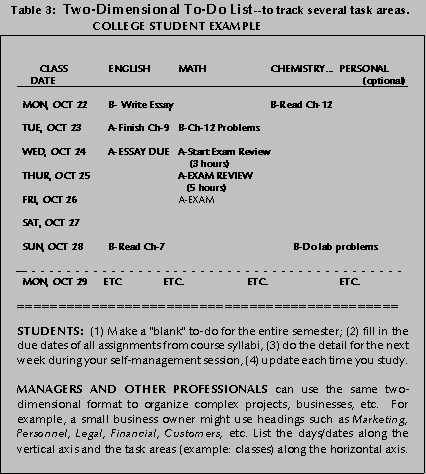
NOTE: AN ALTERNATIVE "TWO-DIMENSIONAL TASK LIST" METHOD FOR KEEPING TO-DO LISTS IS SHOWN IN APPENDIX A. STUDY THIS APPROACH. IT IS ESPECIALLY ADVISED THAT STUDENTS USE THIS METHOD FOR TRACKING THEIR CLASS ASSIGNMENTS. Others who have complex task management chores such as executives or engineers might also use this system for tracking special projects or their business.
( TIP: many people find it helpful to have a short self-management session each
day to take items from their "weekly list" and put them on their daily list.)
Return to INDEX
SAMPLE TO-DO BOOK--One week at
a glance. My own To-Do book for one week:
Note: If book
is not in a large image, right button click on it and chick on full image.
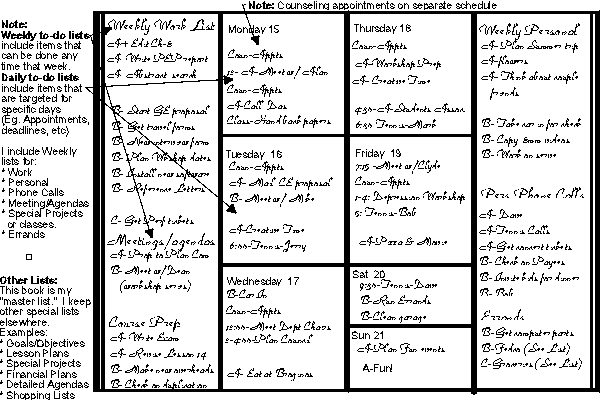
NOTE: I have replaced my To-Do book
with a personal electronic device that includes a phone, calendar, task-list, address
book, etc. I have adapted this system to use with this device. It has
the added advantages of having alarms for reminders (important!), the ability to
back it up, ability to coordinate with my MS Outlook computer program, and other
features.
SELF-MANAGEMENT SESSIONS ARE YOUR MOST IMPORTANT ACTIVITY EACH WEEK
ESSENTIAL CHARACTERISTICS OF GOOD SELF-MANAGEMENT
SESSIONS
1. HOLD THEM AT A REGULAR TIME EACH WEEK--AND KEEP THAT TIME SACRED.
(Without the regular self-management session the O-PATSM SYSTEM WILL NOT WORK
RIGHT. Just keeping lists without a regular session does not work well, because
you will loose perspective of your overall values, goals, and 6-months objectives.
It is these bigger values and goals which provide the direction and clarity about
what your priorities are on a weekly basis.
Not holding weekly self-management sessions and consulting your objectives will make you more subject to control from immediate daily outside pressures competing for your attention and time.
Remember, that a 1% increase in your overall happiness and productivity will more than repay you for the hour your spend in your self-management session. Also, most professionals and many others can justify work time for their session, since much of their planning does directly relate to their jobs.)
2. Find a PLEASANT and DISTRACTION FREE PLACE.
(Remember, that facing
all of the things you need to do each week can be anxiety producing for many. Try
to make the session AS REWARDING AS YOU CAN so that you LOOK FORWARD TO IT EACH
WEEK. One way is to hold it in a place that is CONVENIENT and that you look forward
to being in. I often hold mine in a park-like setting on the way to work.)
3. Find a TIME WHICH FITS WELL INTO YOUR SCHEDULE AND WRITE IT IN YOUR TO-DO
BOOK AND ON YOUR PROPOSED WEEKLY SCHEDULE.
(Most people prefer times early
or late in the week to plan for the coming week. Finding a place BETWEEN other activities
which are very regular in your schedule is a very good idea. Examples include between
classes, on a lunch hour, and at 8:00 am before meetings start. DO NOT SCHEDULE
THEM WHEN THERE MAY BE COMPETING ACTIVITIES OR YOU MAY BE TOO TIRED. Examples of
bad times are before bed, on a weekend day, or on a lunch hour when you may frequently
go to lunch with friends.)
4. IMPORTANT ACTIVITIES FOR EACH WEEKLY SELF-MANAGEMENT SESSION.
Following is a step-by-step outline of a typical self-management session.
All of these elements should be in each session.
Return to INDEX
SM SESSION STEP 1: RELAX AND THINK POSITIVE THOUGHTS
SM SESSION STEP 2: SEARCHING ALL SOURCES OF TO-DO'S AND LISTING PRIORITIZED TO-DO'S.
For EACH ITEM THAT YOU ARE ABOUT TO WRITE ON YOUR TO-DO LIST:
1. Decide specifically what it is you want to do.
2. Decide which week, day,
and/or sublist it goes on.
3. Decide on it's priority (A, B, C, or A+, B, etc.)?
4. Write it down in the right place with a PRIORITY TO THE LEFT. (Remember to
group higher priority items near top of lists.)
SEARCH EACH OF THE FOLLOWING SOURCES OF TO-DO ITEMS:
1. REVIEW YOUR PAST WEEK'S TO-DO LISTS. Go over the last week's pages and cross off those items which you completed. Study briefly the ones which you did not complete and decide whether you want to rewrite them for some other week or eliminate them altogether. One idea for items you know that are important but can't get to this week is to just turn over a few pages and write them several weeks ahead.
As you cross off the incomplete items do it with a different type of mark so that you can later tell the items that were done from those that weren't.
Do not be distressed about items you are NOT COMPLETING. FOCUS ON POSITIVE ACCOMPLISHMENTS. Remember, that anyone can complete all the items on their list each week. All they have to do is make short lists with easy items. An active, involved person will usually find his/herself rewriting a number of items. The important thing to ask yourself is whether or not you are DOING THE HIGHEST PRIORITY ITEMS FIRST! Then putting off the less important items is NOT PROCRASTINATION, BUT GOOD TIME MANAGEMENT.
2. REVIEW YOUR PERSONAL OBJECTIVES LIST. (Go over your list of personal objectives. This ties the O- to the PATSM in the system. It is essential for filling that VALUES & GOALS--ACTION GAP discussed earlier. This is what gives you control over the direction of your own life instead of being so influenced by all of the outside pressures, demands, and other forces in your daily environment.
On bigger goals and projects which are listed in your objectives, try DOING SMALL STEPS REGULARLY EACH WEEK. Working one step at a time can help you achieve goals you never really thought you could do.
Use your sessions to also MODIFY YOUR OBJECTIVES AS NEEDED. You may add objectives,
modify them, remove them, or change their priorities.
Return
to INDEX
3. REVIEW OBVIOUS AND EXTERNALLY IMPOSED TO-DOS. There are usually external sources of to-dos which you may be consulting in planning your week. A chart listing the major goals of a big project, appointments scheduled by your receptionist, your class syllabus, etc. are examples.
4. SELF-EXPLORATION AND PROBLEM-SOLVING. It is good to have time just to TUNE IN TO YOURSELF AND YOUR FEELINGS at least once a week. Ask yourself how you have been feeling during the past week and how you feel about yourself in relation to your personal values, goals, and objectives.
This is a time when you can think about personal issues or make decisions about plans for the future. When you have come to some conclusions, WRITE THEM DOWN in the form of revised objectives of specific to-dos that can make a difference in your life.
Tuning in to yourself regularly can help you clear up underlying "unconscious"
issues that keep you feeling bad. It can help you stay FEELING HAPPY, MOTIVATED,
and give you a SENSE OF CONTROL OVER YOUR LIFE.
Return to INDEX
SM SESSION STEP 3: SPECIAL PLANNING TO GET YOURSELF TO DO UNPLEASANT OR
OVERWHELMING TASKS THAT YOU MIGHT OTHERWISE AVOID DOING.
* BREAK OVERWHELMING TASKS INTO SMALL DO-ABLE STEPS AND DO THEM ONE STEP AT A
TIME.
(If you anticipate special problems because a task is OVERWHELMING--seems
too complex, large, and/or you don't know what to do next, try using the POSSI system
or breaking it into small steps with the help of someone who knows how to do it.
Try persons who have successfully done it before or try a good how-to-do-it book.)
* USE INCENTIVES OR OTHER MOTIVATIONAL TECHNIQUES TO GET YOURSELF TO DO UNPLEASANT
OR LOW-IMMEDIATE-REWARD TASKS.
(Try making a CONTRACT WITH YOURSELF such as
"When I finish reading those two chapters, then I can eat dinner." Or try using
"stimulus control" techniques such as putting yourself in a place where you are
AWAY FROM TEMPTATIONS to not do what you want and NEAR STIMULI or people which HELP
MAKE YOU WANT to do the task.)
SM SESSION STEP 4: END WITH A POSITIVE
FEELING--BEGIN THE NEXT WEEK WITH GUSTO!
* TUNE IN TO ALL OF THE
POSITIVE, YET REALISTIC OPTIMISM YOU CAN.
Return to INDEX
(Learn these well!)
1. KEEP YOUR TO-DO LIST WITHIN 3-5 SECONDS REACH AT ALL TIMES.
2. MAKE QUICK ADDITIONS IMMEDIATELY AS YOU THINK OF THEM.
(Your to-do book can serve as a perfect memory if you use it properly. Recall the discussion on your attention and memory limits earlier. You must WRITE TO-DOS DOWN IMMEDIATELY BEFORE YOUR ATTENTION LEAVES IT FOR ANOTHER TOPIC.)
3. CONSULT YOUR TO-DO LIST BEFORE EACH NEW ACTIVITY.
(Make a habit of this. This is essential if the system is to work. As a MINIMUM check the list at the beginning of the day, between major activities, before leaving your workplace, and at least once at night at home. Also, you must check it during the weekend.
I have found a tendency to not check it at home, because at home I don't want to have too much structure at times--I may just feel like relaxing. However, that is a serious error. Because, when I don't check it, I don't do some really high payoff things like arrange tennis matches, reserve restaurants, buy theater tickets, call friends, etc.)
4. DO HIGHER PRIORITY ITEMS FIRST.
(Little more should need to be
said about this. Doing "FIRST THINGS FIRST" is at the heart of leading a happy and
productive life.)
5. CROSS OFF COMPLETED ITEMS WITH GUSTO! FOCUS ON ACCOMPLISHMENTS, NOT WHAT WAS NOT DONE.
6. FOLLOW-UP ITEMS.
(If you need to "follow-up" on a to-do,
write it down later as a "FU" item. For example, if I loan someone a book, I ask
them when they will return it and write that "FU" item in my book during that week.)
7. SET ALARM.
(Your alarm watch can be your FINAL CUE reminding you
to do an important to-do.)
8. MOMENT-TO-MOMENT FREEDOM TO CHOOSE.
(You have freedom to choose
between items on the to-do list and cues from the immediate environment. Ask yourself
the most IMPORTANT QUESTION IN YOUR LIFE,
The satisfaction of our values--and thus our happiness--depends upon our ACTIONS. Since the only time we have any control over our own actions is in the present, WHAT WE ARE ABOUT TO DO IN THE NEXT MOMENT IS THE KEY TO CONTROLLING OUR LIFE AND HAPPINESS. Return to INDEX
We have freedom to choose between all of the cues in our immediate environment which are competing to influence our feelings, our thoughts, and our actions. But all of these represent only immediate situational factors.
Where are all of the values, goals, and desires that we think of only when we
are removed from this immediate situation and free to get more in tune with ourselves?
We must look in our to-do book to widen our choices within the immediate situation.
It may be that something which we would truly rather do has just come up, but CHECKING
OUR TO-DO BOOK FIRST GIVES US MORE FREEDOM TO CONTROL OUR LIFE.)
Return to INDEX
1. MAKE A LIST OF PERSONAL OBJECTIVES
- For each life area
- Make list of key objectives
- Prioritize them
- Make only one including all life area activities
- Use it to "reality test" your objectives and plan to do items on your objectives list.
4. SET A REGULAR TIME & PLACE FOR YOUR WEEKLY SELF-MANAGEMENT SESSIONS
- DAY & TIME:
- PLACE:
- Begin even if personal objectives are not complete
- Include items from each area of your life
- Prioritize ALL items
- Make the sessions as rewarding as possible--even reward yourself
I commit myself to the following: (check commitments)
___ 1. Availability (list with me at all times).
___ 2. Quick additions (add
items as I think of them).
___ 3. Consult list before each new activity (at
least 3 times per day).
___ 4. Generally do higher priority items first.
___ 5. Cross off items with GUSTO!
___ 6. Other (Specify):
1. Avoiding overwhelming or unpleasant to-do's and giving up using the system. Instead reward yourself for doing it or even give up the big to-do instead of the PATSM.
2. NOT USING THE SYSTEM REGULARLY--ESPECIALLY:
- NOT WRITING OBJECTIVES 2-3 TIMES/YEAR
- NOT KEEPING WEEKLY SELF-MANAGEMENT SESSIONS
- NOT PRIORITIZING ITEMS
- NOT WRITING DOWN ITEMS FROM ALL LIFE AREAS
3. ALSO:
- Don't write down too much.
- Don't waste time looking for "deeper" causes of your problems at the expense of spending time on PATSM to take ACTION to meet your current needs.
- Don't look for quick or easy paths to success. (The secret is there is no secret, it is persistence--ONE STEP AT A TIME, ONE DAY AT A TIME.)
A. Actual Two Dimensional To Do List Used by a Student
1.The two-dimensional to do list on the next page is one page from her list which included everyday of the semester. (See next page)
2.Notice how at a glance this student was able to see where she was for the entire semester.
3.She made the form with all lines and dates for the entire semester in an hour. She filled in assignments, test dates, paper-due dates, etc. as she learned of them. She added her own "to-do's", such as "completing Chapter 6" as she was able to.
4.She revised her list weekly.
5.She said, "It was amazing how this list motivated me to get my assignments done early. I would look at how much I had to do and see what would happen if I put things off. That really spurred me on like nothing before ever has."
6.She could have added a "PERSONAL" column, "JOB " column--or any other column she wanted and used this format INSTEAD OF THE WEEKLY TO-DO BOOK illustrated in figure 4.
7.FOR EXECUTIVES, COORDINATORS, AND MANAGERS. I have similar two-dimensional lists to help me lay out all that I need to do to coordinate complex projects so that I can monitor all main aspects of the project at once. Instead of classes I listed project areas such as "research", "coordinating group leaders", "budget", "publicity", "materials", etc.
==> SEE TWO-DIMENSIONAL TO-DO LIST ON NEXT PAGE
The BOOK (free download): Go to Contents of Dr. Stevens' book, You Can Choose To Be Happy: "Rise Above" Anxiety, Anger, and Depression.
SELF-HELP INFORMATION: FREE SELF-HELP materials available on this web site (click here to see list)
ORDERING the BOOK: How to ORDER You Can Choose To Be Happy
SHAQ QUESTIONNAIRE: Free Success and Happiness Attributes Questionnaire (SHAQ) to assess self on many factors including HQ-Happiness Quotient
EMAIL DR. STEVENS: Email feedback to Dr. Stevens tstevens@csulb.edu I welcome your comments about my web site or any of its contents.
Self-Help and other resources on this website (and site map)
Web site created and maintained by: Tom G. Stevens PhD Psychologist-Faculty Emeritus,
California State University, Long Beach Counseling and Psychological Services.
URL of this web site: http://home.csulb.edu/~tstevens
HOME PAGE: Return to Dr. Stevens' Home Page