
Ch-7: Harmonious Functioning Creates Peak Learning, Performance, and Happiness
Part 4: Harmonious Functioning is the Root of Emotions
Tom G. Stevens PhDPsychologist/Professor Emeritus, California State University, Long Beach
Send Feedback/Questions to: Tom.Stevens@csulb.edu
You Can Choose To Be Happy:
Site dedicated to enhancing human happiness, self-development, and success
SITE MAP: All free Self-help resources includes online book, You Can Choose To Be Happy, and SHAQ

|
|||
| search engine by freefind |
Go to book Contents Go to chapter contents Go to Dr. Stevens' home page
How can harmonious functioning be the root of all emotions?
HARMONIOUS FUNCTIONING (or not)
IS THE ROOT CAUSE OF ALL EMOTIONS
Learning how to maximize our time spent in harmonious functioning is one of the most important keys to happiness. Maslow's self-actualized people spent most of their time highly involved in what they were doing. Their ability to regulate their own harmonious functioning (emotions) may be one of the main reasons why they were so happy and successful.
THE HARMONIOUS FUNCTIONING MODEL EXPLAINS OUR EMOTIONS
A good example of the harmonious functioning principle is regulation of body temperature. The human body functions most harmoniously in the comfort zone of about 98.6 degrees Fahrenheit. If the body temperature gets too high or too low, all cells will die. The brain regulates our body temperature. It monitors body temperature and controls various body mechanisms--such as perspiration or metabolism rate--to lower or raise our body temperature.
For example, when the outdoor temperature rises to 110 degrees, lower brain centers cause us to feel too hot and to perspire. If the outdoor temperature lowers to 10 degrees, these brain centers cause us to shiver and feel too cold. They redistribute our blood away from our extremities so that our vital organs will stay warm enough to survive.
Higher brain centers (the cognitive brain) also help control body temperature. The conscious temperature discomfort is very functional, it causes the conscious part of our brains to pay attention to our body temperature and take actions to fix it. If we feel too hot, we can remove clothes or enter an air-conditioned building. If we feel too cold, we can put on a coat or stay indoors.
Our brains attempt to keep us in the comfort zone. The brain attempts to get mental control over the outdoor temperature. It has one bag of tricks to cope with temperatures that are too high and another bag of tricks to cope with temperatures that are too low.
The brain needs optimal stimulation and learning to be healthy. The brain has special needs of its own. Like the cells in our muscles, our brain cells need stimulation and exercise. Just as the body has an optimal temperature for optimal functioning, each part of the brain has an optimal level of stimulation for optimal functioning. In other words, each cognitive part of the brain has an optimal level of learning or processing input that keeps it maximally healthy and happy.
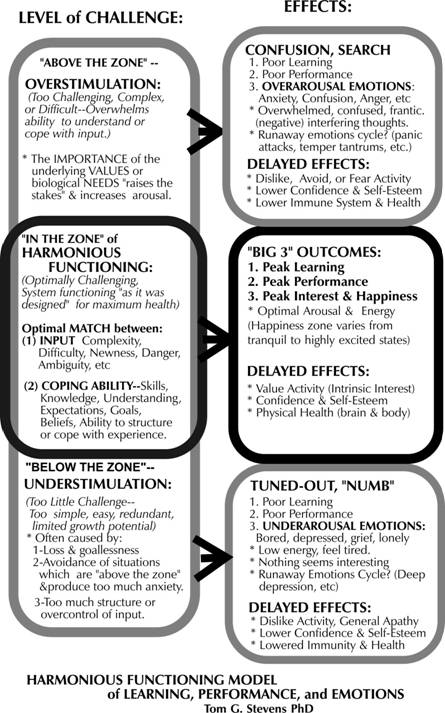
If it gets too hot--overwhelmed with too much input it cannot adequately process, it gets overstimulated and produces negative overarousal emotions such as anxiety or anger. If it gets too cold--too little input for its processing ability, then it produces negative underarousal emotions such as boredom or depression. To be happy we must keep an optimal level of matching between our inputs and our abilities to process them. Too little or too much matching is the brain mechanism at the root of unhappy emotions.
The harmonious functioning model provides a unifying explanation of all emotions. Being in the zone of harmonious functioning produces varying states of happiness--such as enthusiasm, love, joy, or peace. Being above the zone produces overarousal emotions such as anger, anxiety, guilt, or fear. Being below the zone produces underarousal emotions such as apathy, boredom, grief, or depression.
The zone of happiness ranges from peace and tranquility to exhilaration and ecstasy. When we are fresh, at peak energy levels, and have a highly challenging task such as a big tennis match or speech to give, being in the zone of harmonious functioning is at a much higher level of stimulation and arousal than being in the zone is at the end of the day.
At the end of the day laying on the couch with my head in Sherry's lap, a fire in the fireplace, and watching a good mystery on TV is being in the zone. Being in the zone covers a range of stimulation and arousal levels. It also depends upon a variety of conditions--such as my expectations, energy level, and the external situation.
EMOTIONS MAY HAVE BRIEF OR PROLONGED TIME SPANS
�� During any single hour or day, it is likely that all basic emotions will be felt at least briefly. These emotional variations are caused by variations in cognitive states.� It is also theoretically possible to measure an emotion occurring at any instant or to mathematically sum the intensity and duration of any particular emotion over a specified time period. That summative or average measure for the hour, day, or even year would be an overall measure. Thus, it is possible to have brief moment-to-moment or long-term overall measures of any emotion. For example SHAQ’s Overall Happiness Scale is designed to be a long-term average measure of huge numbers of actual happiness emotional responses over a long time period.
HARMONIOUS FUNCTIONING INCREASES VALUING of objects, activities, people
The more we understand about values, the more we gain a tool for getting control of our happiness. The next few sections will show how closely the key concept of values is connected to the concept of harmonious functioning.
Happiness is caused by satisfaction of underlying values. In earlier chapters I stated that our happiness depends upon satisfying underlying values, and I gave examples of common values--such as desires for achievement, intimacy, money, independence, and security. However, I didn't say what I think causes us to learn these values in the first place.
The harmonious functioning model explains how values are learned. When I was in the second grade, I didn't know anything about baseball and didn't like or dislike baseball. I had little knowledge of it and did not value it. But Mom literally pushed me out the door and forced me to try out for the little league team. The coach taught me the rules and taught me how to play. At first I didn't like it too well.
However, as I improved and began to function more harmoniously with the ball (I learned to throw, catch, and hit it), I began to enjoy playing with it. I also began to enjoy the social aspects as I functioned harmoniously with other team members. Within a year or so, baseball seemed like the most important value in my life. I wanted to be a big-league baseball player when I grew up. I kept that dream until the eleventh grade.
This story illustrates how baseball became an important value for me. My brain had associated baseball with harmonious functioning. There wasn't anything in my life where I felt as much in the zone as I did playing ball. Baseball--and nearly everything associated with it--became a positive value. I loved playing baseball, I loved thinking about baseball, I even loved the smell of the grass.
Those stimuli all gave me happy feelings. The underlying cause of loving
baseball was that my brain had learned that playing ball meant harmonious
functioning. Harmonious functioning made me love baseball.
�
 |
Each subpart has its own values and potential for harmonious functioning. As a boy, my inner baseball player had grown to be a big part of me. It developed a lot of expertise at baseball and its own set of values and goals. I no longer play ball. However, whenever I see a movie about baseball, the smell of the leather gloves, the sensations of pitching, and the excitement of the game all rush back. That role of baseball player is etched in my brain and still loves baseball, playing on a team, and the excitement of everyone focused on whether my next pitch will be a ball or a strike.
We consist of many subparts. Our values reflect our various subparts' desires. Happiness is the emotion we feel when these values are being met (I.e. when that subpart is in harmony). When all of our active cognitive subsystems [little people in our heads] are functioning in harmony at any one moment, then we feel happy for that moment. When these values are not being fulfilled, the feelings they cause are the feelings of unhappiness such as anxiety, anger, and depression.
MONITOR EMOTIONS TO GET BACK IN THE ZONE AND FEEL HAPPY
Emotions--even the negative ones like anxiety, anger, and depression--are useful and normal. They tell us about the states of our values, goals, and expectations. We each feel some degree of anxiety, anger, and depression every day.
Our emotions vary moment to moment. We all have periods in our lives--especially during transitions--when we feel prolonged, intense amounts of these emotions. That is also normal. Frequently, these intense emotional transition periods are periods that help produce our greatest growth. So they are periods of great opportunity.
Emotions serve as warning signals about underlying issues. The main positive function of the negative emotions is that they tell us that something is wrong. There is a mismatch or conflict going on in our cognitive system. Our goals, expectations, plans, perceptions of reality, or other thoughts aren' in harmony.
Some part of ourselves is not getting its values met at the level it expects. For example, if you are about to be laid off from your job, your inner financial manager(valuing money and your job), might feel threatened. Similarly, if someone you love starts giving subtle messages that he or she is tiring of the relationship, your inner lover might get upset. You may feel the negative emotions before becoming conscious of those subtle messages.
FACTORS AFFECTING EMOTIONAL INTENSITY
Do you ever wonder why you feel an emotion so intensely? A client came into my office because he was feeling a great deal of anxiety and depression. His partner had just broken up with him, his college work had deteriorated, he had lost his job, his finances were a mess, and he couldn't sleep. The importance of the value, the number of values affected, and the immediacy of the value all can have major effects upon our emotions. In his case his career, relationship, finances, and sleep are all important values and the threats to them were current--not sometime in the future.
It is no wonder that he felt so much anxiety and depression, since he had little mental control over any of these important values when he first sat down. However, after looking at these situations and gaining more mental control, he felt much better. He achieved that mental control through increased understanding, making some decisions, changing some expectations, and developing some alternative plans. Within one hour he had increased mental control in all four areas and felt much more in control. In order for you to understand why you get so upset, it is important to consider each of the following seven factors which influence the intensity of your emotions. It is useful to memorize them (See box).
KEY FACTORS AFFECTING EMOTIONAL INTENSITY
1. Importance of the values affected. How important is this one value to your overall happiness? The more important the value, the higher the emotional intensity.
2. Expectation and adaption levels of values affected. The higher your expectations and standards, the harder it is to meet them. Values, expectations, and goals are key aspects of the HF model and directly cause mental search, stimulation, and reinforcement. Adaption levels and novelty also cause varying degrees of search, stimulation, and reinforcement. For example a child used to poverty may feel very happy about receiving a used toy that a wealthy child would feel upset receiving.
3. Number of values affected. The greater the number of values, the greater the emotional intensity.
4. Immediacy (versus delay) of the values affected. The closer the deadline or event, the greater the emotional intensity.
5. Certainty of value satisfaction. The greater the certainty that it will be met, the happier we will be. The greater the certainty that we will not get the value met, the more depression or anger we may feel about it. The greater the uncertainty, the greater the anxiety. Certainty affects the type of emotion as well as the degree of emotional intensity (see Chapter 8).
6. Length of time value will be satisfied (or not). The longer the expected period of satisfaction or dissatisfaction, the greater the intensity.
7. Amount of understanding and planning related to getting the values met. The more we understand important aspects of the situation and the more confident we are in a clear plan to meet the value, the more confident and happier we will feel.
�� The less cognitive structure we have for coping with an important value situation, the greater the negative emotions--especially anxiety. In the next chapter, you will learn a variety of specific methods for gaining increased understanding and planning to get mental control of your emotions.
8. Classical conditioning (mental association). Cognitive responses can also become classically conditioned (associated) with emotional responses. An image of the ocean can lead to very different emotions for a surfer versus a person whose sister drowned there. Mental associations are powerful stimuli.
�� Mental associations may work in either direction. For example, research shows that people who become happy tend to generate more positive and less negative thoughts; while those who become depressed tend to do the opposite.
UNDERSTAND YOUR KEY VALUES TO UNDERSTAND YOUR EMOTIONS
We have seen how functioning in the zone and satisfying values are essentially the same phenomena. We have seen how the seven factors listed below affect the intensity of our emotions. If you have not already done so, now would be a good time to begin exploring your own key values so that you can understand why you feel the emotions you feel, and so that you can get more conscious control over your values and therefore your emotions.
PRACTICE 1: Make your values checklist. If you have not done so already, (1) make a Values checklist of all your important values/needs for each area of your life--such as career/school, people, recreation, safety/health/physical activity, self-development, spiritual, and financial. (2) Include important activities, types of activities, and underlying, more general needs/values on your checklist. (3) Assess the relative importance of each value/need. (4) Assess how well each value is currently being met (relative to your own standards). (5) Begin problem-solving on needs/values that are not up to expectations. You can either modify expectations or modify what you are doing to meet that value.
PRACTICE 2: Understanding why you feel so bad-identify the factors that increase the emotion's intensity. Think of a problem that is upsetting you (perhaps more than you expect or think it should). Try the self-exploration method (chapter 2) to identify the underlying issues that are bothering you. List which important values are being affected, denied, or threatened by the situation. Then consider the seven factors described above to understand why you are experiencing the emotion with such intensity. What are the important values? How many are being affected? What conflicts between values (and subparts) are occurring? How immediate and certain is the threat or problem? How long can the effect last?
WE CAN GET MENTAL CONTROL OF HARMONIOUS FUNCTIONING AND EMOTIONS
The harmonious functioning model is a powerful idea for understanding how our mind processes inputs and how our emotions monitor that processing to reinforce us when we are in the zone and warn us when we are not. It unifies ideas from many areas of psychology. You can use it to gain control over your emotions (and life) in any area--such as your career, academic life, relationships, self-development, health, or spiritual life.
In the next chapter I will present some powerful methods for getting mental control over your emotions. I use them almost every day with my own emotions or with my clients.
Chapter Summary:
We were designed to maximize learning and growth.
When the mind has optimal challenge and inner harmony,
it produces maximum learning, performance, and happiness.
Over time it produces maximum motivation, self-esteem, and health.
It is as if all the members of a great orchestra played in perfect harmony
to produce one great crescendo at the climax of a magnificent concerto.
Our Higher Selves can conduct our subparts
to focus our knowledge and energy
toward our best performance and keep us in the zone
of harmonious functioning--benefitting ourselves and others.
The BOOK (free download): Go to Contents of Dr. Stevens' book, You Can Choose To Be Happy: "Rise Above" Anxiety, Anger, and Depression.
SELF-HELP INFORMATION: FREE SELF-HELP materials available on this web site (click here to see list)
ORDERING the BOOK: How to ORDER You Can Choose To Be Happy
SHAQ QUESTIONNAIRE: Free Success and Happiness Attributes Questionnaire (SHAQ) to assess self on many factors including HQ-Happiness Quotient
EMAIL DR. STEVENS: Email feedback to Dr. Stevens tstevens@csulb.edu I welcome your comments about my web site or any of its contents.
Self-Help and other resources on this website (and site map)
Web site created and maintained by: Tom G. Stevens PhD Psychologist-Faculty Emeritus,
California State University, Long Beach Counseling and Psychological Services.
URL of this web site: http://home.csulb.edu/~tstevens
HOME PAGE: Return to Dr. Stevens' Home Page