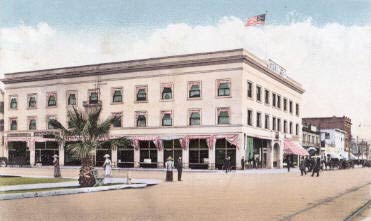
A Visit to Old Los
Angeles and
Environs.
23. Long Beach (Part
2).
by
Brent C. Dickerson
Copyright © Brent C. Dickerson
Index to Episodes (click here)
Long Beach—Downtown and
Uptown; Signal Hill.
• The next morning, it was
mainly we men-folk, and Anna, walking the streets of Long Beach; Mother
declared that if the baby didn't have at least one day without being
carried through the streets, he would turn into a suitcase. Minnie
meantime announced her intention of familiarizing herself with "the finer
points of tennis" outside the hotel. We left the hotel, and started
walking east on Ocean Avenue past the city park, where the buildings
began again at its corner with Pacific Avenue.
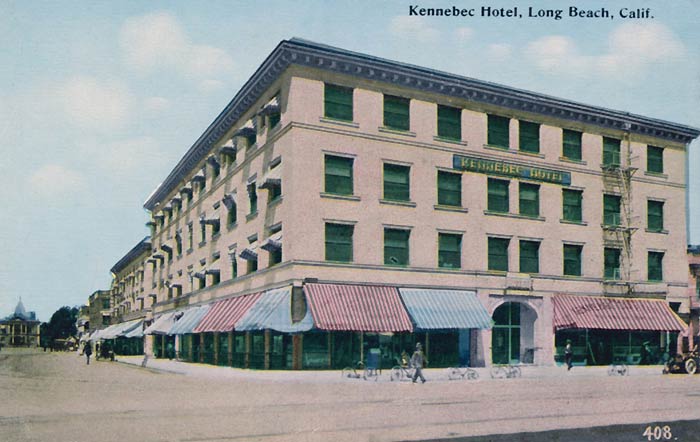
• The Kennebec Hotel was at the northeast corner of the intersection. City Hall can be spotted straight down Pacific Avenue.
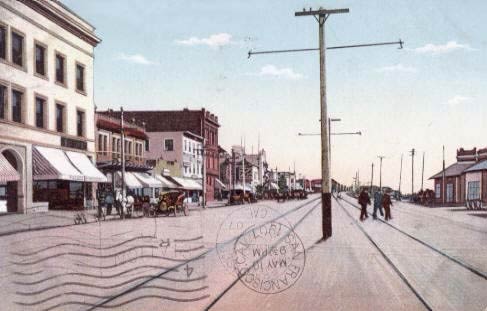
• As we started walking, young Frederick Johan ran to the middle of the street between the parallel trolley lines. "Just as well," said Papa from the sidewalk, loud enough so that FJ could hear; "the good thing about children is that they can always be replaced." FJ just smiled to himself and continued his observations.
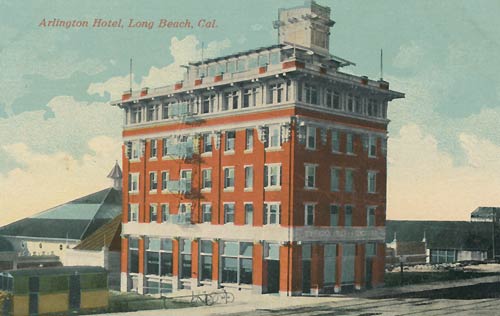
• Across Ocean Avenue on the "water" side of the street—at the southwest corner of Ocean and Pacific—would be found the Arlington Hotel.
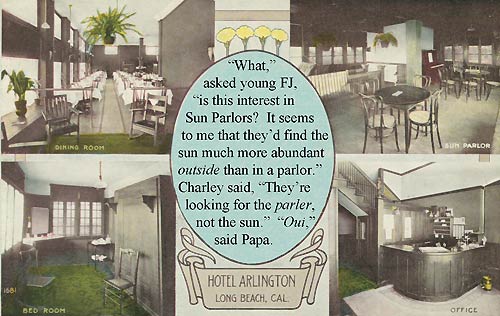
• The next street, Pine Avenue, seemed to be the main street of downtown Long Beach. The trolley station was located there; and the pier was essentially an extension into the water of Pine Avenue.
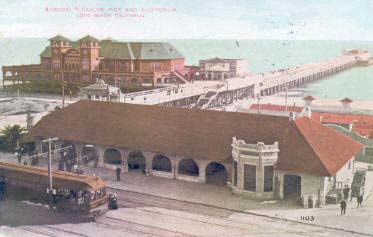
• Seeing Anna and young Frederick Johan step towards the pier, Papa said, "Folk, we are taking the inland route today," continuing that we'd all enjoy the "amusement zones tomorrow together—that is, unless the baby starts growing handles and latches again." Charley said, "I shouldn't think that Minnie would have mastered any part of tennis by then." "Not if the players are quick on their legs," I added, as Anna bit her lip. And so we looked inland from the intersection of Pine and Ocean.
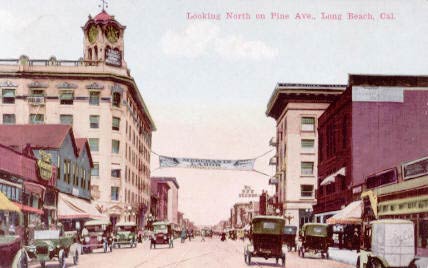
• We walked a few yards past the intersection, and turned to look back at the corner with Pine, the trolley station, and the hotel in the distance. The Arlington Hotel would be built about where the small barrel-vaulted, quonset-hut-like structure is seen, near center, on the far side of the trolley station.
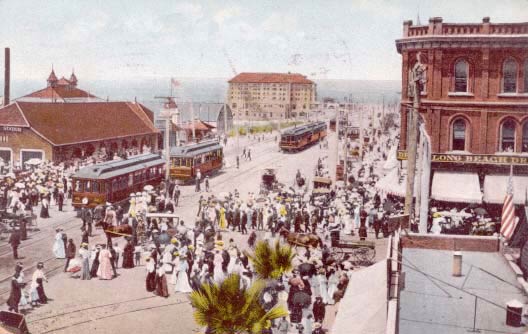
• Young Frederick Johan—who could rarely be kept at ground level for long—wanted to go up to the top of the bank building at First and Pine, "to make observations," as he put it. "That means, 'to look around,'" said Charley and I in unison to each other.
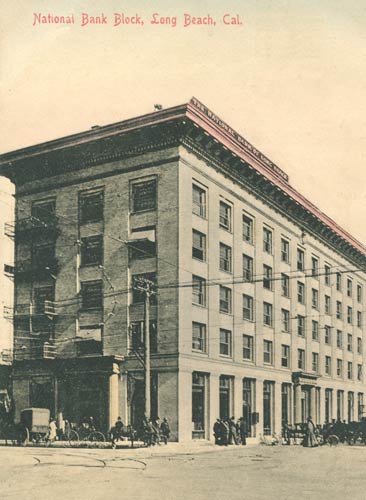
• Papa and Anna took the occasion to sit on a bench on the street and watch the comings and going of the people on the trolley, while meantime the three of us walked into the bank. "Let's not shell peanuts this time," said Charley. It was 10, and the bank had just opened. The sharp smell of after-shave and macassar oil hung in the air. Several of the tellers looked up from their counters at us. Nearby, behind a parlor palm, a substantial middle-aged man with a pince-nez and a melancholy look sat at his desk, sighing. "Sir," started I, as I was closest to him... "Gentlemen," said he, "please don't ask if you may go up onto the roof." Young Frederick Johan stepped forward and said, "May we go up onto the roof?". The man sighed again; and I thought I saw a tear form in one eye. Suddenly, a voice boomed from behind us. "Why, certainly you may, gentlemen. It would be our pleasure! Wilkins, take the gentlemen up." "Certainly, sir," said our melancholy Wilkins, as he grabbed a key-ring off a nearby peg; "follow me." As Mr. Wilkins explained to me, his was the misfortune to have the desk nearest the door; and "every trolley-load of people carries at least two parties who want to be taken up to the roof, which has become the major part of my duties at this bank. When my family writes to me from Indianapolis, expecting me to announce that I am now the vice-president of this bank, imagine my feelings when I have to report to them that I spend my day ushering tourists up to the confounded roof, as my columns of beautiful figures in my ledger wait impatiently at my desk. What's more, I am supposed to interest these people in taking out an account as I lead them down the stairs again. Now, you tell me, gentlemen—what are my chances of success in interesting folks visiting from the four corners of the earth in starting an account with the First National Bank at the corner of First and Pine in Long Beach? It's a hard fate, I tell you—a hard fate!" By then, we had reached the roof. Quite a view towards the northwest, I can tell you! That's City Hall at mid-left.
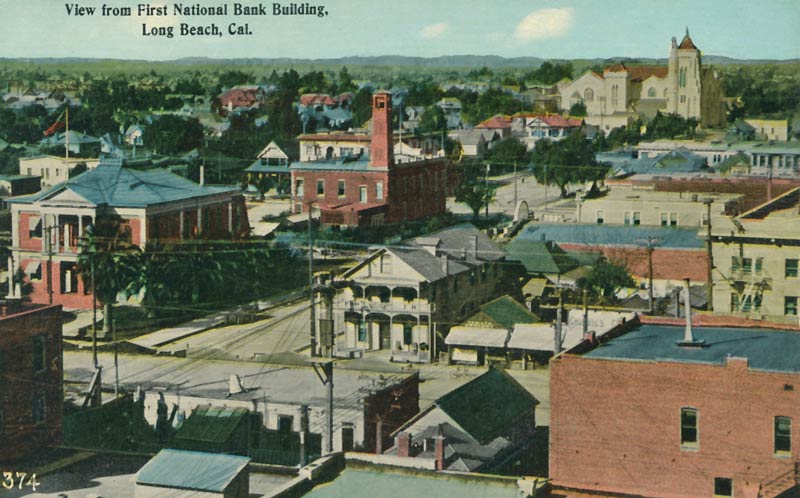
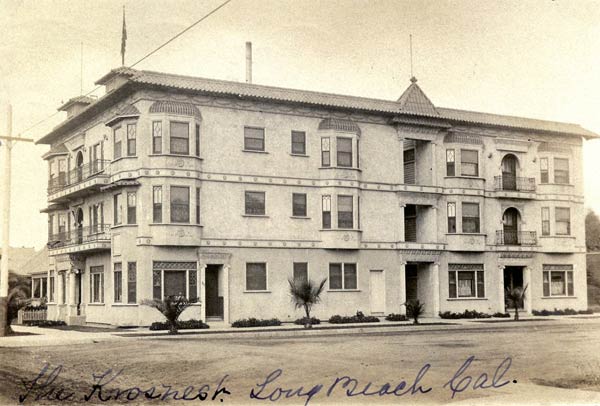
• Behind the brick tower at the center of the previous picture can be seen, but not well, a building which is at the northwest corner of Pacific Avenue and Third Street. This is the "Krosnest" hotel/apartments, built by December, 1903. "'Krosnest'," mused Charley; "Is that clever or annoying?". I asked, "Do we need to make a choice?"
• Now we turned a little to the east and had looked north along Pine Avenue for only a moment when Mr. Wilkins shouted, "Do cover your ears, gentlemen!", with the tower chimes sounding off immediately after. We heard a shout from down below, and saw Anna and Papa waving up to us.
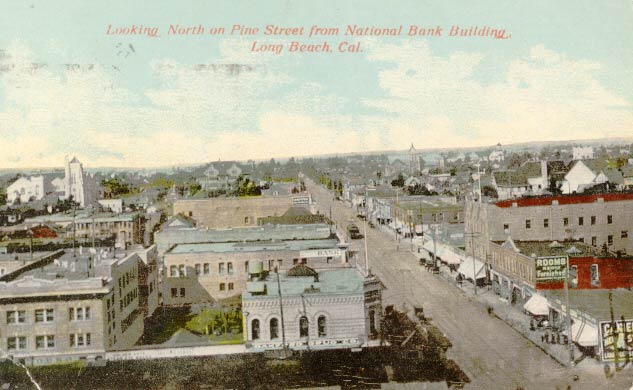
• The Pine Avenue School, a few blocks north, was visible. Young FJ found a close-up view of it at a postcard shop the next day.
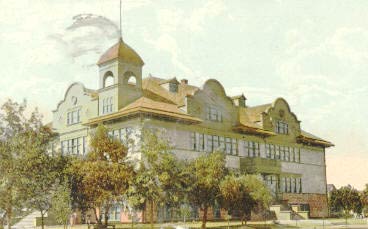
• Noting our interest in the surroundings, Mr. Wilkins put his anguish aside for a moment to remark that, "Fifty years ago, there was nothing here but a shepherd's hut." "Exactly fifty years ago?", queried young Frederick Johan. "Approximately fifty years ago," answered Mr. Wilkins. Charley remarked, "That would be about when Papa was your age, FJ," which set FJ to thinking. "You're in from Los Angeles...?" Mr. Wilkins asked, continuing—upon our nods—"Perhaps you saw a particular Temple Street there? That Mr. Temple used to own this whole area"—he gestured vaguely around—and then sold out to the Bixbys. They're still around. They built that big hotel down the other side of the park." We sensed Mr. Wilkins' impatience to be back at his figures, and so took our leave; as we went out the door, a gentleman with a rather large family—I thought I saw two sets of twins—stopped me and said, "Excuse me, but how is it you got up there?", pointing to the bank's roof. "Well," I said, "it's very restricted; we only got up because my brother here built the clock you see there. Isn't it a nice one?" The man walked up to Charley and said, "Sir, that's a fine piece of work. Thank you!", and then herded his family off towards the pier. Later at dinner, Charley said he should have asked out one of the man's daughters. "She might have asked you about clocks!", said Papa. "I could speak to her at great length about getting 'all wound up'," said Charley. Mother set down her water-glass and gave Charley a severe look, while Minnie said, "Charley, could you explain that? I don't know what you mean at all." Papa cleared his voice, and said, "Surely you all remember the pocket-watch I gave Charley when he left for college?". "Most assuredly," said I, winking at Charley, who was blushing slightly. Returning to our walk down Ocean Boulevard: We crossed to the seaward side of Ocean, walked nearly a block east, and looked back at the corner of Ocean and Pine.
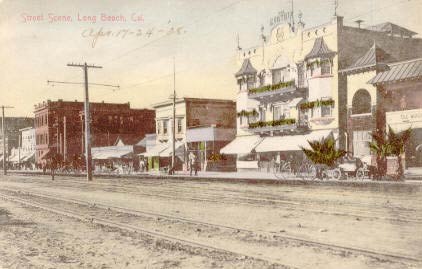
| • Going east along Ocean Avenue, the next cross-street was Locust Avenue. On the northwest corner was the Hotel De Luxe. | 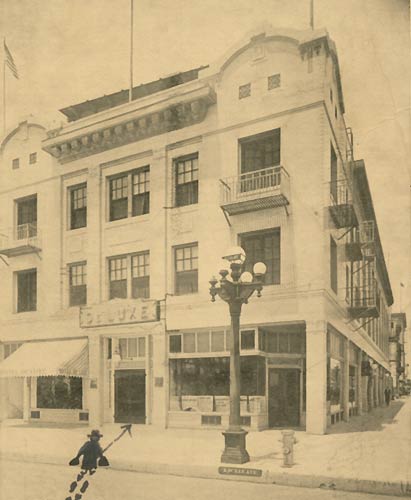 |
• At Locust Avenue, commercial buildings were starting to give way to private homes...
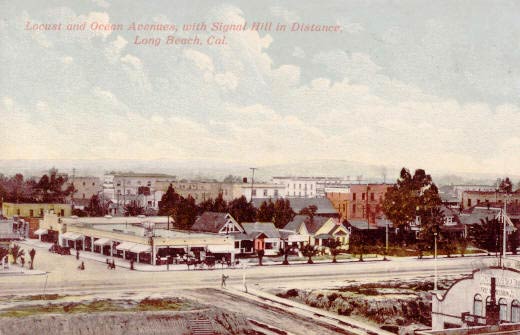
• ...But a block inland, it could have passed for a street in downtown Los Angeles! Here, we're looking west on 1st Street towards Pine Street and the park. Locust Avenue crosses left to right.
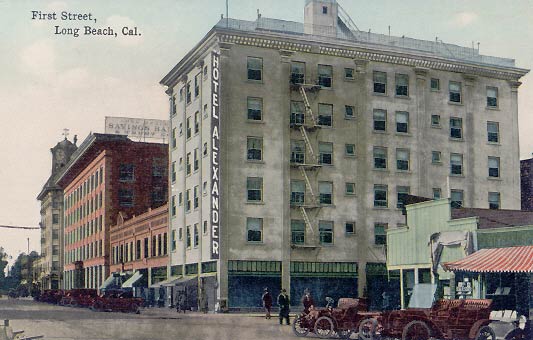
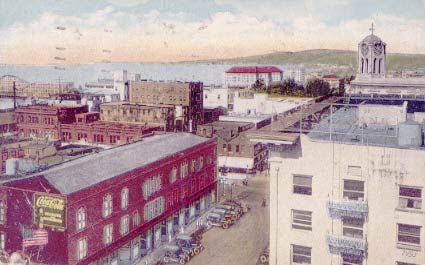
• On the pretext of looking for "people," we cajoled a somewhat bemused janitor into unlocking the hatch to the roof of the Hotel Alexander for us. He did, however, make us promise not to throw ourselves, or anyone else, over the side. To the west, we could see the city park, the Hotel Virginia, and—in the distance—San Pedro and the Palos Verdes peninsula.
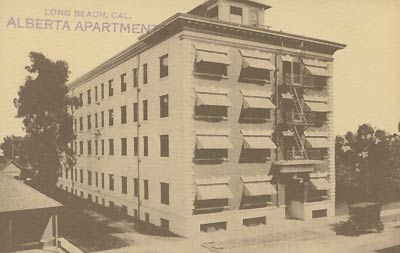
• Coming down, without throwing ourselves, or anyone else, over the side, we found the Alberta Apartments close by, at 118 Locust Avenue.
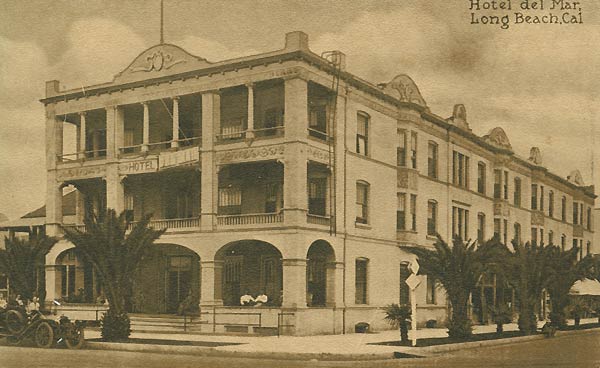
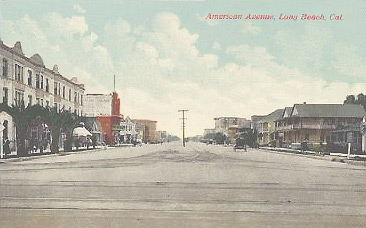
• We liked the fresh sea breezes, and so returned to Ocean Boulevard. The Hotel Del Mar was located at the northwest corner of the next intersection eastwards, the intersection of Ocean Boulevard and American Avenue [later to be renamed "Long Beach Boulevard"].
• Turning around instinctively to see the view which the guests at the Del Mar would have had, we looked down from the top of the cliff to where beachgoers had left their horses—not very far from the auditorium! "The sea breezes," said young Frederick Johan, "will disperse any horse-smells inland rather than blow them into the auditorium." "I should rather hope so," said Anna.
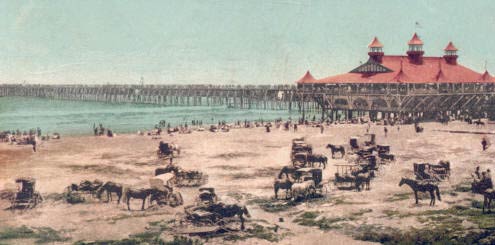
• We looked east, along the seaward side of the street. "Ja," declared Papa, "what a grand view—open, airy, fresh—the feeling of freedom! Tank goodness dey have kept it mostly natural—it does a heart good..." "They'd have to be insane to close out the view with buildings," said I. "Insane, or short-sighted," Charley offered. Young FJ offered, "Greedy!" Anna sighed, "Highly misled." "Or all of the above," summarized Papa; "Future ages will tank dem for dis."
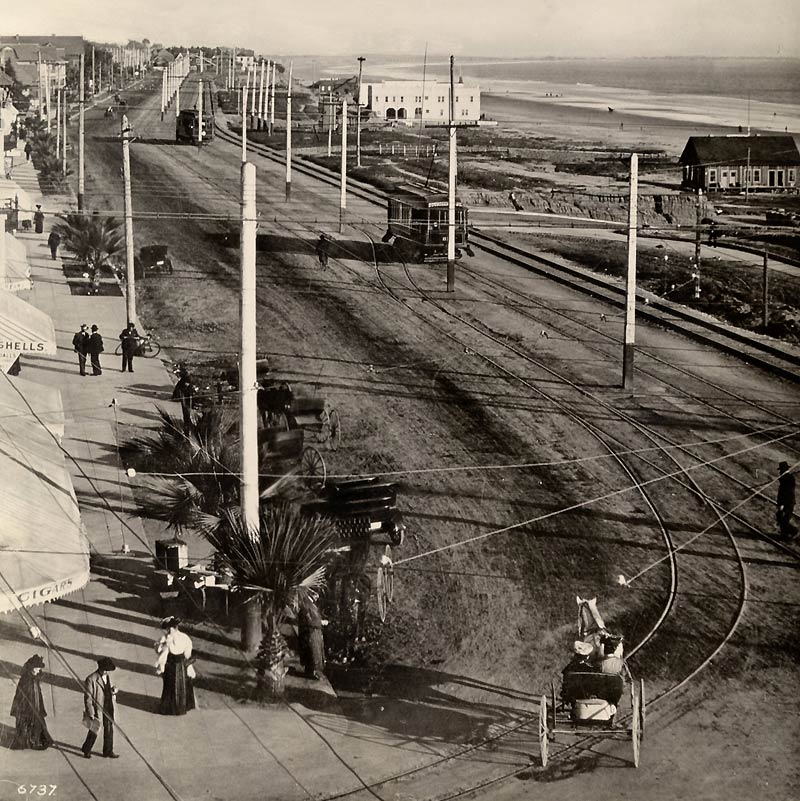
• The suggestion of horse-smells dispersing inland made us all turn in that direction; and thus it was that we looked north up American Avenue, the Hotel Del Mar at the left of our view. "Nice wide street," yawned Charley, adding, "Wonder if it's for demonstration, or if people come out sometimes."
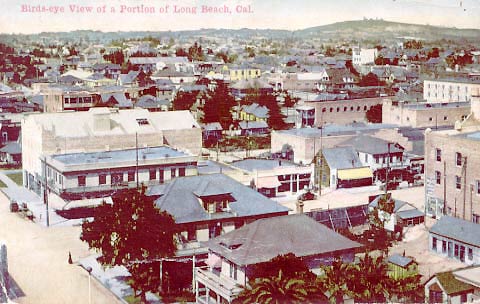
• Then we looked north over the city towards Signal Hill.
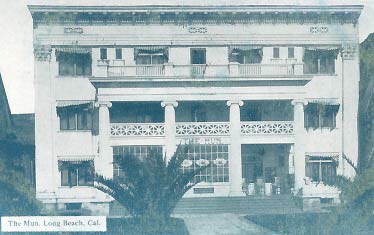
• We continued our walk east on Ocean Boulevard towards the next intersection, that with Elm Street. First we walked past "The Mun" ("What's a 'Mun'?", asked young Frederick Johan)...
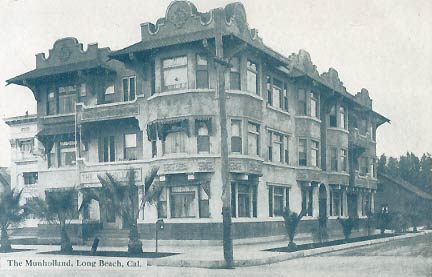
• ...Adjoining which, just beyond, at the intersection with Elm Street, was "The Munholland" ("What's a 'Munholland'?", asked young Frederick Johan; Charley answered, "It's like a 'Mun,' except with wooden shoes.").
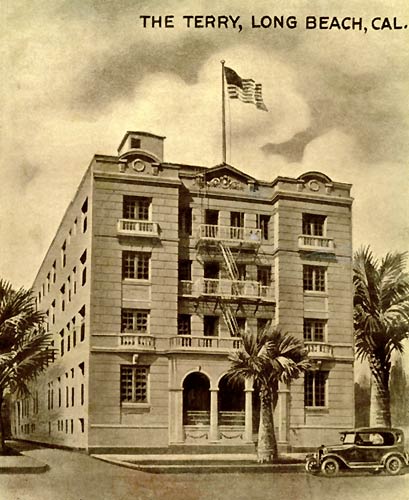 | • The Terry Apartments would be built in 1919 at the northwest corner of Ocean Avenue and the next street east, Frontenac. |
• On nearby Atlantic Avenue was—the Atlantic Avenue School. "What?", quoth I, "not the Munschool?"
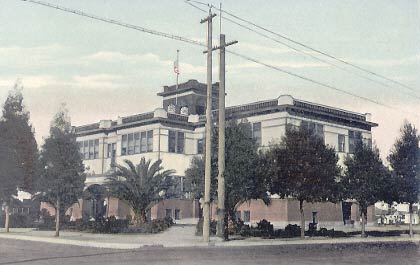
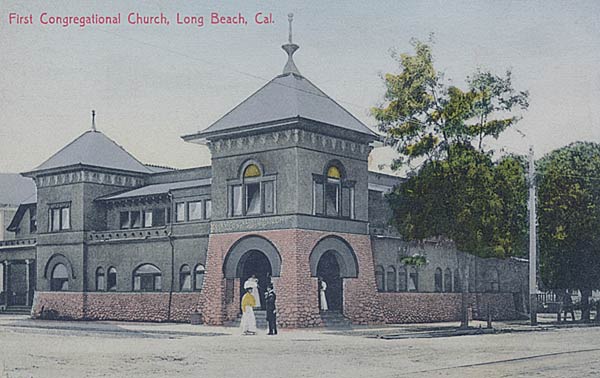
• After all our walking and climbing, Anna—with her eye on Papa—said that she was quite tired out, and sat down on the curb, "leaving us fairly well at longitude Nowhere and latitude Nothing," as Papa described it at dinner that night. Charley suggested that we return hotel-wards, and pass the afternoon around the pier. "Nay," quoth Papa; "that's for tomorrow." I spoke up: "We could place ourselves in the lap of destiny and chance." "You mean there's a poker parlor here?", asked Charley. Anna gave him a strange look. "I know what he means, folk; 'tis what your thumb is for." Now Charley gave Papa a strange look. "Hitchhike!" cried young Frederick Johan. And so we took turns putting on our respective best demeanors for drivers going our way. As it happened, it was my own manly and elegant extremity which succeeded in arresting the attentions of the driver of a grocer's cart—a two-horse grocer's cart—who said he was going a couple miles east to a church, climb on, the horses won't know the difference. As the horses plodded along eastwards, we entered the residential area; and even there the built-up area was thinning out the farther we went. We turned at Cherry Street, where there was a park on one side of the street, and went inland a few blocks to Third Street, where we found ourselves at the First Congregational Church. "End of the line, folks," said the man as he pulled up, got down, and turned his attention to delivering his goods to the church. As he hustled a wedding cake in, young FJ tried to prevail on him for a snack by trying to look hungry. "Takes more than that, son," he said, as he disappeared into the church.
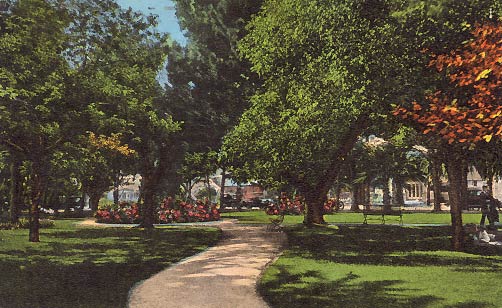
• We trudged back to the park. Young Frederick Johan disappeared into the shadows to tally the number of species of trees in the park.
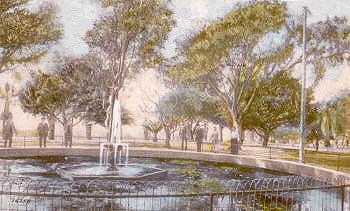
• Meantime, Anna and Papa reclined on a bench near a fountain in the park.
• Charley and I scouted passers-by on the boulevard, he sighing for bathing beauties making their way to the beach across the street and down the cliff, and I sighing for you of course dear.
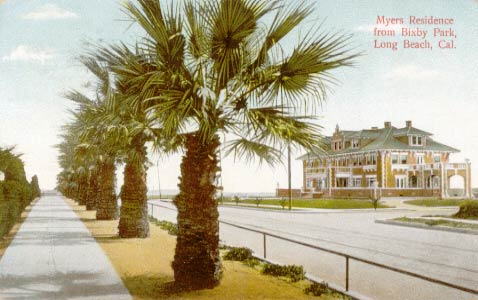
• At Junipero Street, on the east edge of the park, we crossed over to look at the coastline. Looking back in the direction of town, we could barely make out the pier near the hotel.
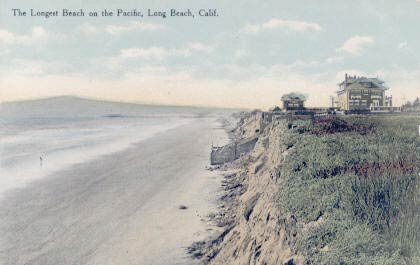
• The seaward side of the same home we have seen in the previous two images. This house belonged to the Myers family.
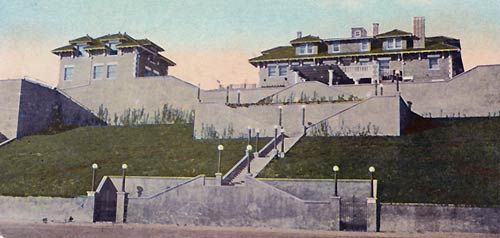
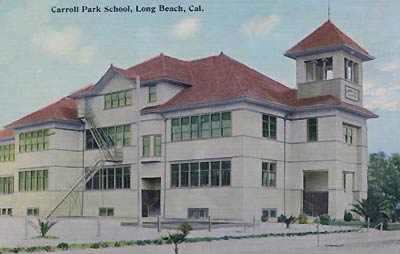
• While all of this was going on, Papa engaged a red-haired man in conversation—Anna later reported that he was the only red-haired man she had ever seen without a single freckle on his face—the upshot of which was that we all were to be motored first to Signal Hill back of town, and then all the way 'round to our hotel. At dinner, Minnie asked for an explanation of how this came about. Papa took a deep breath, and began, "Minnie, there . . . " "I can finish that statement, if I might," interjected Mother, as Papa nodded assent; "The answer is, 'Minnie, there is a fellowship of the cigar!'. Am I correct, Mr. S?". Papa beamed, and sat back in his chair. "You are correct, Mrs. S." Minnie sniffled, looked blank, and stuck her fork into a spiced carrot; "I see," she said. Anyhow, our roundabout way back to town began as we passed by the Carroll Park School not far from the park we had just visited. "And so," declared young FJ, "that was Carroll Park that we were just in." "Nope," said the man; "that was Bixby Park." "Then where's Carroll Park?", asked Charley, reasonably enough. "This is Carroll Park." We looked around. "Where's the park?" "There isn't any park. The houses are the park." This reduced us all to silence. "And good thing, too!" said Mother, as we related the tale at dinner.
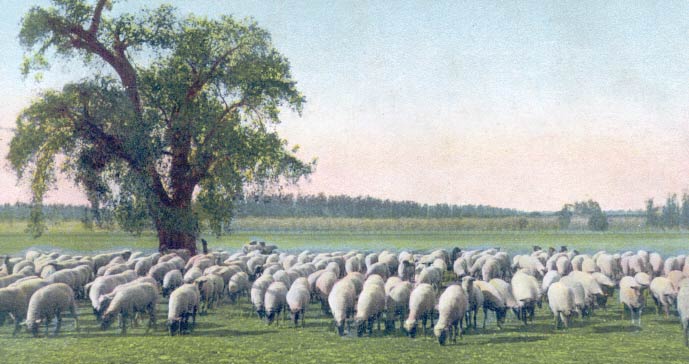
• On the way around the east end of town, we drove past a sheep ranch. The red-haired man said, "You were just in Bixby Park; you're staying in a hotel Bixby built; and this is the Bixby sheep ranch." "I was going to ask him why Bixby didn't have the sheep stay at the hotel," said young FJ that evening, "as it would keep their wool softer. But I didn't." Papa puffed on his cigar for a moment. "Young man," he said, after a moment, "I think, yes I do, that, since we don't have sheep, I will keep our goats in your room when we get home. It will make their milk sweeter." "I have one thing to say to that," declared young FJ, after a moment's thought. "And what might that be, young man?," asked Papa. "Bah!"
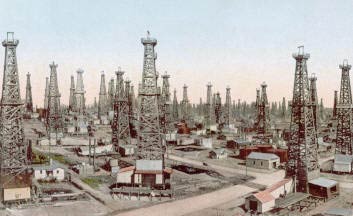
• From east of town, we drove around to the back of Long Beach. Signal Hill is pretty much given over to oil.
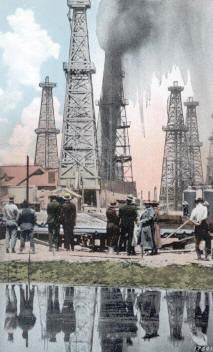
• Sometimes there is a "gusher."
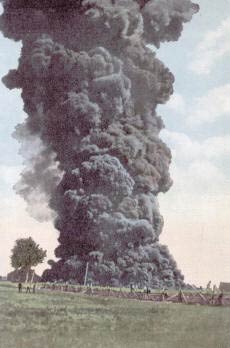
• Sometimes it catches on fire. "Not this again!", exclaimed FJ.
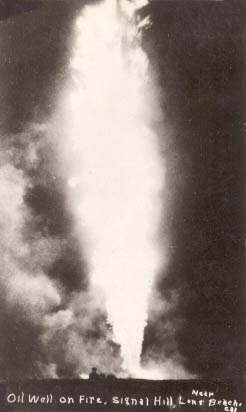
• And sometimes it happens at night.
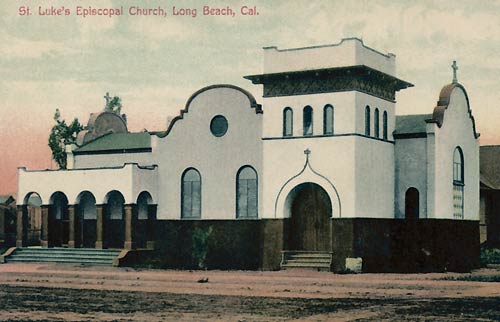
• The red-haired man—who had been something less than talkative, but who now seemed to be warming up a bit—said, "If you'd like, I can take you past quite a number of churches and schools and such." Charley, who had been pouting in the back seat, responded, "No!" Papa explained that this meant, "Yes, please"; and so it was that we came to St. Luke's Episcopal Church at the corner of Atlantic Boulevard and Seventh Street.
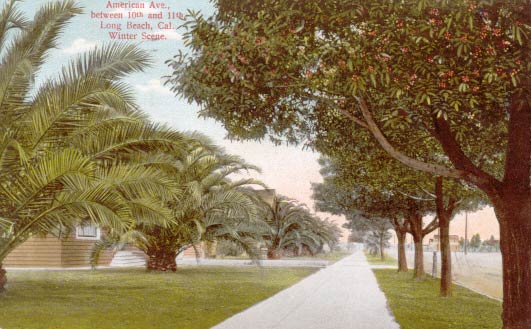
• We came back towards downtown via American Avenue, the ocean end of which we had seen earlier. But he turned back inland a few blocks to show us his own home. "It's the one with the palm tree," he said.
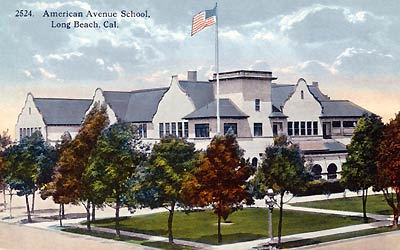
• The American Avenue School was at the corner of American and Eighth Street. "I was at the dedication," said our driver; "—me and my daughter Rowena, who was in the first class here. That was in May of 1898." Charley cleared his voice. "Your daughter—Rowena—she's doing well, I hope . . . ?" "Oh, yes—three children, and a fine husband—not necessarily in that order. In fact, not at all in that order." Charley sighed, and went back to pouting.
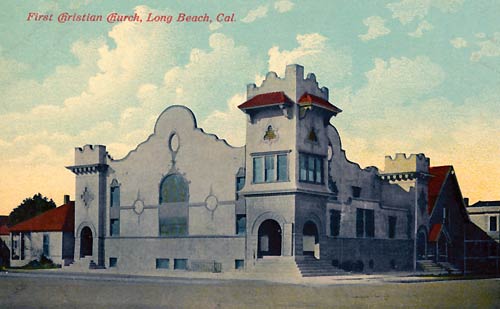
• At American Avenue's crossing with Fourth Street was the First Christian Church. "Churches! Banks! —Always First! Who is looking after the last Christian?", was my plaintive query. Charley muttered, "Certainly I am looking forward to the last church today." "Boys, boys," cautioned Papa, "ja, I'm sure that your mother is blanching at this very moment without knowing why."
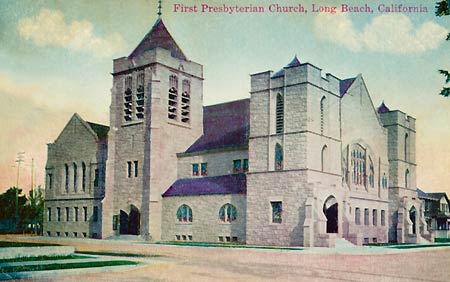
• "Oh," said the red-haired man—a little too gaily, it seemed to me—"if it's firsts you're after... ["It isn't," said Charley], just hang on to your hat!". "Anna," said Charley, "could you hang on to my hat for me? I'm feeling overtided by apathy at the moment." After we had rounded a corner or two, we came to the First Presbyterian Church at the northeast corner of Locust Avenue and Sixth Street. "The flocks," said Anna, "are shepherded most aggressively in this town, it seems to me." "I feel sorry for the wolves," said I.
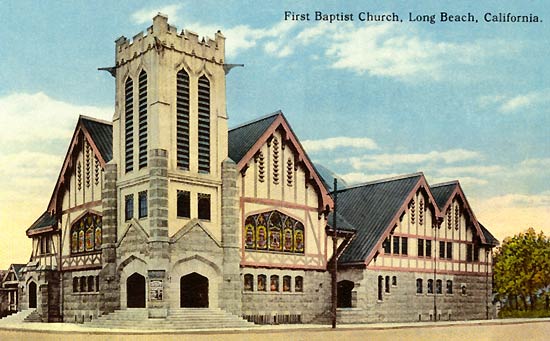
• But the red-haired man was not done with us, as at Locust Avenue and Fourth Street could be found the First Baptist Church. "My feelings," stated Charley, "may well be imagined." "'Tis a fine building," declared Papa, whose graciousness, as you know, is more than exemplary.
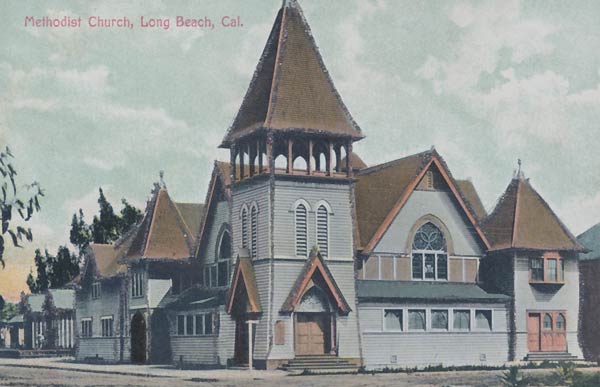
• We were nearly back to "our" part of town, as I realized when I saw the street sign for Pine. "And then," said the man, forging ahead, unstoppable, "here at Fifth and Pine we have the Methodist Church." Young FJ opined that "They could consequently call it the Fifth Methodist Church, and be hewing to the truth" an opinion which the red-haired man ignored.
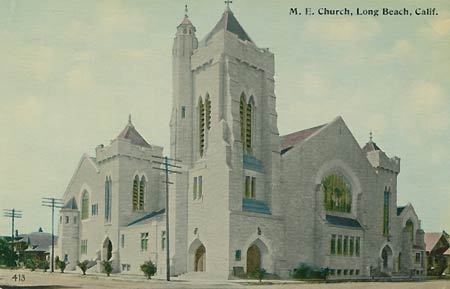
• The man finally let us out at the Methodist Episcopalian Church at the corner of Pacific Avenue and Fifth Street. "That should put religion into you," he said, with an air of satisfaction. Charley smiled in his winning way, and said, "It certainly made me pray!"
• Now, between our return and the aforementioned dinner that evening, I was drafted by Mother into being the chaperone at a little affair ("No—good gracious, Ulf, don't call it an 'affair'—call it a . . . a 'set'," insisted Minnie. "Darling sister," said I, "have you given o'er your soul to tennis? Is that what this racket is all about?" "Puns will not avail you, my good man. No, this 'set' is as in two people setting together, as I plan to do with Willis." "No, not if I'm along, you won't!" "This abrupt turn towards the Puritanical comes as a shock, Brother Ulf. I'm . . . I'm rendered speechless." "My point, young Miss, is that, if I'm along, your set-to will involve three people setting together." "Your mathematics seem firmly based, and I congratulate you." "Willis?" "Willis P. Willis, if you insist." "I most assuredly don't insist." "I met him on the courts . . . at the middle net." Here, Charley broke in and said, "Yes, I knew a net had to be involved." And so it went, dear.). The moment for this expedition arrived, and Minnie and I strolled out of the hotel, Papa's admonition to be thoughtful still in my ears. "Would that pale creature on yon bench be the distinguished Mr. Willis?," I queried. "His moustachios are quite manly, I think." "I will view them in that light," said I, as we approached the bench in question. The formalities being disposed of successfully—the "P." stood for "Panck," let the record show—the skirmish began: "Your moustachios," I began. Willis started. "Oh!," said he, "you must be talking to me!" "Yes, quite so. Your moustachios," I began again, this time to be interrupted by a firm poke from Minnie. A short silence ensued, terminated by Willis's enquiry "Yes, what about them?". Minnie answered quickly with "Ah, Willis, you must understand that Ulf frequently expresses himself without verbs, and indeed frequently without an object in his sentences. Isn't that so, Ulf?" I smiled and said, "Yes. Economic tariff." "—And often blurts out the words 'economic tariff' when he means, 'Do go on, I'll sit here quietly and not disturb anyone.'" Willis gave me a searching look, blinked, and essayed "You have another brother, do you not?" "Two. Well, 'three' would be the correct answer at this point, counting recent events." "Me, I'm an only child." "Most interesting," said Minnie. Another long silence ensued. "What about your brothers, then?" Here, he darted a glance at me. "Your other brothers, I mean." "Economic tariff," said I. "First of all, there would be Charley. You could say that he is like an ostrich." Willis paused a moment to ponder this. "He . . . he buries his head in the sand, you're saying?" "Ah," laughed Minnie, "gracious grandmothers, no, not at all. 'In the sand'! Why, he'd be shaking his ears out for the next week. No, what I mean is that, in providing for the future, he lays a big egg." Willis darted another glance at me, though one of a different nature. "Then there would be young Frederick Johan. Now, it is important to call him young Frederick Johan because there is, or at least there was, an old Frederick Johan, my late uncle. In fact," she continued with a shudder, "here he is now. The young one, I mean. The old one is not to be anticipated." And, as it happened, young FJ was indeed strolling up with that innocent look which meant to two of us three that he had been sent by Mother to see how things were going. Willis made a bold stroke by seizing the initiative. "Good afternoon, young Frederick Johan!" Young FJ fell back on one of Papa's characteristic phrases in this situation: "Delighted to meet you, sir—delighted!", and then, looking him up and down with curiosity, added one of his own: "What do you do?" "I . . . I travel . . . " "Business?" "No, pleasure." "So you don't really do anything?" "Oh, sometimes I look over the books." "What books?" "My father's books. Bookkeeping books, you know." "What does your father do?" "Dear child," said Minnie, in some distress, "we don't want to keep you from your errand." "Ohhhh," young FJ drawled out, "you could say that I have a minute maybe to spare." "My father's an investor." "So he doesn't really do anything either?" At this point, as Willis gaped, I thought it would be best for all for me to "be thoughtful." "FJ, I feel that it's a good moment to indulge in some verbs. Let's go get some ice cream," and I whisked him, and myself, off. From a distance, I could see Minnie and Willis engaged in rather fitful and, as time went on, dwindling conversation. "This is most interesting," said young FJ, following my gaze. "Let's see how interesting," said I; and we walked back to the bench. "Ah," said Minnie, standing up, "here are my dear brothers on the way back to the hotel. So nice chatting with you, Willis. Perhaps I will see you again on the courts!" And so she scurried away between young FJ and me. "Dreadful, dreadful!" she said, as we approached the hotel; "somewhere out there is some poor young woman who will spend a lifetime with a man who can only look at her and blink. That poor young woman will not be me!"