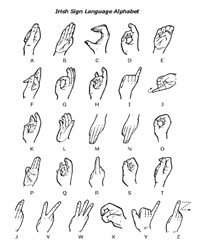
Barbara LeMaster's Irish Sign Language Research
LeMaster's ISL Research: What is it all about?
|
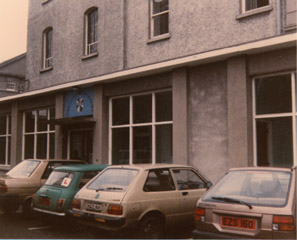
LeMaster's work dates back to 1984. Her work explores gender and generational variations within Irish Sign Language and their social implications and focuses on the history of Irish Sign Language differences within St. Mary's school for Deaf girls and St. Joseph's school for Deaf boys (see pictures below).
If you would like to see a short Quicktime movie to get a glimpse of the current project organized with a large collection of data on 4,000 vocabulary, sponsored by NSF #0318498 from November 2003-January 2005 , press here. Or for a larger-file Quicktime movie--press Here. |
Examples of Gender Differences in ISL
 |
 |
 |
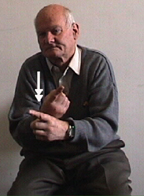 |
| "APPLE" Female Sign | "APPLE" Male Sign | "DAUGHTER" Female Sign | "DAUGHTER" Male Sign |
The Deaf Schools of Ireland
|
|
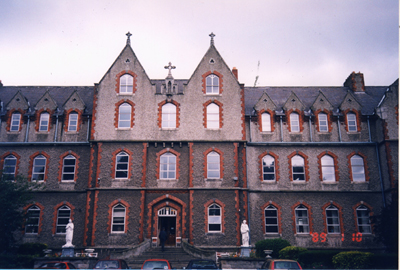 |
| St. Mary's School for Deaf Girls | St. Joseph's School for Deaf Boys |
Grant
aids sign language research
By Sarah Thigpen
On-line Forty-Niner
For many people around the world, sign language is the only connection between
their silent world, and others around them.
Because of the differences in culture around the world, some of the original
versions of sign language are being lost due to the fact that the only keepers
of the language, the speakers themselves, are old and dying. One of these versions
is an ancient form of gender Irish Sign Language.
For Barbara LeMaster, an anthropology and linguistics professor at Cal State
Long Beach, help is on the way. LeMaster has recently been given a $74,482 grant
from The National Science Foundation. This grant enables LeMaster
to continue her research on a form of sign language originated in Dublin, Ireland.
LeMaster, an expert of deaf culture, began her research of Irish Sign Language
almost 20 years ago. Unfortunately, LeMaster was unable to return to Ireland
until three years ago to continue her research.
As a result of this grant, LeMaster will be returning to Ireland in July in
conjunction with her research.
No documented language, spoken or signed, has as extreme gender differences
as [Irish Sign Language]," LeMaster said. "I'm interested in how different
the two gender languages are from each other, and how the genders resolve those
differences."
According to LeMaster, in certain sections of the Dublin community, the native
vocabularies for deaf men and deaf women are so different that they can impair
communications on the most mundane topics. This is a result of men and women
going to different schools to learn the language.
According to LeMaster, the documentation of gender Irish Sign Language is important
for a number of reasons.
"Unlike other gender different situations, these gender varieties are the
product of language socialization experiences that completely segregated males
and females," LeMaster said. "As though deaf girls and boys grew up
on separate islands."
LeMaster does have one benefit that she did not have when she began this journey
20 years ago. Modern technology has made it easier for researchers to study,
record and preserve rare languages that are rapidly disappearing. With the help
of computers, LeMaster can look at different signs for the same word at the
same time.
"It's my goal to create a DVD dictionary of gendered Irish Sign Language
so that anyone may access it," LeMaster said.
This 15-month grant gives LeMaster a chance to complete the work that she began
so long ago. Once her dictionary is completed, any future work tracking the
dissemination of these gendered signs and meaning will always be associated
with LeMaster.
<Copied from http://www.csulb.edu/%7Ed49er/archives/2004/spring/news/volLIVno70-sign.shtml>
LeMaster's Irish Sign Language Publications
ISL Websites