Research
In recent years our group's research interests focused on two aspects of condensed matter theory.
One subject is the study of electronic properties and
coexisting ground states in layered systems. These comprise materials with intrinsic
quasi-two-dimensional properties (e.g. multilayer graphene or halide nitrides),
and hybrid nanostructures (e.g. superconducting-magnetic proximity systems and
magnetic Josephson junctions).
The other topic of interest is the description of crystallization
processes in a d-dimensional solid, and in particular the determination of the non-equilibrium
grain size distribution.
Are you interested in working on a semester or a summer project? Please
contact Andreas Bill.
There are projects available both at the undergraduate and the graduate level.
No specialized knoweldge is required but interest in mathematics and computational tools as well as
enthusiasm and engagement are expected.
Quantum Phases of Hybrid Nanostructures
We study superconducting-magnetic hybrid nanostructures with an emphasis on their properties when the magnetic material
is inhomogeneous. In a recent paper (arXiv:1807.10387) we discuss electronic phase separation and inverse proximity effect in a
two-dimensional proximity system that involves an itinerant ferromagnet. In another publication (Phys. Rev. B 2018) we propose a novel
depleted-triplet minima of the Josephson current and a comprehensive study of the canting of magnetic order on superconducting correlations.
In Phys. Rev. B 2016 we propose two classifications of superconducting-magnetic hybrid structures.
One classification distinguishes two types of magnetic heterostructures (continous vs. discrete domain walls) as they generate
very different mixtures of pair correlations symmetries. The continuous class leads to the unexpected presence of singlet
components deep in the magnetic material. The other classification distinguishes the Josephson current reversal (0-π transitions)
in different systems according to the symmetry of pair correlations involved in generating the current. Three different classes can
be distinguished, one of which was introduced by the group in an earlier publication (New Journal of Physics, 2014).
The study that led to the classification of superconducting-magnetic hybrid structures focused on the diffusive regime,
when many non-magnetic impurities are present in the sample (quite realistic for experimental studies). More recently, the group
also engaged in the study of the ballistic regime, solving the Bogoliubov - de Gennes equations for various hybrid structures.
Read our papers on the topic.
Crystallization of solids
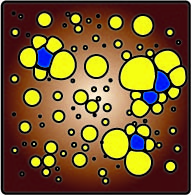 The micromorphology of solids impacts in an essential way their mechanical, electronic,
optical or magnetic properties. It is thus an important task to characterize
quantitatively the granularity and homogeneity of materials. This allows in particular the
determination or tailoring of their functionality. One of the main physical observables
describing the microstructure is the grain size distribution.
The micromorphology of solids impacts in an essential way their mechanical, electronic,
optical or magnetic properties. It is thus an important task to characterize
quantitatively the granularity and homogeneity of materials. This allows in particular the
determination or tailoring of their functionality. One of the main physical observables
describing the microstructure is the grain size distribution.
Over the past years we successfully introduced a theoretical model for the description of the non-equilibrium
grain size distribution during the crystallization process, starting with an amorphous material
and ending with a full tessellation of crystalline grains. We obtained a very general analytical
expression for the grain size distribution, ending in the formation of a lognormal distribution in certain circumstances.
More recently, we undertook the study of this problem numerically to remove some of the assumptions made in the
analytical approach and to determine the effective growth rate introduced by the group to describe the crystallization process.
We completed the study for a thin film and, using advanced parallel programming techniques (GPU) we are tackling the
three dimensional case.
Read our papers on the topic.
Electronic Properties of Layered Materials
Another topic of interest in the group deals with multilayer structures made of graphene and other two-dimensional atomic sheets.
External perturbations such as a magnetic or electric field, impurities affect this system in ways that depart drastically
from the behaviour of conventional metals and semiconductors. In this project we investigate
how electronic properties and size-quantization effects are affected by the stacking of
two-dimensional sheets to form a multilayered material.
In recent work we study a small number of layers and we are presently using more advance programming techniques (GPU)
to address these questions further.
Read our papers on the topic.