3
Toward an Anthropological Marxism
Just as Darwin discovered the law of development of organic nature, so Marx discovered the law of development of human history: the simple fact, hitherto concealed by an outgrowth of ideology, that mankind must first of all eat, drink, have shelter and clothing, before it can pursue politics, science, art, religion, etc.; that therefore the production of the immediate material means of subsistence and consequently the degree of economic development attained by a given people or during a given epoch form the foundation upon which the state institutions, the legal conceptions, art and even the ideas on religion of the people concerned have been evolved, and in the light of which they must therefore be explained, instead of vice versa, as has hitherto been the case. (Engels 1883:681)
Social science, in both its bourgeois and Marxist traditions, is in crisis. The difference is that Marxists realize their science is in crisis, while the representatives of the bourgeoisie are loudly proclaiming their ascendency. The crisis in Marxism is largely associated with the dramatic changes associated with perestroika and glasnost, and has led to a re-examination of what had formerly been thought to be unchallenged truths. While the loss of illusions may be painful, it is beneficial, for it gives us a welcome opportunity to re-formulate our science in new and perhaps more satisfactory ways. There is no general agreement among Marxists, however, about how to proceed with this task.
One avenue worth exploring is the reformulation of Marxism using biological concepts to create a Marxian sociobiology. Although such a procedure has parallels to that of the bourgeois sociobiologists criticized in the last chapter, the intent and the results are quite different.
"In the beginning was the gene," the genetic mystics tell us (Barash 1979:16) but genes do not exist in a vacuum, and never have. Genes are but one form of information and could not exist without matter and energy. Matter, energy, and information existed billions of years before the earliest genes. The genetic mystics have seized upon one aspect of reality and treated it as if it were the whole.
Similarly with the other social scientific blind men. The functionalists focus on social order and ignore conflict. The structuralists focus on mental structures and ignore material ones. Geertz tells us that culture is made up of "webs of meaning" but ignores the purpose of these webs and how they are attached to material structures. The economists tell us to look at choice and ignore the structures within which choice occurs.
The problem with such views is not that they are wrong, but that they are woefully incomplete. To be useful, a conceptual framework must include all the elements of the causal system. Otherwise, explanation is impossible. Further, a natural science of society must be equally applicable to all animal species. Otherwise, it will be impossible to specify the similarities and differences between human and animal social structures and behavior (Vayda and Rappaport 1968).
Genetic mysticism, in reducing human social structure and human behavior to genetic programming, misunderstands the similarities and ignores the differences between human and animal behavior. The genetic mystics understand that humans and animals share a dependence on genetic information, but they ignore the fact that culture radically alters this dependence for humans.
Human and animal populations also share a common dependence on food and other material things to satisfy their biological needs. The genetic mystics also ignore this, perhaps because they consider it uninteresting, perhaps because they realize that it would force them into areas they really don't want to go. It was, after all, Marx who first stressed
the simple fact, hitherto concealed by an overgrowth of ideology, that mankind must first of all eat, drink, have shelter and clothing before it can pursue politics, science, art, religion, etc. (Engels 1883:681)
All animals, not only humans, must eat, drink, have shelter and other material things to satisfy their species-specific needs. This dependence on the material environment links animals and humans into the total web of life, what we now call the ecosystem. Ecosystems are the systems of relationships between organisms and between the organic and inorganic world. Ecosystems are characterized by cycles of matter and flows of energy and information. Ecology, the scientific study of the ecosystem, provides a useful framework for sociobiology for it includes the study of food and other material features as well as genetic and other kinds of information. Ecology also provides a framework for examining the biological functioning of populations. The genetic mystics provide no way of understanding such phenomena as malnutrition, disease, and premature death—biological facts of paramount concern to humanity.
But while Marxism does consider such things, and while Marx did make important statements about human societies in general, the bulk of Marx's scientific work focused on one type of human society, capitalism. Marxist scientific concepts, such as the labor theory of value, the analysis of surplus value, and the general law of the capital accumulation, are specific to capitalism and cannot be directly applied to feudalism or other precapitalist social formations, nor to socialism. In order to generalize Marx's analysis to noncapitalist social orders, and make Marxist analyses of human societies comparable to analyses of non-human societies, Marxism must become sociobiological.
But this Marxist sociobiology must be grounded in ecology. While genetic mysticism is concerned only with genetic information, ecology considers the total ecosystem, including information. While genetic mysticism is thoroughly reductionist, ecology, like Marxism, is consistently materialist.
The materialism of Marx and Engels was developed prior to the emergence of the modern sciences of ecology and genetics. Clearly, had these sciences been available, Marx and Engels would have utilized them, for they were astute followers of the latest developments in the natural sciences as well as the social sciences. Our task, accordingly, is re-think Marxism in the light of these newer developments.
The materialism of Marx and Engels, it should be stressed, was dialectical rather than mechanical. They did not view matter as lifeless and inert, but rather in a more complex way. Writing approvingly of Bacon's conception of matter, they state:
The first and most important of the inherent qualities of matter is motion, not only mechanical and mathematical movement, but still more impulse, vital life-spirit, tension, or, to use Jacob Boehme's expression, the throes (Qual) of matter. The primary forms of matter are the living, individualizing forces of being inherent in it and producing the distinctions between the species (Marx and Engels 1845:57)
Matter does not simply "exist" in a static manner. Rather, "matter and motion, or as it is now called, energy," (Engels 1892:143) exist as dynamic forces which develop into progressively higher forms of organization, of which the human mind and human thought are but the latest development. The information in human thought could not exist without the matter and energy in the human mind, just as the information in the gene could not exist without matter and energy.
Our Marxian sociobiology, then, is both materialist and dialectical. It sees human life as embedded in ecological systems composed of matter, energy, and information.
3.I. The Components of Sociobiological Systems
3.I.1. Matter
Sociobiological systems, as material systems, are composed of the population and its environment. The population is the aggregation of individuals who occupy a definite space within an environment and who interact in definite ways (Odum 1971:162). On the one hand, the population has group characteristics, such as fertility, mortality, migration rates, age and sex structure, and spatial distribution, and may be broken down into groups and classes for purposes of analysis. On the other hand, the individuals comprising the population are the only real actors in the sociobiological system, as Marx and Engels observed:
The premises from which we begin are not arbitrary ones, not dogmas, but real premises from which abstractions can only be made in the imagination. They are real individuals, their activity and the material conditions under which they live, both those which they find already existing and those produced by their activity. These premises can thus be verified in a purely empirical way. (Marx and Engels 1846:6-7)
The activity of individuals occurs within a definite material environment. The most important environmental features are use values, or things which satisfy some need of the members of the population. Food satisfies our hunger, water our thirst. Both food and water are therefore use values. All organisms have needs which can only be met through interaction with the material environment, but these needs are species-specific. As Marx observed,
To know what is useful for a dog, one must study dog-nature. This nature itself is not to be deduced from the principle of utility. Applying this to man, he that would criticise all human acts, movements, relations, etc., by the principle of utility, must first deal with human nature in general, and then with human nature as modified in each historical epoch. Betham makes short work of it. With the dryest naivete he takes the modern shopkeeper, especially the English shopkeeper, as the normal man. Whatever is useful to this queer normal man, and to his world, is absolutely useful. (Marx 1867:609)
What is a use-value for a dog is thus not necessarily a use-value for an orangutan or a lizard, nor for a human being. What is a use-value for one human being, say in a hunting and gathering society, is not necessarily a use-value for another human being in another society, say an industrial society. Needs vary from society to society and from species to species, and thus use-values, being determined by these needs, also vary from one population to another. Although the particularities are species-specific and culture-specific, the generality remains: all organisms have needs which can only be met though interaction with the material environment, with use-values.
In addition to use-values, the environment contains hazards, which threaten the well being of the members of the population. Such hazards include both inanimate forces, such as wind, rain, and lighting, and other organisms, such as predators, parasites, and disease organism. Human populations, especially in modern industrial societies, also produce wastes which may be hazardous for the population.
Both humans and animals depend upon environmental use values to satisfy their needs, but there is an important difference. Animals satisfy their needs by consuming naturally-occurring use values. The food quest of chimps or baboons, for example, simply involves searching for food and consuming it in a direct and individual manner. Humans, by contrast, depend upon artifacts, use values that have been modified in some way by human activity. We do not simply browse for food, we consume food only after it has been extensively modified by human labor. Similarly with our clothing, our houses, automobiles, books, and so on—none of these occur in nature, they are produced by human labor. One of the distinctive features of human beings, then, is the way in which we surround ourselves with the products of our own and other people's activity.
In addition to distinguishing between natural and artificial use values, we must also distinguish between use values which directly satisfy human needs in consumption and those use values which are used in the productive process. Articles of consumption are those use values which directly satisfy some human need—food, clothing, shelter, ornaments, books, and the like. The means of production, by contrast, are used indirectly to satisfy human needs by being used in the production of articles of consumption. The means of production thus includes both the instruments of labor, tools, machinery, etc., as well as resources, raw and semi-finished materials.
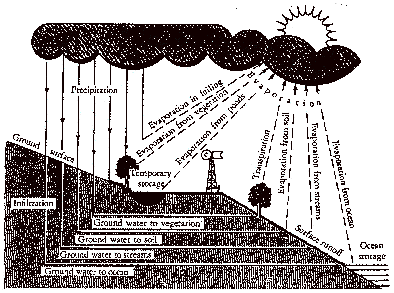
Figure 3.1. The Hydrologic Cycle.
The ecosystem is characterized by a continual cycling of matter, with the same elements being used and reused by the various component parts of the system. This chart illustrates how one material entity, water, is cycled through the ecosystem. Source: (Duncan 1964:36).
Human societies vary considerably in the variety and scope of the use values they produce and consume, from the simplest hunting and gathering societies to our own industrial civilization. This variety, however, should not obscure the gulf which separates all human societies from the animal kingdom. All human beings, and only human beings, depend upon artificial use values which are produced by social labor. (As will be discussed below, some animal species, most notably the social insects but also social carnivores and apes, do produce artificial use values of a rudimentary sort through what I call protolabor.)
3.I.2. Energy
These material entities are kept in motion by a continual flow of energy through the sociobiological system. There are different kinds of energy flow, and it is essential to distinguish between the bioenergy system, the ethnoenergy system, and the auxiliary energy system.
The bioenergy system is the flow of biological energy through the ecosystem, entering as solar energy, captured by green plants, eaten by animals, and ultimately dissipated through respiration. The bioenergy system of a given population is its food sources, the manner in which it articulates to the total flow of energy through the ecosystem.
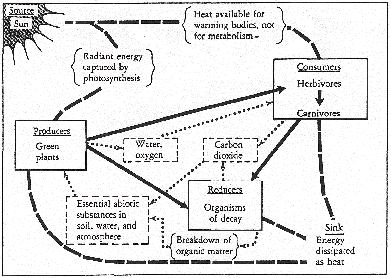
Figure 3.2. Energy Flow Through the Ecosystem.
In this generalized chart of the flow of energy through an ecosystem, types of food chains are represented by solid lines, selected transfers of material by dotted lines, and the continuous entry and degradation of energy by dashed lines. This diagram is based on the ideas of Alfred J. Lotka, who wrote: "The several organisms that make up the earth's living population, together with their environment, constitute one system, which receives a daily supply of available energy from the sun. . . . It is not so much the organism or species that evolves, but the entire system, species and environment." Source: (Duncan 1964:38).
The ethnoenergy system (or behavioral energy system) is the manner in which the bodily energy of the members of the population is expended in the satisfaction of their needs. The ethnoenergy system includes the behavior of population members in food-getting, escape from predators, production and reproduction, and rest and recreation. Energy enters the individual members of the population as bioenergy, in the form of food, and emerges as ethnoenergy, or behavior. Figure 3.3 diagrams this relationship.
As will be argued at greater length below, the ethnoenergetic system is of paramount importance in the analysis of social relations and sociobiological systems, for ethnoenergy is, quite simply, animal and human behavior. Social relations have an ethnoenergetic component which can be measured in units of time. This is of course not the only aspect of social relations, but it is a very important aspect which cannot be neglected. It is not neglected in either classical or Marxian political economy, for the labor theory of value is essentially an ethnoenergetic analysis of the social relations of the market and capitalism (Ruyle 1977b). Ethnoenergetics provides a way to generalize such analyses to non-market, non-capitalist systems.
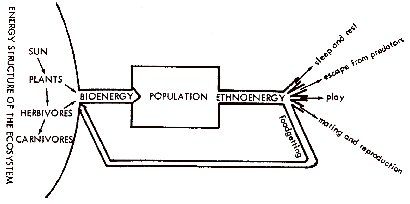
Figure 3.3. Bioenergy and Ethnoenergy.
Organisms harness bioenergy from the environment and expend this energy as ethnoenergy, or behavior. A portion of the ethnoenergy must be expended to harness more bioenergy; the rest is available for other forms of behavior.
The concepts of bioenergy and ethnoenergy are applicable to all animal populations, both human and non-human. A third thermodynamic system is associated almost exclusively with human populations. This is the auxiliary energy system, made up of the exosomatic energy, such as draft animals or fossil fuels, used instrumentally by members of the human population. This auxiliary energy system is the primary focus of popular discussions of the "energy crisis" and is, of course, very important for the well being of our species. However, it is primarily a technological system and its importance lies in the relationship between the human population and the environment rather than in the structure of society itself. It will therefore not play a crucial role in our discussion.
These material and thermodynamic entities, together with the relations between them, make up the material sphere of human life, which ultimately determines the content of information.
3.I.3. Information
The third aspect of sociobiological systems, information, is no less essential than matter or energy. Neither human nor plant and animal life would be possible without the information that determines the growth and development of organisms as well as their behavior. Information comes in many forms, and the interaction between these forms and the material sphere of life is incredibly complex. We will attempt to unravel some of these complexities later in this chapter, but a few introductory remarks are in order.
The most basic form of information, both from an evolutionary and an individual standpoint, is the genetic information on the DNA molecule. Life begins with the gene, and genetic information, in interaction with the material sphere of life, determines the growth and development of the organism.
The gene, however, does not exist in a vacuum. In addition to this genetic information, all organisms gather information from the environment to tell them how to expend energy in order to satisfy their organic needs. Even amoeba gather information to let them know whether food or danger is present, frogs gather more complex forms of information, and our primate cousins, the monkeys and apes, need to gather, process, and store vast amounts of information about their environment and other members of the population.
Organisms also need to communicate with one another. At least since the beginning of sexual reproduction, the individual organisms within a population have transmitted vital information to one another. The communication systems different species have developed for transmitting information have become increasing complex and increasingly wide in the scope of what kinds of information can be transmitted.
Organic information systems thus include both genetic and learned information. The genetic information systems of different life-forms are essentially comparable. There are no significant differences, in terms of the genetic information system, qua system, between the genetic pools of humans, apes, walruses, or parakeets. Systems of learned information, by contrast, range from relatively simple, in amoeba, molluscs, or insects, to incredibly complex, in mammals, especially primates.
With the emergence of humanity there was a quantum leap forward in the complexity and scope of learned information systems. The information gathered, processed, transmitted, and stored by humans is quantitatively and qualitatively different from that of animals. The distinctive features of human information systems are subsumed by the anthropological concept of culture. The classic definition of culture was given by E.B. Tylor in 1871:
Culture, or Civilization, taken in its wide ethnographic sense, is that complex whole which includes knowledge, belief, art, morals, law, custom, and any other capabilities and habits acquired by man as a member of society. The condition of culture among the various societies of mankind, in so far as it is capable of being investigated on general principles, is a subject apt for the study of the laws of human thought and action. (1871:1)
In its anthropological sense, then, culture refers to capabilities and habits that we acquire as members of society. The differences in thought, behavior, and economic conditions between different populations (French and English, Europeans and Africans, or white and black Americans) are not the result of innate individual differences, but instead are due to the fact that the members of these populations learn different cultures. This anthropological view is much broader than that of non-anthropologists, including Marxists. Most Marxists see culture in the popular sense as a sphere which includes art, music, and literature and is distinct from technology, economics, and politics. For anthropologists, not only literature, art, and music, but also modes of production and political, legal, and ideological superstructures are included within the rubric of culture, as parts of what people learn as members of society.
Although this anthropological concept of culture may seem unworkably broad, it serves to underscore an important characteristic of our species (most anthropologists would say the unique characteristic of our species), the fact that we learn how to be humans by absorbing information from other members of our species. In contrast to the genetic information that controls the growth and behavior of most animals from the inside, so to speak, the cultural information that molds human growth and behavior comes from the outside, from the traditional life-ways, customs, and beliefs of society, and is internalized by human beings through the process of enculturation.
As Tylor points out, the condition of culture among various groups of humanity, and among humanity in general, is a worthy topic for study. Just as there is a distinct science, genetics, which studies genetic information, so there needs to be a distinct science which studies culture. Leslie White has proposed the term "Culturology" for the science of culture (White 1949), but this has not gained wide acceptance. Most anthropologists see this as simply the province of Anthropology.
There are, however, various problems with traditional anthropological concepts of culture and how to go about studying culture. We will discuss these problems and propose solutions to them in a later section. At present, we will merely stress that a Marxian sociobiology must deal with both genetic and cultural information. Culture is a crucial component of human biology, for it is how humans satisfy their basic biological needs for food and reproduction as well as our "higher" social, intellectual, and spiritual needs.
3.II. Minimaxing and Social Life
The premises from which we begin are not arbitrary ones, not dogmas, but real premises from which abstractions can only be made in the imagination. They are real individuals, their activity and the material conditions under which they live, both those which they find already existing and those produced by their activity. These premises can thus be verified in a purely empirical way (Marx and Engels 1846:6-7).
We begin, as did Marx and Engels, with the behavior of individuals. Individuals are continually expending energy in attempting to satisfy their needs. We spend our time and energy eating, drinking, sleeping, working, moving about, making love, watching TV, and and the various other things we feel will satisfy some need. It is possible to measure, with varying degrees of precision, this energy expenditure, and construct time-budgets showing how much time is spent in various activities (Rifkin 1987, Ruyle 1977b).
Looking at human behavior in this way is useful not only in comparing human behavior in different cultures, it also provides useful comparisons with other animals. All animals spend time and energy in satisfying their needs, and ethologists have gathered data on the time-budgets of baboons, gorillas, lions, and other species.
The pan-animal expenditure of energy in need-satisfaction has a dual aspect. On the one hand, individuals are expending their energy in need-satisfaction; on the other hand, it requires a definite amount of energy to satisfy the needs of any individual. A definite amount of time and energy is required to find food and eat it, to sleep, escape from predators, and so on.
Generally, most of this energy comes from the individual whose needs are being satisfied, but especially in the case of humans, much of it comes from other individuals. When this occurs, and one individual is satisfying his or her needs by tapping the behavioral energy of another individual, we may speak of energy flowing from one individual to another. There are a number of considerations in such energy flows.
Life, as Marx stressed, is struggle. Individuals, in seeking to satisfy their own needs, are engaged not only in what Darwin, following Spencer, called a "struggle for survival," but also in a "struggle for satisfaction," as they attempt to satisfy their needs. They are seeking to maximize their own benefits, i.e. maximize the amount of behavioral energy devoted to their need-satisfaction, and to minimize their own energy costs. We may speak, then, of a minimaxing principle in human behavior, a thermodynamic statement of the principle of economic self-interest (and comparable in most respects to the "inclusive fitness" of the genetic mystics, see (Ruyle 1977a).
This usage of the term minimax has led to some confusion. Christenson has recently argued that my usage "is semantically incorrect and can lead only to confusion" (1982:419). Following Burling (1962), he quotes Zipf:
when we offer a prize to the submarine commander who sinks the greatest number of ships in the shortest possible time, we have a double superlative - a maximum number and a minimum time - which renders the problem completely meaningless and indeterminate (1949:3).
This, of course, is an overstatement; it may be difficult to solve the problem in a precise mathematical manner, but it is scarcely "completely meaningless and indeterminate." We humans are always attempting to increase our benefits and reduce our costs. Some of us do this more strongly, consistently, and effectively than others. The social effect of this is comparable to a situation in which everyone is involved in conscious minimaxing. There are a number of analytical tools for handling minimaxing.
Game theory, where a MINImum payoff or output is MAXimized (Luce and Raiffa 1957:385-393, cited by Christenson 1982:419) is only one framework for analyzing this complex human reality.
Another set of tools for analyzing minimaxing is provided by neoclassical economics which focuses on the problem of choice. As Robbins has defined it, economics "is the science which studies human behavior as a relationship between ends and scarce means which have alternative uses" (1935:16). The concepts of marginal utility and marginal costs are useful in analyzing the economizing behavior of individuals.
Although the minimaxing, or economizing, behavior of individuals is usually analyzed from the standpoint of the individual, it must be stressed it must be stressed that minimaxing is social behavior. Social life, in fact, originates and evolves from situations where an individual can maximize benefits and minimize energy costs through interactions with others. Thus, the concept of minimaxing (like the concepts of self-interest or economic rationality) does not mean that each individual is a social imperialist, selfishly seeking his or her own interest at the expense of or in opposition to the well being of other individuals. To the contrary, individuals usually find their own interest best served by cooperating and sharing with other individuals. Further, other individuals are usually themselves sources of satisfaction to most humans. Minimaxing and the struggle for satisfaction thus lead individuals to participate in a social system of cooperation and sharing, as well as of competition and exploitation. The ensemble of social relations in any animal population involves a complex mix of cooperative and competitive relations, depending on the precise need in question and the material conditions (environment) of the population in question.
Following Odum (1971:211) we may note a number of different kinds of relations between individuals. (These are all dyadic relations; in practice there are also multi-actor relations as well which need to be considered.) In neutralism neither partner is significantly affected. There are two kinds of competitive relations: amensualism, where one partner is unaffected and the other negatively affected; and competition, where both partners are negatively affected. In both of these competitive relations, the energy expenditure of one individual inhibits the needs satisfaction of another, so that either benefits are reduced or energy costs increased. There are three forms of cooperation: commensualism, where one partner receives benefits and the other is unaffected; protocooperation, where both partners receive benefits but the relationship is not obligatory for either; and mutualism, where both partners receive benefits and the relationship is obligatory for both. In all of these cooperative relations, the energy expenditure of one individual facilitates the need satisfaction of another, so that benefits are increased or energy costs reduced. In such cases we may speak of energy flows from one individual to another. There are also parasitism and predation, where one partner receives benefits and another has costs.
All life may be viewed as the continuous expenditure of energy in pursuit of need-satisfication. The basic need of all living forms, of course, is the continual harnessing of free energy, in the form of food, but all organism have additional needs which they satisfy through their behavior. Life may be viewed, then, as the continuous outpouring of energy, in various forms of behavior, in pursuit of the satisfaction of the needs of the living organism. This expenditure of energy may be either facilitated or hindered by other members of the population.
The ensemble of social relations in any population may be viewed as a system of thermodynamic flows and blockages. The struggle for satisfaction by individuals occurs within this complex system. Blockages occur when there are scare resources (food, shelter, sexual partners) and the behavior of one individual reduces the resources available for others, leading to an increase in the amount of energy required for need satisfaction (or to needs going unsatisfied). Thermodynamic flows occur when the energy expenditure of one individual facilitates the need-satisfaction of another. Barash (1982:202) discusses situations in which such cooperative relations are likely to develop: reproduction (including parenting), avoiding predators, gathering food, social facilitation & biologic conditioning of the environment, minimizing competition or competing more successfully, division of labor, and the social transmission of information. Figure 3.4. gives a schematic representation of these thermodynamic flows and blockages from an individual standpoint.
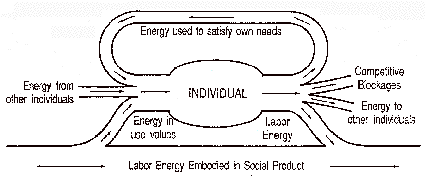
Figure 3.4. Ethnoenergetic Flows In and Out of the Individual.
Humans are thermodynamically unique in at least two ways. First, in terms of their immediate, surface flows of energy, they are dependent upon the behavioral energy of others as well as themselves. Second, all humans are dependent upon use values produced by labor energy. This is the deep flow of energy, as individuals pump their labor energy into the use values of the social product and in tern consume this labor energy as they consume these use values.
Energy flows occur in many mammalian species, especially primates. In human populations a distinctive kind of energy flow occurs. Humans expend labor energy to transform environmental resources into use values. The use values produced by human labor then may be said to embody a definite amount of labor energy, and when the use values are consumed there is also the consumption of a definite amount of labor energy. Further, when use values are consumed by someone other than their producer, there is a definite flow of energy from producer to consumer. This flow occurs at a different level than those discussed above, and we may distinguish between the deep flow of labor energy as embodied in use values and the more superficial flow in day to day social life. This distinction between deep and surface thermodynamic structures is diagramed in Figure 3.4.
We began with the behavior of individuals, but we cannot stop there. The behavior of individuals is part of a total system of energy flows between individuals and between classes which must be understood in its own terms. The genetic mystics have little to offer here. We must understand the total material conditions of life of the population in question. Central to such understanding are the concepts of modes of production and reproduction and mode of exploitation.
These phenomena, production, reproduction, and exploitation, are vital aspects of human biology. Exploitative systems, in particular, are essential parts of human sociobiological systems for they determine how humans will satisfy their basic biological needs. Yet they are ignored by the genetic mystics and cultural idealists alike, for they cannot be reduced to information, genetic or cultural. Indeed, these material structures of production, reproduction, and exploitation generate selective pressures which determine the content of informational systems. We may turn to an analysis of the processes through which ideology is articulated with the material conditions of life.
3.III. The Functioning of Sociobiological Systems
These various material, thermodynamic, and informational components interact in sociobiological systems. The material components are kept in motion by the flow of energy through the system and the pattern of this flow is controlled by the information encoded within the material entities. Each of these kinds of entities is essential, none is more basic than any other. It is impossible to imagine a sociobiological system without matter, or without energy, or without information.
Human sociobiological systems, however, are distinct in each of these areas. In terms of matter, our bodies are unique in terms of our bipedalism, which frees our hands for productive labor, and in the size and complexity of our brains. We are also unique in that we satisfy our needs though artificial use values produced by the labor process. This dependence on social labor is the thermodynamic peculiarity of our species, which in turn opens the possibility of exploitation and class struggle. Finally, in terms of information, we are distinct in our use of symbols to process and transmit information. These distinctive features of our species may be subsumed by the two concepts, labor and language, which will be considered in greater detail below.
In considering the functioning of human sociobiological systems, it is useful to adopt the familiar three levels of observable phenomena: physical world of non-living objects, the biological level of living systems, and the cultural world of humanity.
To understand the behavior of physical objects, we need need to understand the general laws of physics and of thermodynamics. One of these laws, the Second Law of Thermodynamics, states that the universe is breaking down structurally and running down dynamically, that is moving from a state of greater order to a state of less order.
Living systems, however, are characterized by movement in the opposite direction. As summarized by White:
According
to the second law of thermodynamics, the universe is breaking down structurally
and running down dynamically; i.e. it is moving in the direction of lesser
degrees of order and toward a more uniform distribution of energy. The logical conclusion of this trend is
a uniform, random state, or chaos.
In a tiny
sector of the universe, however, we find a movement in the opposite
direction. In the evolution of
living material systems, matter becomes more highly organized and energy is
raised from lower to higher levels of concentration. This does not mean that living beings constitute an
exception to the second law.
Animate organisms are able to move in a direction opposite to that
specified by the law of entropy only because they are able to draw upon free
energy outside themselves and incorporate it within their own systems. All life, as the Austrian physicist
Ludwig Bottzmann (1844-1906) pointed out long ago, is a struggle for free
energy. All living beings — on our
planet at least - are dependent upon energy derived from the sun. Plants obtain energy directly from the
sun through radiation and transform it into organic compounds by the process of
photosynthesis. All animals live
directly or indirectly upon solar energy stored up by plants. Thus, all living organisms are
thermodynamic system which are both expressions and results of a movement
toward higher concentrations of energy and greater organization of matter. The process that is life is sustained,
perpetuated, and in some instances developed by energy from the sun (White
1959:33-34).
To understand the behavior of living systems, then, we must understand that such systems are, first of all, physical systems and subject to the laws of physical systems, including the Second Law of Thermodynamics. Living systems are able to temporarily reverse this law only by harnessing energy from the environment. This is accomplished by individual organisms which expend ethnoenergy to harness the bioenergy required by all living organisms.
Sociocultural systems of course share this general characteristic of all living systems. What is distinctive about sociocultural systems is that this energy harnessing is done through a distinctive form of ethnoenergy, social labor. The human individuals that are the dynamic actors in sociocultural systems harness bioenergy by consuming the products of social labor. Thus, if the struggle for existence of all life can be viewed as a struggle for free energy, the struggle for human existence can be viewed as a struggle for the labor energy embodied in use-values. This struggle involves both competition and cooperation with other humans, as we will discuss more fully later.
Thus, to understand the functioning of human sociobiological systems we must understand, first of all, that they must obey all the laws of the physical and biological worlds upon which they depend. There are addition areas of interest in the functioning of sociocultural systems.
First of all, what determines the behavior of individuals? Clearly, human behavior is determined by information encoded within the individual. This information includes both genetic and cultural information. What is the relationship between these different kinds of information? Further, what determines the content of these different kinds of information, especially what is the relationship between genetic information and learned information, both cultural and protocultural?
These are all fascinating and important questions. Genetic mysticism provides us with ready made but unsatisfactory answers. These answers, however, deserve to be considered seriously as one of a number of alternatives.
There is another area which, to the best of my knowledge, the genetic mystics have ignored. This is the area of the systemic nature of social interaction. When we look at social behavior, we need to examine not only the behavior of individuals in society, but also the system of social interaction and social relations qua system. This system needs to be scientifically analyzed in its own terms, not necessarily in terms of individual behavior. Adam Smith's "invisible hand" of the market, and Marx's analysis of capitalism are good examples. In both of these, the social effect of individual behavior is different from the result intended by individuals, and the nature of the social system cannot be reduced to information, cultural or genetic, within individuals. It is clear, I think, that the material cause and effect relations within societies form an essential focus for social science, and one which cannot be reduced to the genetic or culturally determined behavior of individuals. Importantly, here, one must consider the question of class> How are classes formed in human societies, and how do they interact? Further, there is the question of the relationship between social systems, as thermodynamic systems, and symbolic systems, and how social systems generate and are supported by particular ideological complexes.
It needs also to be stressed that these sociocultural systems have a very real impact on the biological functioning of their members, on such things as diet, disease, fertility and mortality, longevity, and general health and well-being. Such matters would seem to be a reasonable topic for sociobiology, but are ignored by the genetic mystics.
The analysis of human sociobiological systems, then, requires a variety of conceptual tools. Such analysis may begin with the behavior of individuals but cannot end there. It must go on to analyze the social systems which humans create but do not yet control since they do not yet understand them. As Washburn (1978) notes, the genetic mystics, in reducing human behavior to genetically determined patterns, ignore a major focus of social science, the concern with what Durkheim called "social facts." Marxian sociobiology, therefore, must not only subsume the valid insights offered by the genetic mystics, but also address the classic issues of social science, as posed by Marx and well as bourgeois thinkers.
3.IV. Labor and Language
The relationship between labor and language deserves special consideration, for these represent the two areas in which humans are most clearly distinguished from the animal kingdom. Only humans are dependent upon use values that they themselves produce through social labor, and only humans communicate with one another through the rich, symbolic medium of language. Humans live, in a sense, in two worlds. The first is the material world which we have radically altered through social labor in a symbolic world of ideas and meanings that make sense only to ourselves. What is the relationship between these two distinctive features of our species?
To answer this question we must examine the nature of language and the similarities and differences between language and the communication systems of other primates. Human language shares with the various call systems of monkeys and apes a variety of features such as a vocal-auditory channel and arbitrariness (the lack of any necessary relation between a sign and the meaning it carries).
Human language is also unique in a number of ways. First is universality. Unlike monkeys and apes which have a relatively limited number of signs in their communication systems, humans can and do talk about anything and everything, even things which do not exist! Second is productivity. Monkeys and apes rarely if ever say anything which hasn't been said before, but humans are constantly uttering sentences which no one has ever said before. These features make human language a tremendously powerful system of communication which has no parallel elsewhere in nature.
Underlying the universality and productivity of human language are three structural features: duality of patterning, syntax, and transformations.
Duality of patterning refers to the structural feature of language that takes a relatively small number of meaningless units, or phonemes, and combines them into a extremely large number of meaningful units, or morphemes. Syntax refers to the structuring of these morphemes into larger utterances. Transformations refer to the rules for saying the same thing in different ways. Some further explanation of linguistic structure might be helpful.
Language is structured at several levels. At the phonetic level of the sounds themselves, there is infinite variety to the sounds that humans can make. From this infinite variety of possible sounds, each language selects a relatively few for use in constructing its phonemic system. This relatively small number of phonemes is then used to make an extremely large number of morphemes, which can then be combined in various ways according to definite syntactic rules. The tremendous versatility of human language, its universality and productivity, is dependent upon these underlying structural features: duality of patterning, syntax, and transformations.
Language thus provides the basis for the formation of symbols, and humans construct a symbolic world which "reflects" not only the material world, but also the world of society and the spiritual world of humanity.
Now, the labor process is also highly structured, comparable to the structuring of language. The human body is capable of an infinite variety of motions, some of which are used in the labor process. Certain activities, such as chipping flakes off a stone, which are useless in themselves, may be combined to form a useful result, such as an arrowhead. The result can be combined with other objects, such as an arrow shaft and bow, and placed in a structured behavioral sequence to produce a useful outcome, such as a dead deer. The dead deer may be obtained through other means, such as a deer drive or trapping. The labor process which produces useful objects exhibits structural features which are analogous to the duality of patterning, syntax, and transformations of language. Both involve the arbitrary creation of utility or meaning through a highly structured sequence of bodily or verbal behavior. Dependence on the labor process, then, generates selective pressures which favor those mental abilities upon which language depends.
To clarify this relationship, it is necessary to examine more closely the human labor process. As Marx explains,
We pre-suppose labour in a form that stamps it as exclusively human. A spider conducts operations that resemble those of a weaver, and a bee puts to shame many an architect in the construction of her cells. But what distinguishes the worst architect from the best of bees is this, that the architect raises his structure in imagination before he erects it in reality. At the end of every labour-process, we get a result that already existed in the imagination of the labourer at its commencement.... The elementary factors of the labour-process are 1, the personal activity of man, i.e., work itself, 2, the subject of that work, and 3, its instruments.... No sooner does labour undergo the least development, than it requires specially prepared instruments. Thus in the oldest caves we find stone implements and weapons. In the earliest period of human history domesticated animals, i.e., animals which have been bred for the purpose, and have undergone modifications by means of labour, play the chief part as instruments of labour along with specially prepared stones, wood, bones, and shells. The use and fabrication of instruments of labour, although existing in the germ among certain species of animals, is specifically characteristic of the human labour-process, and Franklin therefore defines man as a tool-making animal. Relics of bygone instruments of labour possess the same importance for the investigation of extinct economic forms of society, as do fossil bones for the determination of extinct species of animals. It is not the articles made, but how they are made, and by what instruments, that enables us to distinguish different economic epochs. (Marx 1867:179-180)
Marx uses a mentalistic feature ("the architect raises his structure in the imagination") to distinguish between human production and that of bees or spiders. A more modern formulation would stress that bee production is based on genetically-encoded information while human production is based on culturally-learned information. This is significant because bees cannot produce anything other than that which their genes tell them to produce, while humans have, in the course of their evolutionary development, learned to produce a wide variety of increasingly complex use values.
Marx's mentalistic feature, however, does not serve to distinguish human production from the nest building or tool-making behavior of chimps, who also appear to exhibit foresight and imagination (Kohler 1926, Poirier 1974:335-337, Van Lawick-Goodall 1971:36-37). It is possible, however, to distinguish apes and humans in a purely materialist manner, in terms of energy (see Figure 3.5). First, the human labor process is far more complex than anything seen among apes; and second, humans are completely dependent upon social production, while apes are not. Let me examine each of these more closely.
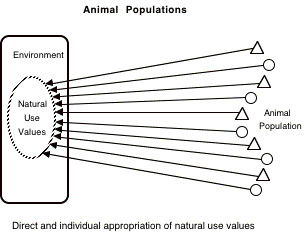
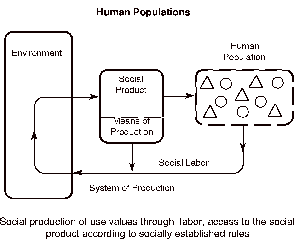
Figure 3.5. Energy Flow in Animal and Human Populations.
This is another way of looking at the thermodynamic peculiarity of the human primate. Among animals there is direct and individual appropriation of naturally occurring use values. Humans, by contrast, expend energy in producing a social product, the use values of which are then consumed according to socially established rules. This makes all humans dependent upon a deep flow of labor energy as embodied in the social product.
In order to see more clearly the differences between the human labor process and the life processes of other creatures, we must elaborate on Marx's discussion. The human labor process includes:
1. the personal activity of human beings, i.e. work itself, or the expenditure of human energy;
2. the subject of that work, which is transformed through human activity;
3. the instruments of labor, or tools;
4. the conception of what is to be produced, which is a cultural construct learned by humans as members of society;
5. the social relations of production, including both cooperation in the productive process and sharing of the product according to established social conventions; and
6. the separation, both spatial and temporal, of production and consumption.
This fully elaborated labor process occurs only among humans, but numerous other species exhibit some, but not all, of these features. Such approximations to the human labor process may be termed protolabor. Examples of protolabor include the tool making and tool using activities of chimps, the social hunting of lions, hunting dogs, and wolves, the nest building of birds, ants, and termites, and the storage of nuts by squirrels.
In the labor process, the labor that is expended in transforming nature into socially acceptable use-value becomes embodied, in a sense, in those use-values. When the use-values are consumed, a definite amount of labor energy is also being consumed. Thus, if I spend two hours digging up yams and another two hours cleaning and cooking them, there are four hours of my labor time embodied in the resulting yam pie. When I eat the pie, I am consuming not only 2000 calories of food energy, I am also consuming four hours of labor energy. If I split the pie with someone else, I am consuming two hours of my labor time, and the other person is also consuming two hours of my labor time. In this way, we may speak of two hours of my labor time flowing to the other person. All human beings are dependent upon these sorts of energy flows as they consume use-values produced by other members of the population and in turn produce use-values which are consumed by others. There is thus a thermodynamic substratum in human societies upon which all human beings depend.
This deep thermodynamic structure is a distinctive feature of our species and, as I have argued elsewhere (Ruyle 1976), underlies the other unique features of humanity. (Similar structures occur in the social insects and, in rudimentary form, in the social carnivores.) Human societies are thus marked by an elaboration of the patterned flow of energy through the sociobiological system, as diagramed in Figure 3.5. These energy flows occur within a definite mode of production, which includes the forces of production, the technological and other information in the minds of the population, the means of production, the tools used in the productive process, and the relations of production, or the social relations of production and consumption.
A mode of production is always associated with a definite mode of reproduction, which includes not only the reproduction of new individuals but also the continual reproduction of existing individuals as they satisfy their basic human needs in domestic organizations. The human family is thus different from the "families" of other species in that human families process, share, and consume use values which are products of labor.
This deep structure of energy flow in production and reproduction creates an added level of human life, for all human individuals are dependent upon use values produced by labor, mostly other people's labor. Again, there is a definite, measurable amount of human labor embodied in the use values consumed by any individual, and each individual expends a definite, measurable amount of labor energy into the system of social production and reproduction. To the extent that use values satisfy needs, there will be efforts to maximize one's access to them (and hence, one's control over labor energy) and to the extent that labor is not satisfying in itself, there will be efforts to reduce one's own expenditure of labor energy. Thus, minimaxing occurs at this level also, but here it has additional ramifications.
In small scale, highly mobile populations of hunters and gatherers, excessive minimaxing creates tensions that jeopardize the system of social production and all individuals that are dependent upon it. For this reason, social relations tend to be egalitarian, with all individuals consuming roughly equal amounts of labor energy and expending roughly equal amounts of energy into the productive system.
In larger, denser, sedentary populations of horticulturalists and agriculturalists, accumulation of wealth becomes a real possibility and with accumulation, the attempt to exploit the labor of other individuals. Such attempts lead to the emergence of exploitative systems designed to pump labor and its products out of the direct producers and into the hands of the exploiting class. A mode of exploitation is an ensemble of exploitative techniques, such as simple plunder, slavery, rent, interest, and wage-labor, designed to extract labor from the direct producers, together with a definite system of violence and a system of thought control.
This mode of exploitation is the instrumentality through which a predator-prey relationship is established within the human species, a relationship in which the stakes are not the bioenergy locked up in animal flesh but rather the labor energy that the human animal can expend in production. The benefits (wealth and privilege) accrue to members of the ruling class, while the costs are borne by the producing classes.
Thus, it is possible to distinguish between human and non-human mammalian societies in thermodynamic terms, so we may distinguish between two types of human societies, egalitarian and stratified.
The mode of exploitation, then, divides the human population into classes, which may be defined as groups of intermarrying families which share a similar qualitative and quantitative relationship to the total flow of labor energy through the system. Different classes develop different behavioral ways of life in adaptation to the total system (for a fuller discussion of exploitation and class society, see Ruyle 1973b, Ruyle 1975, Ruyle 1977b).
All historic and contemporary civilizations are based on definite modes of exploitation which have grown increasingly powerful and sophisticated in the course of cultural evolution. During the past century, however, we have seen another tendency emerge, that of world proletarian revolution, which seeks the dismantling of exploitative systems and the creation of a more egalitarian society.
3.V. Mode of Production and Mode of Exploitation
All human populations adapt to their environment by means of a mode of production, a system of techniques and social relations through which human energy is applied to the transformation of environmental resources into culturally acceptable use values. This productive system is consciously manipulated by the members of the population in order to satisfy biologically based and culturally conditioned needs and desires.
Viewed in thermodynamic terms, human societies fall into two great classes, as diagrammed in Figure 3.6.
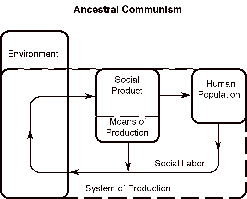
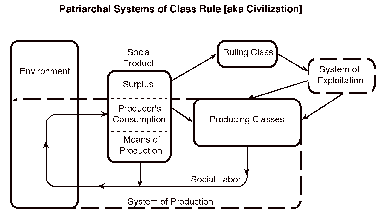
Figure 3.6. Energy Flow in Primitive Communism and Class Rule.
The flow of energy in human populations becomes increasingly complex. Just as there is a fundamental difference between animal and human patterns of energy flow, so there is a fundamental thermodynamic difference between primitive communism and class rule. In primitive communism all members of the population expend and consume more or less equal amounts of labor energy, while in system of class, members of the ruling class expend energy into a mode of exploitation which extracts surplus from the direct producers.
The ensemble of use values produced and consumed by a given population constitutes its social product, which is distributed among members of the population according to socially established rules. This social product has a definite amount of labor energy embodied in its component use values. When individuals consume these use values, they are thus consuming a definite quantity of social labor.
When more than one individual is involved in the production of a particular set of use values, we may speak of a cooperative pooling of labor energy, and when these use values are consumed by someone other than their producers, we may speak of labor energy flowing from producers to consumers.
All human societies are characterized by a high degree of cooperative pooling of labor energy and by labor energy flows between individuals, groups, and classes. Most of what any individual in any human society consumes has been produced by someone else, so that human societies are characterized by a high degree of interdependence between individuals. This interdependence can be empirically verified and measured in thermodynamic terms.
It is possible, then, to abstract from the variety of different sorts of use values consumed by any individual and simply measure the amount of energy (social labor) consumed by each individual. Similarly, we may measure the contribution (in energy) of each individual toward the production of the social product. In doing this, we focus our attention on an essential aspect of human social life. Just as the consumption of bioenergy, in the form of food, is an indispensable aspect of all animal life, so the consumption of labor energy, in the form of socially produced use values, is an essential aspect of all human life.
On the one hand, there are egalitarian, or primitive communist, societies, typically found among hunting and gathering peoples. In primitive communism, all members of the population contribute more or less equally to the social product through expenditure of their own labor energy for most of their lives. Further, all members of the population consume more or less equal amounts of labor energy. The basic unit of social organization is the local band, composed of a small number of families who hunt, gather, and camp together. Band membership fluctuates as the component families move about in response to changing ecological conditions and the ripening of vegetal food, concentrations of game, and for social reasons. All members of the band enjoy equal and unimpeded access to strategic productive resources, all engage in production, and food is shared freely and equally within the band. There is little division of labor except by age and sex. Contrary to popular stereotypes, hunting and gathering peoples do not spend their lives in drudgery but rather are able to satisfy their basic subsistence needs in less than twenty hours of labor per week. Leadership is by example and persuasion and headmen lack any powers of coercion. All members of the population, at least the adult males, have equal access to violence, both because they possess their own weapons and because they can call upon their own kinsmen for support. This equality of access to violence helps prevent the emergence of exploitation. Similarly, the nomadic way of life also prevents exploitation, first because people can freely move away from undesirable social situations and because nomadism prevents any accumulation of wealth goods. All members of the population have roughly equal access to the supernatural and can become shaman, curers, and participants in collective rituals.
Thus, in primitive communism there are no great differentials in wealth or life-style. No one grows up expecting to be exploited throughout their life, nor to live solely by the fruits of exploitation. Related to this, there are no oppressive agencies such as the State and the Church, and no police, no prisons, and no armies. Social order is maintained through a variety of informal mechanisms, but is ultimately rooted in the social and economic interdependence of all members of society. The "liberty, equality, and fraternity" of the primitive commune, then, is rooted the material conditions of life of hunters and gatherers.
But primitive communism should not be viewed as idyllic. Class oppression was not yet developed, but humanity was still subject to the forces of nature. Hunger, disease, high rates of infant mortality, forced infanticide, and abandonment of the aged were common. Further, the mechanisms of social order and conflict resolution were imperfectly developed, and homicide was perhaps the most common cause of death among males. Nonetheless, the primitive communism of the hunting and gathering world was a viable and technologically progressive social order for the greater part of human life on earth.
In contrast to the rough equality of primitive communism, class societies are marked by gross differentials in access to the social product. The last five thousand years of human evolution have been dominated by men who, although they do not participate directly in production, nevertheless are abundantly provided with the good things in life. In all class societies, those classes (slavemasters, nobles, landlords, capitalists) that contribute the least amount of labor energy to production receive the greatest rewards, while those classes (slaves, serfs, peasants, workers) that contribute the most receive the least. Why is this?
Bourgeois social science would have us believe that "society" rewards these people because they contribute something more important than labor to society - brains, managerial skill, technical expertise, valor, or whatever - but this is clearly nonsense. As Rousseau remarked, this is an explanation that slaves might give when they think they are being overheard by their masters but is unworthy of free men and women. No, the real explanation is quite different.
The emergence of wealthy, leisured classes occurs simultaneously with the emergence of special instruments of violence and thought control that are staffed and/or controlled by those who enjoy special privileges and wealth. It seems reasonable, therefore, to conclude that the wealth and privileges of ruling classes result from the activity of the members of the ruling class itself. This activity takes the form of expenditures of energy into a mode of exploitation which pumps surplus labor out of the direct producers and into the exploiting classes. It is thus not "society"that rewards the wealthy and powerful; they reward themselves. They accomplish this by manipulating a mode of exploitation which may thus be thought of as the "mode of production" of the ruling class.
A mode of exploitation has three sets of components (the analysis here is of precapitalist modes of exploitation; modern modes of exploitation require a somewhat different analysis). First of all, there are the exploitative techniques, the precise instrumentalities through which surplus is pumped out of the direct producers and into the ruling class. These may be direct, such as simple plunder, slavery, taxation, or corvee, or indirect, such as rent, differential withdrawal from a redistributive network, or various forms of market exchange, including wage labor. Second, there is the State, which monopolizes legitimate violence and is thereby able to physically coerce the exploited classes. Third, there is the Church, which monopolizes access to the sacred and supernatural and is thereby able to control the minds of the exploited population. These elements, or functions, of the mode of exploitation are combined in different ways by different ruling classes. The State and the Church, for example, may be institutionalized separately, as in medieval Europe and Japan, or they may be combined into a single unitary institution, as in many bronze age civilizations.
The State and the Church, then, form twin agencies of oppression whose purpose is to support and legitimate ruling class exploitation and the wealth and privileges resulting from exploitation. But in addition to their repressive role, these agencies also carry out a variety of socially beneficial functions.
Marx once wrote of the Asiatic state:
There have been in Asia, generally, from immemorial times, but three departments of Government: that of Finance, or the plunder of the interior, that of War, or the plunder of the exterior; and finally, the department of Public Works. (Marx 1853a:90).
Marx's statement here calls our attention to the dual role of the State, as an agency of oppression and of government. Generally speaking, the State carried on the following functions in developed class societies: waging war, suppressing class conflict, protecting private property, punishing theft, constructing and maintaining irrigation works, running state monopolies of key economic resources, regulation of markets, standardization of weights and measures, coinage of money, maintaining roads, and controlling education.
The Church is often viewed as a religious institution, but it is also an important agency of social control. This is well understood by the Catholic Church. Pope Leo XIII, for example, declared that
God has divided the government of the human race between two authorities, ecclesiastical and civil, establishing one over things divine, the other over thing human. (as quoted in White 1959:303)
The importance of the Church in social control is made even more explicit in the following statement of Pope Benedict XV:
Only too well does experience show that when religion is banished, human authority totters to its fall . . . when the rulers of the people disdain the authority of God, the people in turn despise the authority of men. There remains, it is true, the usual expedient of suppressing rebellion by force, but to what effect? Force subdues the bodies of men, not their souls. (as quoted in White 1959:325)
The implication is clear. Only the Church can subdue the souls of human beings and make them accept the oppressiveness of class rule. Leslie White has provided abundant documentation of the role of the Church in subduing the souls of human beings and supporting the ruling class by 1) supporting the State in its functions of waging war, suppressing class struggle, and protecting private property, and 2) "keeping the subordinate class at home obedient and docile" (White 1959:303-328). The content of the religious ideology promulgated by the Church helps fulfill this latter function by promising the subordinate class in the afterlife the rewards they are denied in this world, and by threatening the punishment of Hell for misbehavior in this world.
The Church also plays an important role in legitimating the system by teaching that the social order is an extension of the natural and sacred orders. This legitimation has a dual aspect. First, there is the manipulative, thought control aspect in which the content of religious ideology is consciously shaped in order to support the existing system. Second, and also very important, is the legitimation of the system to the rulers themselves. Max Weber discussed the latter aspect as follows:
When a man who is happy compares his position with that of one who is not happy, he is not content with the fact of his happiness, but desires something more, namely the right to this happiness, the consciousness that he has earned his good fortune, in contrast to the unfortunate one who must equally have earned his misfortune. . . . What the privileged classes require of religion, if anything at all, is this psychological reassurance of legitimacy (Weber 1922:106-107).
It is important to distinguish between religion and the Church. Religion is any body of ideas about the sacred and supernatural. As such, it precedes class society and plays important functions even in primitive communism. In class society, religion becomes an arena of class struggle and religion becomes divided into the religion of the oppressed and the religion of the oppressor. It is the latter which is promulgated by the Church, which is a social organization, controlled by the ruling class, which uses religion for purposes of thought control. In modern systems, it may be noted, these thought control functions are largely taken over by other institutions such as the mass media and educational system, so that the role of the Church is somewhat reduced.
This mode of exploitation, including an ensemble of exploitative techniques, the State, and the Church, is the instrumentality through which a predator-prey relationship is established within the human species in which the stakes are human labor energy rather than the energy locked up in animal flesh. The differentials of wealth, privilege, and prestige which characterized all historic civilizations are created by this predatory relationship between ruler and ruled.
Once this predatory relationship is established, the system of exploitation become larger and more complex, with a complex division of labor developing not only in the sphere of production (between agricultural workers and workers in the industrial arts, metallurgy, textiles, pottery, etc.) but also in the sphere of exploitation (warriors, priests, scribes, etc.). The result is an elaboration of occupations and statuses among the different kinds of producers, exploiters, parasitic groups, and so on. This predatory relationship between rulers and ruled, then, generates the division of the population into classes, which are best defined by their relationship to the underlying flow of labor energy through the population.
The surface structure of developed class societies may be quite complex, and the fundamental class opposition between ruler and ruled is likely to be overlaid and concealed by a more diversified arrangement of classes attached to the flow of social energy in a variety of ways. In addition to the ruling class itself, there are typically privileged retainer classes (officials, scribes, priests), various divisions within the producing class (between peasants and artisans and between rich and poor peasants, for example), and finally an underclass (composed of outcastes, outcasts, beggars, and thieves), which may not be directly exploited but which nonetheless plays an important role the the overall system of exploitation.
The mode of exploitation, then, divides the human population into classes, which may be defined as groups of intermarrying families which share a similar qualitative and quantitative relationship to the total flow of labor energy through the system. Different classes develop different behavioral ways of life in adaptation to the total system (for a fuller discussion of exploitation and class society, see Ruyle, 1973b, 1975].
All historic and contemporary civilizations are based on definite modes of exploitation which have grown increasingly powerful and sophisticated in the course of cultural evolution. During the past century, however, we have seen another tendency emerge, that of world proletarian revolution, which seeks the dismantling of exploitative systems and the creation of a more egalitarian society.
We began with the behavior of individuals, but we cannot stop there. The behavior of individuals is part of a total system of energy flows between individuals and between classes which must be understood in its own terms. The genetic mystics have little to offer here. We must understand the total material conditions of life of the population in question. Central to such understanding are the concepts of modes of production and reproduction and mode of exploitation.
These phenomena, production, reproduction, and exploitation, are vital aspects of human biology. Exploitative systems, in particular, are essential parts of human sociobiological systems for they determine how humans will satisfy their basic biological needs. Yet they are ignored by the genetic mystics and cultural idealists alike, for they cannot be reduced to information, genetic or cultural. Indeed, these material structures of production, reproduction, and exploitation generate selective pressures which determine the content of informational systems. We may turn to an analysis of the processes through which ideology is articulated with the material conditions of life.
3.VI. The Formation of Ideology
Our analysis thus far has focused on sociobiological systems as thermodynamic structures characterized by definite patterns of energy flow through systems of production, reproduction, and exploitation. Sociobiological systems also contain information, both the genetic information stressed by bourgeois sociobiology and the information in people's heads, cultural information. Such information is an essential component of any sociobiological system. As Marx points out, however,
the distinction should always be made between the material transformation of the economic conditions of production which can be established with the precision of natural science, and the legal, political, religious, aesthetic or philosophical—in short, ideological—forms in which men become conscious of this conflict and fight it out. (Marx 1859:5)
This is essentially the distinction I am attempting to elaborate, between, on the one hand, the thermodynamic systems of production, reproduction, and exploitation which constitute what might be called the material conditions of life, and, on the other, the ideas which people have in their heads and express in their verbal and non-verbal behavior and which belong in the sphere of information. The former can, as Marx points out, "be established with the precision of natural science," although the practical problems of doing so should not be underestimated (as the fact that Marx was never able to complete Capital can attest). The latter are also a legitimate object of natural scientific inquiry. A natural science of humanity must understand not only the nature of ideology and the role of ideology in social life, but must also address questions such as: Where does ideology come from? What determines the content of ideological systems? How is ideology related to the material conditions of social life?
It is to such questions that we now turn.
3.VI.1. What is Ideology?
Ideology, broadly speaking, is what goes on in the heads of human beings. As such, it is a form of information which may be counterposed to the information in our genes. The information in our heads is quite complex, and includes not only the symbols involved in conscious thought, but also the underlying values and psychological drives of our subconscious and unconscious lives. Ideology thus includes not only political and economic ideas, but also technological ideas, ideas about proper and improper social relationships, values, norms, laws and rules, and artistic and philosophical ideas.
In addition to this broad view of ideology which I am adopting, there are also more narrow views that would restrict ideology more narrowly to beliefs systems that function to legitimize the political and economic interests of particular groups, to forms of false consciousness the function of which is to conceal the world in a Mannheimian sense, or to public ideas about human affairs promulgated by the state (for more thorough discussions, see Mannheim 1927, McMurtry 1978:123-144). Although these more restricted views of ideology are more prevalent, I will use the term in its broader sense.
Bourgeois sociobiology and some forms of "economic determinism" reduce ideology to epiphenomenal status: what is really important is the genetic information formed through the process of "inclusive fitness" or of "reflection" of economic and political interests. On the other hand, bourgeois idealists go to the other extreme and see the ideas in people's heads as almost a deus ex machina which determines human behavior. Human history, and the cultural variation between societies, are seen as determined by the movement of ideas.
Bourgeois social science does indeed provide good analyses of ideas and the impact of ideas on human behavior and human history, although it tends to overemphasize the ideology "factor" and neglect the class question. Where bourgeois social science fails, as we noted in the last chapter, is in not asking the questions: Where do these ideas come from? Why do certain ideas characterize some historical periods, and some societies, and not others? Such questions are either not asked or simply dismissed by most bourgeois social thought. In one of the classic works of anthropology, for example, Ruth Benedict simply referred to an old Digger Indian myth: "God gave to every people a cup, a cup of clay, and from this cup they drank their life. … They all dipped in the water, but their cups were different." (Benedict 1934:33, as quoted by (Harris 1968:403) As Harris points out, this may be quite poetic and humanistically pleasing, but is unacceptable from a scientific standpoint.
In order to address the question the roots of ideology in human social life, we must examine the functions that ideology plays, the human needs that it satisfies.
Ideology, first of all, and always foremost, serves as a basis for human activity. As humans, we lack the precise genetic programming that guides the behavior of social insects and many other animal species. Instead, we acquire this programming through the process of enculturation as we learn the various behaviors necessary to satisfy our needs. These needs include not only our material needs for food, clothing, shelter, and so on, but also our social needs for companionship, warmth, respect from our fellow humans, and so on. Ideology also gives us models for our interactions with other human beings, sets of ideas about social statuses, role behavior, norms, and rules for us to follow or break (and rules for breaking rules). Ideology allows us to make sense of the world, providing us with a model of the reality, how the world functions, and our place in it. Ideology provides us with core values which govern our decision making, and our artistic, musical, and literary sensibilities. Ideology may also serve to conceal unpleasant portions of reality from us.
Ideology, as the ideas, norms, and values inside people's heads, thus serves the needs of its bearers. But although the ideological complex within people's heads forms an integrated system, it is not a perfect system. It is marked by both coherence and contradiction. In part this is because people's needs are frequently contradictory, but it is also because people live within contradictory social systems marked by class struggle. The class struggle is fundamentally thermodynamic in nature, concerned with the struggle over the control of human labor and its products, but it is also ideological, a struggle to control the content of people's minds.
In analyzing ideology, therefore, we must examine not only how it serves human needs, but whose needs are being served.
3.VI.2. Ideology and Material Conditions
The scientific investigation of ideology is, of course, a complex matter which both Marxist and bourgeois social scientists have grappled in a variety of ways, with varying degrees of success but never in an entirely satisfactory way. Marx touched upon the topic repeatedly and with considerable insight, but did not give us a systematic and complete treatment of the topic. Various writers have attempted to systematize Marx's views on the matter, some sympathetically, and others have attempted to refute Marxist conceptions. Perhaps a brief review of some of these attempts will help define the problem. We will consider the approaches of Gerhard Lenski, who represents the materialist vein in bourgeois social thought, of the Stalinist school of orthodox Marxism-Leninism, and of John McMurtry, who represents a more recent attempt to present Marx's views in a systematic manner.
Lenski divides sociocultural systems into four basic components: language ("a system of symbols capable of transmitting and storing information"), technology ("the information, techniques, and tools by means of which men utilize the material resources of the environment to satisfy their varied needs and desires"), social organization ("any structured system of relationships among people," including individuals, roles, groups, statuses, and classes), and ideology ("a society's basic belief systems and their applications to daily life," including world views, values, and norms) (Lenski 1970:34-47). Lenski uses this framework to espouse a form of technological determinism:
As we have seen at a number of points in our analysis,
technology plays a distinctive role in the process of societal evolution. Compared with the other basic elements
in sociocultural evolution (i.e., language, social organization, and ideology),
it is far likelier to be an autogenous source of change, and it also causes
change in them much more often than they change it.…
From an
evolutionary perspective, the relationship between technology, social
organization, and ideology resembles the movement on a two-way street where the
flow is heavier in one direction than the other.… the dominant flow of influence is from technology to social
organization and ideology; the flow in the opposite direction is not only less
frequent, it is also less important.…
To say that
technology exercises an important influence on social organization and ideology
is not to deny that causal influences also flow in the opposite direction. Social organizations and ideologies,
once established, can influence technological systems. Their chief effect, however, has been
to influence the rate of technological innovation. Some systems of social organization and some ideologies have
been conducive to high rates of innovation, while others have had the opposite
effect. To a lesser degree,
systems of social organization and ideologies influence the content of
technological innovation, stimulating technological advances in some areas at
the expense of others (e.g., advances in military technology taking precedent
over advances in subsistence technology).
These influences are important,… but … over the total course of history
their influence on technology has been loss potent and less important than the
reverse. (Lenski 1970:101-104)
Lenski's materialism here is similar to that of the school of cultural materialism in anthropology (Cohen 1971, Harris 1968, Harris 1985, White 1949, White 1959). Lenski uses his technological determinism in a distinctive manner, however, since he develops a societal taxonomy based on subsistence technology and then uses this taxonomy to analyze the over 900 societies in the Ethnographic Atlas to show how various aspects of social life are correlated to technological type. This is discussed more thoroughly below (Chapter 4). Lenski's framework is important because it provides statistical confirmation of the Marxist principle that material life processes determine the rest of the sociocultural complex.
Although Lenski's framework can be criticized (Ruyle 1975), it has the virtues of being clear and easy to understand. It also effectively refutes bourgeois idealism which sees ideas as the prime movers of human behavior.
Within the Marxist tradition, the most influential statement of the relationship between ideology and material conditions is that of Stalin and more recent Soviet theorists. Stalin saw the material world as primary, as secondary and hence derivative:
if nature, being the material world, is primary, and mind,
thought, is secondary, derivative; if the material world represents objective
reality existing independently of the mind of men, while the mind is a
reflection of this objective reality, it follows that the material life of
society, its being, is also primary, and its spiritual life secondary,
derivative, and that the material life of society is an objective reality
existing independently of the will of men, while the spiritual life of society
is a reflection of this objective reality, a reflection of being.
Hence the
source of formation of the spiritual life of society, the origin of social
ideas, social theories, political views, and political institutions, should not
be sought for in the ideas, theories, views and political institutions
themselves, but in the conditions of the material life of society, in social
being, of which these ideas, theories, views, etc., are the reflection.
Hence, if
in different periods of the history of society different social ideas,
theories, views, and political institutions are to be observed; if under the
slave system we encounter certain social ideas, theories, views, and political
institutions, under feudalism others, and under capitalism others still, this
is not to be explained by the "nature," the "properties" of
the ideas, theories, views and political institutions themselves but by the
different conditions of the material life of society at different periods of
development.
Whatever is
the being of a society, whatever are the conditions of material life of a
society, such are the ideas, theories, political views and political
institutions of that society.
In this
connection, Marx says: "It is not the consciousness of men that determines
their being, but, on the contrary, their social being that determines their
consciousness." (A
Contribution to the Critique of Political Economy.)
It does not
follow from Marx's words, however, that social ideas, theories, political
views, and political institutions are of no significance in the life of
society, that they do not reciprocally affect social being, the development of
the material conditions of society.
We have been speaking so far of the origin of
social ideas, theories, views, and political institutions, of the way
they arise, of the fact that the spiritual
life of society is a reflection of the conditions of its material life. As regards the significance of social ideas, theories, views, and political
institutions, as regards their role in history, historical materialism, far
from denying them, stresses the role and importance of these factors in the
life of society, in its history.
(Stalin 1940:20-22)
These ideas have been developed in a more schematic manner in a recent Soviet textbook:
The nature of production relations determines the economic
system of a given society. This
economic system is the basis on which the various social relations, ideas and
institutions arise, for the mode of production eventually determines all
aspects of life in a given society.
First, the basis determines the political and legal institutions and
organisations which depend upon the class structure of society (the state,
church, political parties, etc.)—everything that constitutes the political
superstructure of society (political, legal, philosophical, religious,
artistic, etc.)—everything that constitutes the ideological superstructure of
society.
Since the
basis determines the superstructure, it follows that every change of basis
entails a change in superstructure, i.e., in the existing political
institutions and ideology.
However, the superstructure, though dependent upon the basis, can in
turn influence production relations and can either accelerate or delay their
replacement.
Every
society is thus an integral organism, a socio-economic formation, a definite
historical type of society with its own distinctive mode of production, basis,
and superstructure. (Mitropolsky,
Zubritsky, and Kerov n.d.:65-66)
Although Stalin may be criticized for being overly schematic and simplistic (Cameron 1987:144-161), his work has the virtue of being clear and direct. It also provides an essentially correct statement of the relationship between thought and matter. More recent work by Soviet scholars provide useful criticisms of the idealism and "great man" theories of bourgeois eclecticism, as well as elaborations of Stalin's framework. A recent Soviet textbook, for example, clarifies the concept of "reflection" as follows:
In
contrast to these various idealist beliefs materialism proceeded, and still
proceeds, from the fact that consciousness is a function of the human brain,
the essence of which lies in the reflection of reality.…
The
dialectical-materialist concept of consciousness is based on the principle of
reflection, that is, the mental representation of the object in the brain of
the individual in the form of sensations, perceptions, representations and
concepts. The content of
consciousness is ultimately determined by surrounding reality, and its material
substratum, or vehicle, is the human brain. It is quite obvious then that without the brain, without the
mechanisms providing the paths that connect it with the world there can be no
spiritual life.…
Consciousness
is characterised by an active creative attitude to the external world, to
oneself, to human activity. The
activeness of consciousness can be seen in the fact that a person reflects the
external world purposefully, selectively.
He reproduces in his head objects and phenomena through the prism of the
knowledge he has already acquired—his representations and concepts. Reality is recreated in human consciousness not in the dead
form of a mirror-like reflection, but in a creatively transformed state. Consciousness is capable of creating
images that anticipate reality.
(Malinin 1974:102-103, 112)
This concept of reflection provides a useful statement of the manner in which ideas are formed in the human mind and how these ideas are related to, or determined by, material reality. It needs to be stressed, however, that this process of "reflection" is a social process. Individuals do not simply create the world anew in their own brains in a completely individual manner, they do so in interaction with other members of the population, in the process anthropologists call enculturation and sociologists call socialization.
Finally, we may look at a more recent attempt to re-state Marx's views on ideology, that of McMurtry. McMurtry compares Marx's views on the formation of ideology with Darwin's views on the evolution of life-forms, and sees the impact of material conditions on ideology both in terms of selecting out ideological forms that do not correspond to the politico-economic structure and in terms of a positive projection of the politico-economic structure into the realm of ideology. Discussing the first of these, McMurtry writes:
It might be objected here that the concept of
"complying" or "corresponding" with the economic structure
lacks rigour, and that in consequence Marx's theory of economic determinism is
not scientifically acceptable.
However, such a caveat tells quite as forcefully against Darwin's
similar, but scientifically accepted, theory of natural selection. Darwin, as we know, claims that "favorable
species tend to be preserved and unfavorable ones to be destroyed." But he never specifies set criteria of
what it is for a species to be "favorable" or "unfavorable"
or, otherwise put, "fit" or "unfit" for natural
survival. Similarly, Marx does not
sponsor such criteria for what it is for a superstructural or ideological
phenomenon to be fit or unfit for social survival. (That is, compliant or uncompliant with the economic
structure). In both cases
empirical inquiry into the relevant concrete circumstances is required to
generate a judgement of what in fact will be selected, or selected out, in the
"struggle for life." But
in both cases, reliable predictions or explanations can be deduced by
application of the "law of selection" in question to the
circumstances in question. Thus,
just as Darwin can reliably predict that, say, dolphins in the Thames will
suffer extinction (because the material succor they require is lacking in such
a natural environment), so Marx can reliably predict that a bill for worker
management of factories on the floor of British parliament will suffer
extinction (because the material "succor" it requires is lacking in
such an environment). Marx's
theory of social selection is, in short, no more problematic in its scientific
form than Darwin's homologous theory of natural selection.
It might
still be objected here that there are many historical occurrences that plainly
falsify Marx's "law" that only what "complies" or
"corresponds" with the economic structure is permitted social
survival. For instance—we cast
about for the most persuasive local example that this sort of rejoiner might
muster—the Canadian volume White Niggers of America by the
Quebec radical, Pierre Vallières, was in recent years permitted publication and
wide distribution in two languages in Canada, though it called for armed
overthrow of the government and the uncompensated expropriation of all
large-scale capitalist enterprises.
Here, surely, a critic might claim, is a clear case of empirical refutation
of Marx's economic-determinist principle.
A
convincing reply would be this.
First, the book itself was published by a large capitalist firm and
earned substantial profits for the firm, thus clearly reinforcing the economic
structure. Second, state repression
of its publication might have generated more challenges to the capitalist
economic order than it prevented and, therefore, been inimical in the end to
the preservation of this order.
Thus, again, the book's correspondence to the economic structure. And finally, when circumstances arose
such that this and similar literature did represent a clearer threat to the
economic structure than hitherto, a special and decisive superstructural step
was taken—invocation by the national government of the War Measures Act—whereby
all support of the cause it embraced was subject to indefinite detention—an
executive move that permitted, among other things, the extended imprisonment of
the book's author. In short, an examination
of specific historical circumstances leads plausibly to the conclusion that the
apparent refutation here of Marx's economic-determinist principle is, on closer
examination, a confirmation of it.
Other apparent refutations might be similarly subverted.
In a footnote, McMurtry continues:
Nonetheless, we think there is a need for refinement of this "law" of economic determinism: namely, that whatever superstructural phenomenon does not correspond to the economic order is blocked from, or selected out of, existence. We propose, then, the complementary "law": The extent of such blocking or selecting out is in direct proportion to the extent of the noncorrespondence in question. That is, the more a superstructural phenomenon "contradicts" the determining economic order, the more thoroughgoing is its annihilation. Marx's exact arguments, for example, maximally contradict the capitalist economic order and are, accordingly, maximally blocked from and selected out of social currency in capitalist-society schools, courts, churches, mass media, and so on. Where they do not suffer such social extinction (that is, in some university curricula) their existence, according to our complementary "law," obtains only to the extent that their noncorrespondence with the capitalist economic order is reduced, that is, via confinement to an elite audience, non-core program, refutive approach, prolix formulation, and so forth. Conversely, insofar as "contradictory" ideology is neither thus extinguished nor reduced, its survival signals impending transformation of the economic order. (McMurtry 1978:163-165)
In addition to this negative selecting out of ideological forms that do not correspond to it, the economic plays a positive role in projecting content into the ideological realm, a process McMurtry calls "mapping":
In this mapping, definite economic-structural content is
projected onto the superstructure, which, in our account, has already been
shown to be constrained within a "limited field," that is, within
bounds that comply with the economic structure. Thus, whereas in the (earlier) sense of economic
determinism, we spoke of the determining limits beyond which
superstructural and ideological phenomena could not go, new we speak of the
actual content within these limits that the economic
structure gives rise to.
Perhaps the
most graphic way of explicating economic determinism by "mapping" is
by illustration.
Consider a
capitalist economic structure. It
is constituted of "bloodless" exchange-value terms: abstract, equal,
and homogeneous monetary units to which all use-values and economic roles in
the society are increasingly reduced.
This capitalist economic structure, says Marx, is qualitatively
"reflected" in the political and legal doctrines of Equal Rights, the
abstract religion of Protestantism, and the empty reified categories of German
Idealism. Its transformation of
social labour into cash-value terms, into the "social hieroglyphic of
money, is "mirrored" as an "image in men's brains" of
commodities and forms of capital ruling the world as independent entities. Its atomicizing of economic intercourse
is reflected in moral doctrines of
exploitative self-interest. Its principle
of unlimited competition is projected onto Malthusian and Darwinist theories of
human life as an eternal contest.
Its indifference to human content is reflected in a scientific and
religious rhetoric of "abstinence"; its inequalities of income in the
popular notion of "God's elect"; its unrestricted extension into
distant lands in the credo of "civilization"; its reduction of the
laborer to machine-appendage status in an ethic or "Work" and
"order"; and its removal of all hindrances to exploitation by capital
in the laws and slogans of "Liberty" and "Freedom". (McMurtry 1978:165-167, parenthetical
citations omitted)
Thus, in addition to constraining ideology in certain ways, the political economic system also projects definite content into the ideological sphere. McMurtry's formulation here is more satisfying, I think, than the more familiar base/superstructure metaphor employed in the Stalinist tradition. It also links Marx's ideas on the formation of ideology with Darwin's ideas on the evolution of species, a parallel I will explore more fully below. Before doing so, we need to discuss the contribution that anthropology can make to this question.
3.VI.3. Ideology and Culture
Anthropologists also deal with the question of ideology. The concepts and examples used by anthropologists may be different, but they deal with the same fundamental question: how do we explain the diverse ideas that men and women use to order their lives? The anthropolological approach is much broader. Both Marxist and bourgeois social science deals with the problem of ideology within a single cultural tradition, Western civilization. Anthropologists deal with the full range of cultural traditions developed by our species.
The anthropological concept of culture is much broader than that employed by non-anthropologists, both bourgeois and Marxist, who usually restrict the concept of culture to literature and the arts. For anthropologists, culture is coterminous with social life itself. This anthropological concept was given its classic formulation by E.B. Tylor in 1871:
Culture, or Civilization, taken in its wide ethnographic sense, is that complex whole which includes knowledge, belief, art, morals, law, custom, and any other capabilities and habits acquired by man as a member of society. The condition of culture among the various societies of mankind, in so far as it is capable of being investigated on general principles, is a subject apt for the study of the laws of human thought and action. (Tylor 1871:1)
The key feature here is that, for anthropologists, culture includes all "capabilities and habits" that people learn as members of society. It includes technology, social statuses and roles, norms, values, world view, and religion,,as well as what is commonly termed "culture" by non-anthropologists, and is counterposed to our genetic inheritance. For anthropologists, human genetics is a constant, the variability in human behavior, life styles, and social structures is a function of culture.
Our problem, then, is to reconcile the traditional Marxist approaches to ideology with the anthropological approaches to the understanding of culture. Culture, ideology, social consciousness—these are all terms for aspects of the information that is associated with human populations. One way of integrating these diverse approaches is through a variation and selective retention model analogous to the synthetic theory of bio-evolution. This approach has generated a respectable literature among anthropologists, social scientists, and others. I believe is the most powerful of the alternative ways of dealing with the topic. It has the further advantage of being integrated with the ecological and thermodynamic approach discussed above for analyzing systems of production, reproduction, and exploitation. The result is what I have termed a unified theory of biocultural evolution capable of explaining both Darwinian biological evolution and Marxist political economy. Applied to our species, it can be used to explain not only the diverse cultural complexes of hunting and gathering and horticultural peoples traditionally studied by anthropologists but also the complex class struggles of the modern epoch studied by Marxists.
3.VI.4. Selective Pressures and the Cultural Pool
Just as Darwin cut through the mystification surrounding theological discussions of the origin of species by introducing the concept of natural selection, so Marx cut through the mystification of then-prevalent idealist conceptions of history by linking ideology into material conditions: "It is not the consciousness of humans that determines their existence, rather, it is their social existence that determines their consciousness." In an earlier paper, I attempted to combine these insights of Darwin and Marx into a unified theory of biocultural evolution, in which "both the genetic and cultural heritages of populations are determined by selective pressures emerging from the material conditions of life and acting on the individual members of the population." (Ruyle 1973a):202]
We begin by restating, in very simple terms, the modern synthetic theory of evolution, so called because it is a synthesis of the ideas of Darwin on natural selection and Mendel on genetic inheritance.
The unit of evolution is the population which is made up of individual organisms, each with varying characteristics. The characteristics of these individual organisms is determined by a combination of their genes and environment. The genetic makeup of an individual is their genotype. The actual physical characteristics of that individual is their phenotype. Phenotypes are determined by genotypes in interaction with the environment. The totality of genes of the individuals making up a population is the population's gene pool. This gene pool may be described in statistically in terms of the relative frequency of the various forms, or alleles, of each gene. Each individual is simply a sample drawn from alleles in the gene pool of the population, and each individual contributes his or her alleles to his or her offspring and hence to the gene pool of the succeeding generation. Those individuals which have more offspring will contribute more alleles to the gene pool, those that have less offspring will contribute less. It is this differential reproduction that leads to evolutionary change and stability.
Variation is a crucial aspect of evolutionary change. Clearly, if all individuals had identical genetic makeups, there would be no evolutionary change even with differential reproduction. But there is variation, and since normally all individuals have the capacity for expanded reproduction (that is, leaving more than enough offspring to replace themselves) there is a "struggle for survival" which results in the "survival of the fittest." The "fittest" individuals survive and leave more offspring and hence their genes come to dominate the genetic pool of the population. This is the process whereby populations of organisms become adapted the their environment and whereby this adaptation is maintained.
This conceptual framework allows biologists to explain the biological characteristics of organisms. For example, if we want to understand why giraffes have long necks, we do so by showing how these long necks contribute to their survival and reproduction. Long necks enable giraffes to eat the leaves of trees and thereby survive and leave offspring. If their necks are too short, they are undernourished and leave fewer offspring; if they are too long, they are too clumsy, can't escape from predators and cannot leave offspring. Although this process involves the life-chances of individuals, its effects are seen only over generations. Selective pressures favor certain variations over others (long necks over short necks) and thereby explain the adaptation of organisms to their environments.
Some further points of clarification need to be made. First, the term "survival of the fittest" is tautological since fitness is defined as the ability to survive and leave offspring. The scientific utility of this concept, however, is that if forces biologists to examine empirically how various biological traits contribute to survival and differential reproduction.
Second, the term "struggle for survival" may be misleading unless it is understood that organisms may engage in this struggle through cooperation as well as competition. Frequently—if not usually—organisms struggle to survive by cooperating in the food quest, care of offspring, and defense from predators. Selective pressures may favor cooperative individuals rather than competitive ones, depending upon particular material circumstances.
Third, the selective pressures favoring certain traits are always specific to particular ways of life within particular environments. Selective pressures favor long necks among giraffes that eat tree leaves, but not among monkeys that live in the trees or among gazelles that eat grass. Selective pressures favor fleetness of foot among gazelles and cheetahs but not elephants or ground hogs. Intelligence is adaptive for monkeys, apes, and humans, but not clams. Further, selective pressures usually favor some optimum level of a particular characteristic—neck length, speed, or intelligence—since there are always countervailing pressures favor other characteristics. The more of a giraffe's biomass that is used up in long necks, the less that can be used in other organs—legs, digestive organs, brains, etc.—that are also essential for its survival and reproduction. The biological characteristics of organisms, then, are determined by complex systems of interacting selective pressures associated with particular behavioral ways of life and particular ecological niches within particular ecosystems.
Thus, the synthetic theory of evolution employed by biologists explains biological traits in terms of the material conditions of life of the organism in question. This theoretical framework includes a variety of concepts—genes and alleles, "struggle for survival," "survival of the fittest," differential reproduction, selective pressures, adaptation, behavioral way of life, ecological niche—to explore the relationship between the genetic information of organisms and the material conditions of the life of organisms. Bourgeois biologists do not, of course, use the Marxian term "material conditions of life" to subsume behavioral way of life, ecological niche, and environment, but the term is applicable and helps open the way for developing an analogous conceptual framework to explain another kind of information associated with human populations—culture, or ideology.
Thus, the analogue of genes and alleles are the ideas, beliefs, and values existing in the minds of individual members of the population; the analogue of the gene pool is the cultural pool, the totality of the ideas, beliefs, and values existing in the minds of all members of the population. The ideas are manifested in the behavior, both verbal and nonverbal, of the members of the population, analogous to the phenotypic manifestation of an individual's genotype. Just as there is a "struggle for survival" and a "survival of the fittest" in which some members of the population are more "fit" and therefore leave more offspring than others, so there is a "struggle for satisfaction" in which individuals are attempting to satisfy their needs and in which some ideas better serve the interests of individuals and are therefore replicated more successfully than others in the cultural pool. Thus, an individual's genotype is drawn from the gene pool and the individual contributes his or her genes to the gene pool of the succeeding population through a process of differential reproduction controlled by selective pressures emanating from the material conditions of life. In a similar way, an individual's ideas, beliefs, and values are drawn from the cultural pool and the individual contributes his or her ideas back into the cultural pool (in speech and other forms of behavior) through a process of differential replication controlled by selective pressures emanating from the material conditions of life. In this way, the content of ideology is "determined" by material conditions.
This analogy between biological and cultural evolution is not, of course, perfect, and it is necessary to examine some of the differences in greater detail.
First, when we compare the information in our heads with the information in our genes, we see clear differences. Our genetic information is independent of our will; it is determined at conception when we inherit fifty per cent of the genetic information of each of our parents. This does not change during our lifetimes, and we in turn transmit fifty per cent of our genetic information to each of our offspring. We cannot change our genes, but, we can change our minds. The information in our heads is learned information, and learning is a life-long process. The process of cultural evolution, therefore, is Lamarkian rather than Darwinian. Darwin's theory—and Mendel's—was based on the non-inheritance of acquired characteristics. Individuals only transmit to their offspring the genetic information that they acquired at conception. Lamark's earlier theory of biological evolution postulated that individuals acquired various characteristics through their own struggles for existence and transmitted these characteristics to their offspring. This has been shown to be incorrect for biological evolution, but is a central feature of cultural evolution.
Further, the element of consciousness, which is excluded from the Darwinian theory, is vital in cultural evolution. Individuals are consciously seeking to satisfy their needs, and are consciously trying to solve the problems involved in doing so. In this process, they select the ideas that are useful and discard those that are not. This makes the process of cultural evolution much more rapid than biological evolution. In biological evolution, a population adapts to its environment slowly, as selective pressures favor the reproduction of more "fit" individuals over less "fit" individuals over the course of generations. In cultural evolution, by contrast, individuals can adjust their ideas and behavior to a new situation very rapidly, as selective pressures favor useful ideas within a single generation. This is not to say, of course, that the process of cultural adaptation is simple and automatic, nor that there are no barriers at work. Clearly, in addition to conscious problem solving there are unconscious, subconscious, and irrational processes at work in cultural evolution. The point is simply that the processes of cultural evolution, though analogous to those of biological evolution, are different.
The information in our heads is acquired by an active process in which the individual seeks to make sense of the world, gathering information through his or her senses and from his or her parents, siblings, elders, peers, schools, the media, and god-knows where else. The process is probably more like a Liebnizian "monad" than a Lockean "white slate" ("Nothing is in the mind that has not been in the senses, except the mind itself. " Liebniz, as quoted by Durant 1963:668).
In their struggle to satisfy their needs as organisms, individuals must learn about the world, make sense of the world, and learn how to use external reality to satisfy their needs. For humans, like most other primates, this is not simply an individual process, but a social process. Most of what we humans learn is learned from other members of society, not simply on the basis of our individual and idiosyncratic encounters with reality. Further, the reality we are most concerned with is a social reality, not simply the natural world.
If we define learning simply as the acquisition of information by other than genetic means, we see that a variety of processes are involved. Learning theory in psychology lists the following: classical conditioning, a la Pavlov, instrumental conditioning, chaining, acquisition of skill, discrimination learning. concept formation, principle learning, problem solving (Kimble 1983:755), to which we can add imprinting and perception through the senses. The kinds of issues addressed by psychologists in learning theory, however, are quite different from those posed by both anthropology and Marxism. Anthropologists deal with exotic customs such as genital mutilation, shamanism, and ghost marriage, while for Marxism, the problem of class consciousness is a central concern. In our effort to understand and explain such phenomena, we need to pose the question of learning in the broadest possible terms, and, following Fried, distinguish between three levels of learning: situational, social, and symbolic:
In terms of the broadest posing of problems of culture, it
seems profitable to make a distinction not usually applied in psychology and to
differentiate three kinds of learning according to the contexts in which they
occur. We may refer to them as
"situational," "social," and "symbolic" learning.
Situational
learning is the most widely distributed of the three and is almost synonymous
with life. Certainly it is found
among protists and all forms of animal life. It is the process by which an organism adopts or alters a
behavioral response on the basis of experience.…
Social
learning occurs when one organism, perceiving another encounter a stimulus and
emit a response, acquires that response as part of its own behavioral
repertory.…
No organism
can rely on social learning alone.
All organisms that learn socially also learn situationally. Man is one of the organisms that learns
both situationally and socially.
But man, as remarked before, also learns symbolically.
The crux of
symbolic learning is the omission of the original situation. In situational learning the learning
organism encounters and responds to a situational stimulus. In social learning the organism
perceives another organism encountering and responding to the stimulus
situation. In symbolic learning
the stimulus situation is not present but is represented by something else—by a
symbol. The symbol may be a fairly
complex bit of representational behavior, but most symbols are relatively
simple, highly concentrated substitutes for the originals.
Symbolic
learning consequently has almost infinite possibilities for aggregation, as
idea can be added to idea and as new formulations can be tried symbolically
with minimal waste of time and effort.
It is also supremely "time-binding" as one well-known phrase
has it. The general behavior of
one generation shapes and, to a great extent, determines the behavior of the
next and is its raw material, apart from genetic patterns. Although something similar can occur in
social learning, the difference in magnitude is so great as to constitute a
genuine difference in kind.
Against
this background, "culture" may be defined as the totality of
conventional behavioral responses acquired primarily by symbolic learning. (Fried 1967:5-7)
This process of learning is linked into the process of determination of the content of the cultural pool. According to our unified theory, diagramed in Figure 3.7., the gene pool of a population is determined by selective pressures emerging from the "struggle for survival" within a definite set of material conditions. In a similar manner, the cultural pool is determined by selective pressures emerging from the "struggle for satisfaction" of individuals within this same set of material conditions.
The material conditions of life of a given population, its pattern of energy intake (bioenergy system) and expenditure (ethnoenergy system), within a definite environment generates the selective pressures which determine, over generations, its genetic makeup and, more immediately, its ideology. It is this concept which unifies Darwinian evolution and Marxian political economy. What is significant is that political economy determines ideology, rather than vice-versa. Let us examine the selective processes at work in the formation of ideology.
First of all, there are selective pressures which operate on individuals in a manner analogous to those on the gene pool. The basic criterion here is differential satisfaction. Individuals select information which provides the basis for behavior which is satisfying within a particular set of social and material conditions. The process differs from genetic selection in that it is much more rapid. New information is learned within the lifetime of a single individual, rather than over generations as is the case with genetic selection. Further, not only does ideology provide a faithful reflection of the real world to serve as a basis for action, but ideology also has a Mannheimian function of concealing distasteful aspects of the real world, which also can provide satisfaction for individuals.
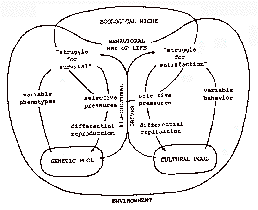
Figure 3.7. Genetic and Cultural Pools.
The gene pool of a population is determined by selective pressures generated by the "struggle for survival" within a particular set of material conditions. Similarly, the ideology, or cultural pool, of a population is determined by selective pressures generated by the "struggle for satisfaction" within a particular set of material conditions.
Another process at work in cultural selection grows out of the efforts of some individuals to control the behavior of others through controlling the flow of information. As we know, people are engaged in massive and continual efforts to control the behavior of others. This is done by controlling the flow of information. Barash (Barash 1982:202) has a discussion of this process in animal populations, and our popular psychology books are filled with discussions of how this works in our daily interpersonal lives. Ideas, in other words, are tools which we use to influence the behavior of others in order to further our own satisfaction.
There is a special form of this which requires special attention. This is thought control. Over the course of the past ten thousand years of cultural evolution, ruling classes have developed elaborate and powerful systems for controlling the content of ideology within the producing classes. The entire purpose of such systems is preserving and extending the wealth, privileges, and prestige of the ruling class. This is another important kind of selective pressure operating on the cultural pool.
There are thus several kinds of selective pressures operating on the cultural pools of human populations. Taken together, they account for the progressive development of technology and the forces of social production, and with these, the transformations of social structures, family patterns, and religious ideology. Lenski's framework, discussed above and more fully below (in Chapter 4) provides statistical confirmation, using the data of anthropology, of this basic Marxist idea that the mode of production in real life determines the general content of social and spiritual life process.
It is also important to understand that these selective pressures are not uniform for the entire population but rather operate in different directions on different classes. This concept requires some further elaboration.
There are two aspects to the formation of ideology in the cultural pool. First, the individual selection of ideas which provide satisfaction, and the replication, on an individual basis, of these ideas into the cultural pool, and second, the differential power of various individuals to input ideas into the cultural pool depending on their social position. This latter is not so important in egalitarian populations, but is crucial in class structured societies in which there are specialized institutions of thought control. Clearly, those that control these institutions will exert a predominate effect of the cultural pool and the ideas they put into the cultural pool will reflect their class interests, as Marx pointed out, the ruling ideas are the ideas of the ruling class, for the ruling class controls the means of mental production. This control, however, is not complete. The history of civilization has been a history of class struggle, and this struggle has been ideological as well as economic and political. As Marx and Engels note:
The
ideas of the ruling class are in every epoch the ruling ideas: i.e. the class,
which is the ruling material force of society, is at the same time its ruling
intellectual force. The class
which has the means of material production at its disposal, has control at the
same time over the means of mental production, so that thereby, generally
speaking, the ideas of those who lack the means of mental production are
subject to it. The ruling ideas
are nothing more than the ideal expression of the dominant material
relationships, the dominant material relationships grasped as ideas; hence of
the relationships which make the one class the ruling one, therefore the ideas
of its dominance. The individuals
composing the ruling class possess among other things consciousness, and
therefore think. In so far,
therefore, as they rule as a class and determine the extent and compass of an
epoch, it is self-evident that they do this in their whole range, hence among
other things they rule as thinkers, as producers of the ideas, and regulate the
production and distribution of the ideas of their age: thus their ideas are the
ruling ideas of the epoch. For
instance, in an age and in a country where royal power, aristocracy and
bourgeoisie are contending for mastery and where, therefore, mastery is shared,
the doctrine of the separation of powers proves to be the dominant idea and is
expressed as an "eternal law."
The division of labour, which we saw above as one of the chief forces of
history up till now, manifests itself also in the ruling class as the division
of mental and material labour, so that inside this class one part appears as
the thinkers of the class (its active, conceptive ideologists, who make the
perfecting of the illusion of the class about itself their chief source of
livelihood), while the others' attitude to these ideas and illusions is more
passive and receptive, because they are in reality the active members of this
class and have less time to make up illusions and ideas about themselves. Within this class this cleavage can
even develop into a certain opposition and hostility between the two parts,
which, however, in the case of a practical collision, in which the class itself
is endangered, automatically comes to nothing, in which case there also
vanishes the semblance that the ruling ideas were not the ideas of the ruling
class and had a power distinct from the power of this class. The existence of revolutionary ideas in
a particular period presupposes the existence of a revolutionary class; about
the premises for the latter sufficient has already been said above.
If now in
considering the course of history we detach the ideas of the ruling class from the
ruling class itself and attribute to them an independent existence, if we
confine ourselves to saying that there or those ideas were dominant, without
bothering ourselves about the conditions of production and the producers of
these ideas, if we then ignore the individuals and world conditions which are
the source of the ideas, we can say, for instance, that during the time that
the aristocracy was dominant, the concepts honour, loyalty, etc., were
dominant, during the dominance of the bourgeoisie the concepts freedom,
equality, etc. The ruling class
itself on the whole imagines this to be so. This conception of history, which is common to all
historians, particularly since the eighteenth century, will necessarily come up
against the phenomenon that increasingly abstract ideas hold sway, i.e. ideas
which increasingly take on the form of universality. For each new class which puts itself in the place on one
ruling before it, is compelled, merely in order to carry through its aim, to
represent its interest as the common interest of all the members of society,
put in an ideal form; it will give its ideas the form of universality, and
represent them as the only rational, universally valid ones. The class making a revolution appears
from the very start, merely because it is opposed to a class, not as
a class but as the representative of the whole of society; it appears as the
whole mass of society confronting the one ruling class. It can do this because, to start with,
its interest really is more connected with the common interest of all other
non-ruling classes, because under the pressure of conditions its interest has
not yet been able to develop as the particular interest of a particular
class. Its victory, therefore,
benefits also many individuals of the other classes which are not winning a
dominant position, but only in so far as it now puts these individuals in a
position to raise themselves into the ruling class. When the French
bourgeoisie overthrew the power of the aristocracy, it thereby made it possible
for many proletarians to raise themselves above the proletariat, but only in so
far as they became bourgeois.
Every new class, therefore, achieves its hegemony only on a broader
basis than that of the class ruling previously, in return for which the
opposition of the non-ruling class against the new ruling class develops all
the more sharply and profoundly.
Both these things determine the fact that the struggle to be waged
against this new ruling class, in its turn, aims at a more decided and radical
negation of the previous conditions of society than could all previous classes
which sought to rule.
This whole
semblance, that the rule of a certain class is only the rule of certain ideas,
comes to a natural end, of course, as soon as society ceases at last to be
organized in the form of class-rule, that is to say as soon as it is no longer
necessary to represent a particular interest as general or "the general
interest" as ruling. (Marx
and Engels 1846:39-41)
The political and economic struggles have been primarily over the extraction and utilization of the social surplus and can be analyzed in terms of the thermodynamic model articulated above. It is the ideological class struggle that must be discussed in the present context.
Although the ruling ideas have always been the ideas of the ruling class, there have also always been challenges to the dominant class ideology. Such challenges have included the thoughts of the Old Testament prophets, Jesus, and the early Christians (and, if we were better acquainted with them, early Buddhist and Islamic writing would be included as well), the revolutionary ideas of the Enlightenment, and Marxism.
Our problem is to articulate this ideological class struggle into our model.
3.VII. Class and Class Consciousness
One of the central problems for historical materialism, and for practical politics, is the question of class consciousness. Clearly, before the working class can perform its historic mission, it must become conscious of that mission. This practical political consideration make the question of the formation of class consciousness a burning issue for historical materialism.
Before we can understand class consciousness, however, we must understand class. A class, in the broadest sense of the term, is simply a category of people who share some characteristic in common. Possession of this common characteristic is likely to affect the selective pressures on this category of people. For example, red haired people are more likely than brunettes to accept the idea that red haired people are superior. Such an example may seem trivial, but not if we substitute white skinned people or males for red haired people.
Class, in this broad sense, may be defined in any way we choose and in this sense there are as many classes in a population as there are different characteristics in that population. However, not all classes, in this broad sense, are equally important. Most important, for purposes of understanding the system as a whole, are the classes that are defined in terms of the thermodynamic system, in terms of wealth, prestige, and power. To examine these, we must return to our earlier discussion of the differences between bourgeois and Marxist views of class.
As we discussed earlier, the typical bourgeois conception of class sees society divided into various strata, so that we have an upper class, a middle class, and a lower class, and, if we choose to divide classes more, an upper upper class, a middle upper class, a lower upper class, an upper middle class, and so on. The relationship between classes is purely quantitative. The upper class has more wealth and prestige than the middle class, which in turn has more than the lower. Clearly, the affluent upper class is going to be subjected to different selective pressures and have a different view of the world than the middle and lower classes.
From a Marxist perspective, however, this only describes the surface of social life, not its underlying reality. For Marxists, the underlying class structure is always a two-class system, with each class dialectically defined in terms of the other: master/slave, noble/peasant, capitalist/worker. The relationship between classes is a qualitative one which always involves exploitation and oppression. Masters are masters because they exploit and oppress slaves; nobles are nobles because they exploit and oppress peasants; capitalists are capitalists because they exploit and oppress workers. It is this underlying class opposition that generates the superficial strata that are described by bourgeois sociology.
As one moves from the simplicity of the underlying class structure to the level of empirical reality, the class system becomes more complex. Even in a slave society, there is a free population that does not own slaves, different categories of slaves, and differences in the number of slaves owned among the slave owners. Similarly, in a feudal society, there are differences among nobles in terms of the amount of land and number of peasants owned. There are merchants and free artisans, and there may be slaves.
Empirical class structures, then, are complicated by at least three things. First of all, classes are internally stratified by income, wealth, and prestige. Some feudal lords own larger estates, control more peasants, enjoy higher incomes, and have more power and prestige than others.
Secondly, there are classes that stand, in a sense, outside the fundamental class opposition. In a slave society, there is always a free population that does not own slaves.
Third, in addition to the fundamental class opposition that defines a society as a slave, feudal, or capitalist society, there are secondary class oppositions, remnants of past social orders and germs of new ones. Thus, in a feudal society marked by a fundamental opposition between noble and peasant, there will still be masters and slaves, and merchants will also make their appearance.
The situation is further complicated by the existence of social mobility. Class systems vary in the amount of mobility that is permitted. Some systems, such as the U.S. class system, are relatively open and exhibit a fairly high degree of upward and downward mobility. Other systems, such as the classical Hindu caste system or the caste system of Tokugawa Japan, have legal and religious barriers and exhibit relatively little social mobility. The existence of social mobility, however, does not negate the reality of the underlying class system; in fact mobility may help to stabilize and consolidate the class system. Marx pointed out, for example, that the more a ruling class is able to assimilate the most able and ambitious members of the ruled classes the more stable and dangerous is its rule.
Finally, we must consider the fact that class is not simply a matter of individuals. More fundamentally, it is a matter of families. People are born and socialized into particular class situations as members of families. People with similar class positions tend to regard one another as equals, socialize on that basis, intermarry, and hence reproduce the class system as members of families. Weber refers to these as the processes of commensualism and connubium.
At the level of empirical reality, then, the population is divided into social classes which may be defined as groups of families which share a common qualitative and quantitative relationship to the total flow of energy through the sociobiological system. The analysis of the class structure of any human population, then, is a very complex undertaking which involves the recognition of the multiple contradictions within that society.
The significance of all this for understanding the formation of ideology is that different class positions necessarily generate different selective pressures favoring different ideological complexes. Most important, here, are the differences between ruling and ruled classes.
Ruling and ruled classes obviously are subjected to different selective pressures on their cultural pool and stream. In his pioneering study of religion in China, for example, Weber (1922) noted that the theodicy of the ruling gentry/literati class was different than that of the peasantry. The former was Neo-Confucianism, which stressed this-worldliness and served to further social manipulation, as is appropriate for a ruling class; the latter was based on cult Buddhism, which was other-worldly, postponed pleasures to the next life, and stressed duty. As Weber noted, these differences are clearly related to the different life patterns of the rulers and ruled within the total class system.
More than this is involved, however, for the ruling class must be class conscious; in Marx's terms, the ruling class must be a class in and for itself. It must be aware of itself, and of its interests, and it must maintain the mode of exploitation upon which its existence depends. One essential component of this mode of exploitation, as discussed above, is thought control. In order to maintain its rule, the ruling class must control the content of ideology for the ruled classes by controlling the selective pressures operating on the cultural pool and stream of the ruled classes.
Consequently, in contrast to the class consciousness of the ruling class, ruled classes will be characterized by various forms of false consciousness. Members of the ruled class cannot be expected to understand the social system as a whole or their place in it, for two reasons. First, as discussed above, one function of ideology is to conceal the world. Selective pressures will disfavor recognition of unpleasant aspects of reality. Secondly, and more importantly, ruling classes actively promulgate ideologies which distort reality for the ruled population.
Clearly, this entire topic calls for fuller treatment than space allows for here. This highly abstract and summary statement is intended merely to bring the study of ideology and class consciousness into the framework of Marxist sociobiology.
Social science, of course, is made up of ideas and is therefore also subject to selective pressures emanating from the system of class rule. This returns us to our opening, and leads into our concluding remarks.
3.VIII. Concluding Remarks
The sociobiology of the genetic mystics is a sociobiology of despair, for it suggests no solutions to the problems facing our species. The sociobiology of Marxism is a sociobiology of hope, for it tells us that we humans can solve our problems, and are in fact solving them in revolutionary societies such as Nicaragua, Cuba, China, and the Soviet Union.
Problems cannot be solved unless they are recognized and understood. In their effort to reduce the complexity of human life to genetic selfishness, the genetic mystics ignore fundamental biological facts about our species. About fifteen million humans die of starvation each year. The vast majority of our species suffers from poor diet, poor health, disease, and reduced longevity. The accelerating destruction of our environment and the proliferation of weapons of mass destruction threaten the well being and very existence of our entire species.
These are all biological facts, but they flow from the sociology of our species. A central task of sociobiology, it would seem, should be the careful evaluation of how the major contending social orders, capitalism and socialism, meet the biological needs of their members. The genetic mystics have shown little interest in this however (and neither have the orthodox social scientists), and have left this task to a Marxist sociologist. In a careful statistical analysis of 98 countries, Cereseto has shown that socialism does indeed meet human needs more fully than does capitalism (Cereseto 1982, Cereseto and Waitzkin 1986). Marxist sociobiology thus not only identifies the disease, capitalism, and specifies the cure, socialist revolution, it has also seen its theories experimentally verified in the socialist revolutions of the twentieth century.
If Marx had studied the sociobiology of ants or tree frogs, his successes would have ensured his work a hegemonic status. He studied capitalism, however, and therefore his very success has ensured his rejection by the status quo. What Marx said of the English Established Church more readily pardoning an attack on 38 of its 39 principles than one 39th of its income is not true of the Ford and Rockefeller Foundations. They will not pardon an attack on any of their principles. This is the material base for the rejection of Marxism by the social scientific establishment.
Social scientists must eat before they can elaborate their theories of society, but they eat precisely by elaborating theories of society. Such theories and associated research and teaching forms the "mode of production" of social scientists. Social science is thus the social productive activity of social scientists within a larger division of labor in society.
Our society, however, is a class society divided into rulers and ruled. The rulers need a social science that will do two things. First, it must provide the necessary information for manipulation and control of the system by the rulers. Second, it must legitimate the existing system, both to the ruled classes and to the rulers themselves.
The blind men of social science fill these needs admirably. Society is like a dung heap, say some, and it is only proper that every dung-beetle is out for himself. Others are actively involved in providing the information necessary to enable the dung-beetles to maximize their profits or control ghetto riots. And in the social scientific kingdom of the blind, as Rose has pointed out, "the one-eyed prophets are to be defined as mad, and have their eyes removed" (Rose 1980:160).
But, although "he who pays the piper calls the tune," he does not determine the laws of harmony. Existing social science, although highly sensitive to the needs of those in power, remains science and, ultimately, must remain faithful to the canons of science. Like it or not, the blind men of bourgeois social science must still contend with the revolutionary theories of Marx.